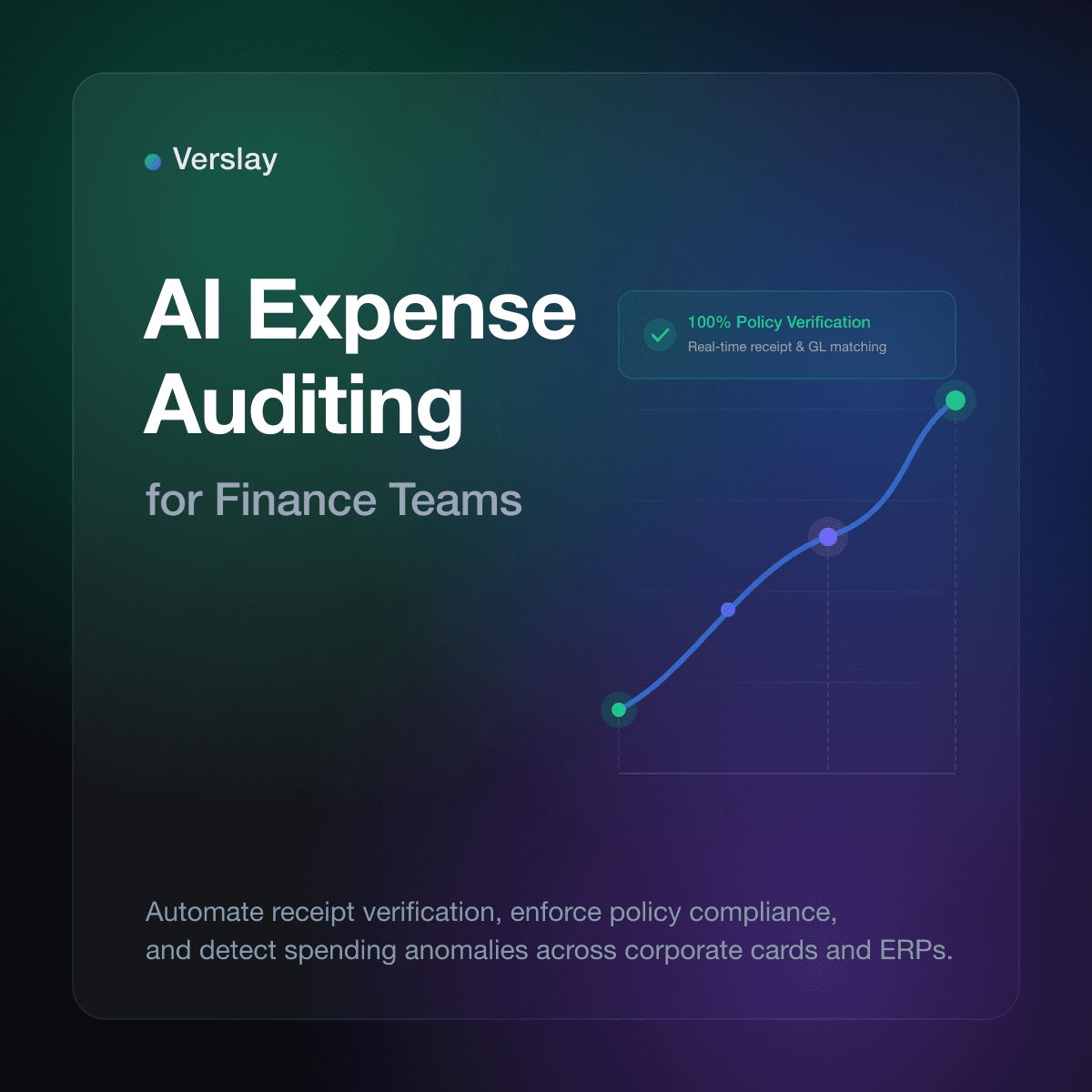
AI expense auditing for finance teams uses autonomous AI agents to automate receipt verification, enforce policy compliance, flag duplicate or anomalous charges, and categorize general ledger (GL) entries in real time. By extracting line-item details from receipts, invoices, and credit card feeds, AI agents verify purchases against organizational travel and expense (T&E) guidelines within seconds. This eliminates manual expense report reviews, prevents out-of-policy leakage, and accelerates reimbursement cycles without adding administrative overhead.
How this maps to Verslay: the Expense Report Auditor page covers this workflow. Employee expense reports check themselves against policy before they reach an approver.
Finance and accounting departments process hundreds or thousands of expense claims every month. From corporate travel receipts and client entertainment tabs to software subscriptions and field purchases, manual expense auditing creates an expensive operational bottleneck during month-end close.
Why Manual Expense Auditing Breaks Down at Scale
Traditional expense management relies on controllers and accounting clerks to manually open receipts, cross-reference line items against policy handbooks, and manually key transaction details into ERP systems.
Manual expense review processes suffer from several structural vulnerabilities:
- Audit Fatigue and Spot-Checking: Due to high submission volumes, finance teams often audit only a small fraction (10% to 20%) of low-value claims, allowing out-of-policy spending and small repeated leakages to accumulate unnoticed.
- Unitemized Receipts and Missing Details: Generic credit card summaries frequently hide unapproved items (such as personal upgrades, alcohol overages, or unauthorized partner expenses) that require tedious manual follow-ups with employees.
- Duplicate and Cross-Channel Submissions: Manual reviewers struggle to catch when an employee submits the same expense across multiple reports, corporate card feeds, or personal reimbursement claims weeks apart.
- Month-End Reconciliation Delays: Chasing missing receipts and resolving policy disputes holds up the general ledger close, delaying financial reporting and payroll reimbursements.
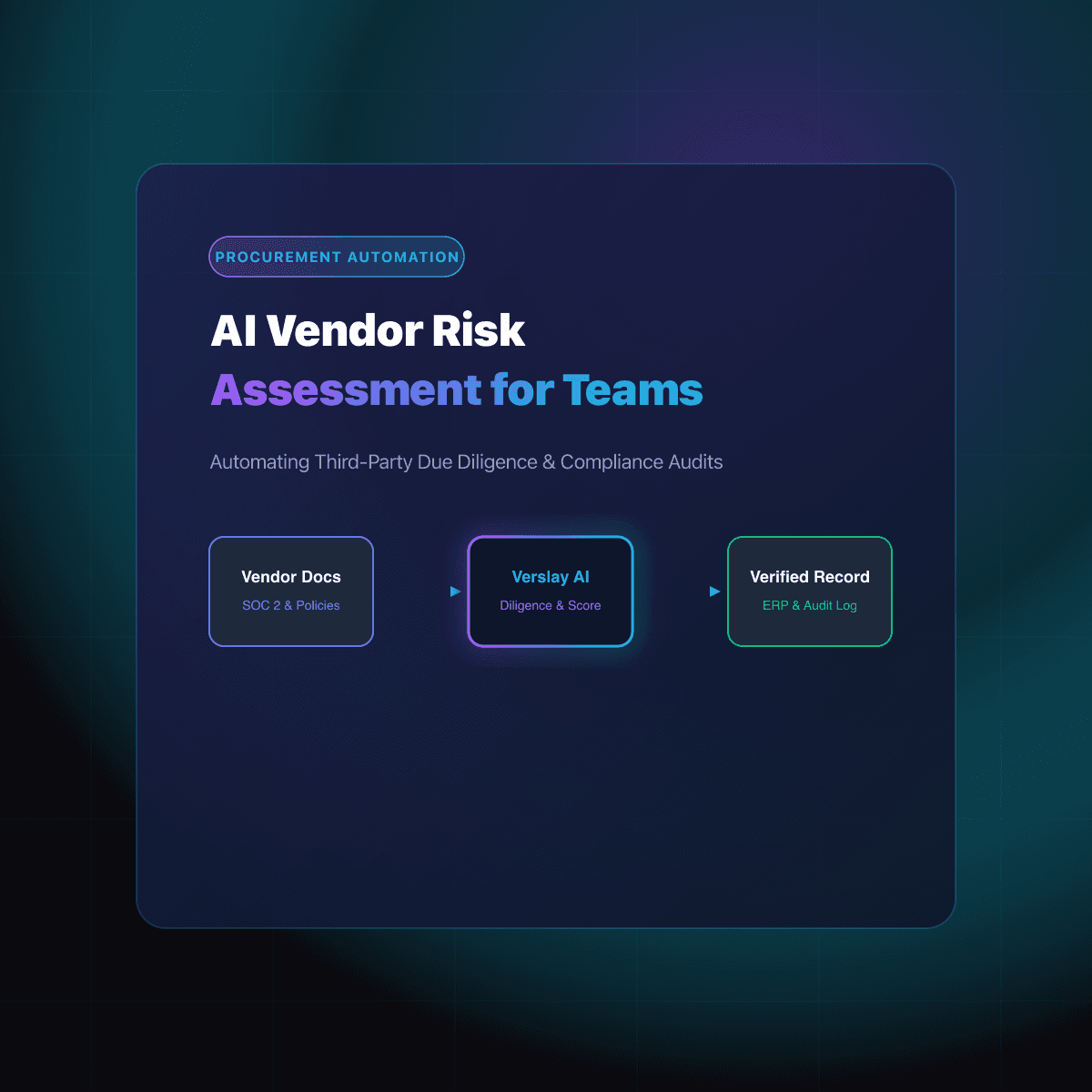
Explore how AI invoice reconciliation for finance teams and AI vendor risk assessment for procurement teams eliminate similar verification bottlenecks across finance and accounting operations.
How AI Expense Auditing Automates Compliance and Verification
Deploying an autonomous AI agent for expense auditing transforms reactive manual checking into a proactive, continuous auditing pipeline that works across four distinct stages:
1. Multi-Modal Receipt Ingestion and Line-Item Extraction
When an employee submits an expense via email, Slack, corporate card swipe, or an expense portal, the AI agent ingests the receipt image, PDF, or digital email confirmation. Using high-accuracy document OCR and vision models, the agent extracts:
- Merchant Identity & Category: Validates merchant name, address, tax ID, and Merchant Category Code (MCC).
- Line-Item Breakdown: Separates individual items (meals, taxes, tips, surcharges, personal add-ons) rather than just the final balance.
- Date, Currency, and FX Rates: Automatically converts foreign currency transactions using real-time exchange rates.
2. Semantic Policy Benchmarking and Per-Diem Validation
The AI agent evaluates the extracted transaction against your company’s custom expense policies in real time:
- Per-Diem and Category Limits: Checks hotel room rates against regional per-diem caps and meal expenses against team budget allowances.
- Weekend and Holiday Rules: Flags corporate card spending that occurs outside business travel dates or during non-working days.
- Alcohol and Luxury Exclusions: Detects non-reimbursable line items embedded inside large dinner bills or hotel folios.
3. Anomaly and Fraud Detection
The AI agent runs historical cross-checks across all employee submissions to detect fraud patterns:
- Duplicate Receipt Matching: Identifies identical receipt images or matching amounts, dates, and vendors submitted by different team members or on separate dates.
- Inflated or Altered Totals: Compares extracted line items against the submitted total to prevent handwritten or manipulated tip alterations.
- Split-Transaction Evasion: Detects multiple micro-purchases made just below manager approval thresholds to bypass escalation rules.
4. Automated GL Coding and ERP Synchronization
For clean, fully compliant expense reports, the AI agent automatically assigns the appropriate Chart of Accounts (COA) general ledger code, project tag, and department cost center based on transaction semantics. It syncs the approved record directly into ERPs like NetSuite, QuickBooks, or Xero, leaving an immutable audit trail.
Learn how centralizing cross-functional intelligence with AI agents for business operations streamlines back-office administration.
Architecture of an AI-Powered Expense Auditing System
Finance leaders can deploy an end-to-end expense auditing pipeline connecting ingestion channels, policy models, and ERP systems:
[Receipt Upload / Corporate Card Feed]
                  │
                  ▼
   [AI OCR & Line-Item Data Extraction]
    (Merchant, Items, Tax, Date, Total)
                  │
                  ▼
     [Policy & Fraud Validation Engine]
   (Per-Diems, Limits, Duplicate Checks)
                  │
        ┌─────────┴─────────┐
        ▼                   ▼
 [100% Policy Match]    [Policy Discrepancy / Fraud]
(Auto-Code GL & Sync)   (Interactive Slack/Email Alert)
        │                   │
        │                   ▼
        │          [Employee Context / Manager Gate]
        │                   │
        └─────────┬─────────┘
                  ▼
    [ERP Sync: NetSuite, QuickBooks, Xero]
- Connect Ingestion Channels: Link corporate cards (Ramp, Brex, Stripe), expense mailboxes, and mobile receipt upload portals.
- Configure Policy Guardrails: Define custom tier thresholds, allowable merchant categories, and escalation workflows.
- Deploy the AI Expense Agent: Activate autonomous verification to audit 100% of transactions with zero human latency.
- Synchronize with Financial Systems: Stream approved, reconciled records directly into your general ledger with comprehensive audit logs.
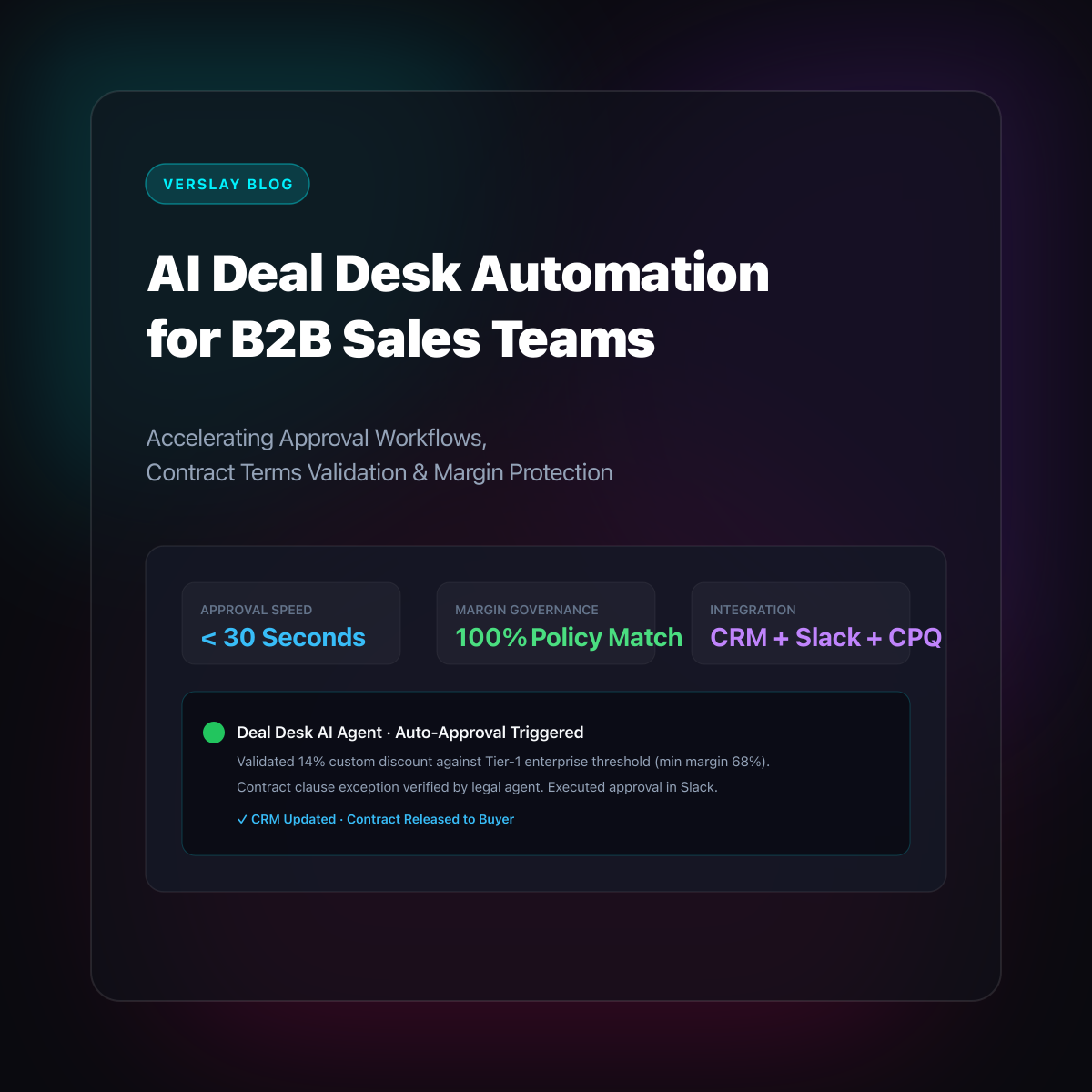
Discover how AI deal desk automation for B2B sales pairs with automated finance operations to protect operating margins.
Measurable Business Outcomes
Implementing autonomous AI expense auditing provides immediate, quantifiable efficiency gains for controllers and finance leaders:
| Metric | Manual Expense Auditing | AI-Powered Expense Auditing | | :--- | :--- | :--- | | Audit Coverage | 10%–20% random sampling | 100% full-line item audit | | Review Turnaround | 5 to 10 business days | Under 60 seconds per report | | Duplicate Claim Slip-Through | 3%–5% undetected leakage | 0% (exact image & metadata hashing) | | Month-End Close Acceleration | 3–4 days spent on reconciliations | Reconciled continuously in real time | | Finance Team Hours Saved | 20+ hours per month per accountant | 85%+ reduction in manual triage |
Get Started with Verslay Finance Automation
Eliminate expense review backlogs, enforce 100% policy compliance, and give your accounting team time back for strategic analysis. With Verslay, finance teams deploy intelligent AI agents that orchestrate receipt OCR, policy verification, and ERP GL synchronization with bank-grade reliability and security.
Learn how Verslay transforms operations across technology and business service teams, or explore our complete catalog of pre-built AI workflow use-cases today.
See it in Verslay
Verslay agents work through the tools you already connect and prepare drafts and staged actions for a person to approve. The Expense Report Auditor page shows the real workflow. You can also browse all use cases or book a 30-minute walkthrough.