AI Lead Scoring for B2B Sales Teams: Automating Intent Signal Analysis and Pipeline Prioritization
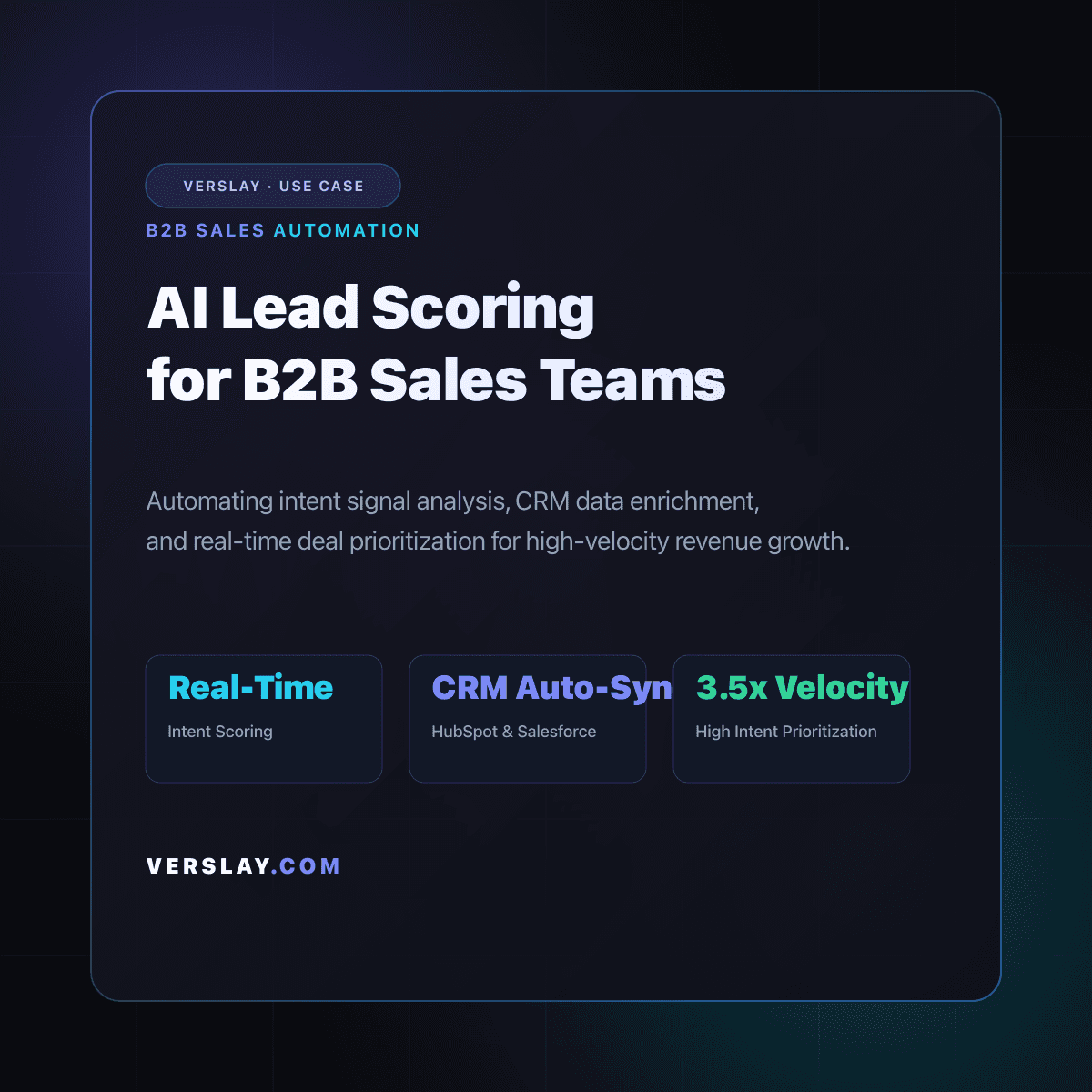
AI lead scoring for B2B sales teams automatically evaluates incoming prospects by synthesizing firmographic fit, behavioral buyer intent, and CRM activity into a dynamic, real-time deal priority score. By leveraging autonomous agents to continuously monitor prospect interactions, revenue teams instantly surface high-intent buyer leads, eliminate manual pipeline triaging, and focus sales capacity on deals most likely to close.
In modern B2B sales environments, lead volume is rarely the primary constraint; prioritizing the right opportunities at the right moment is. Account executives frequently waste hours reviewing unqualified inbound form fills or chasing lukewarm leads while high-intent prospects stall without rapid follow-up. Deploying specialized AI agents for predictive lead scoring converts scattered buyer signals into clear operational priorities across your entire revenue architecture.
The Failure of Traditional Rules-Based Lead Scoring
For years, B2B sales and marketing organizations relied on static, rules-based lead scoring models inside legacy CRMs. Marketers assigned arbitrary points for actions like opening an email (+5 points), visiting a pricing page (+10 points), or downloading a whitepaper (+15 points).
However, static scoring models break down in complex B2B sales cycles due to several structural flaws:
- Static Point Inflation: Prospects who engage repeatedly with marketing content gradually accumulate high scores despite lacking target firmographic budget, authority, or purchasing timeline.
- Ignored Buying Signals: Legacy systems fail to evaluate qualitative intent indicators, such as specific questions asked during chat sessions, technical integration queries, or recent funding announcements.
- Delayed Triaging: Standard CRM batch scoring jobs run on hourly or daily schedules, creating latency between a prospect purchasing intent and outbound rep contact.
- Lack of Win/Loss Learning: Static rules remain rigid over time, failing to adapt when ideal customer profiles (ICPs) or sales cycle dynamics shift.
By contrast, an intelligent sales agent continuously evaluates prospective accounts against historical closed-won patterns to calculate predictive readiness scores instantly.
How AI Lead Scoring Agents Analyze Intent Signals
Autonomous AI lead scoring agents connect directly to business data streams to deliver multi-dimensional lead evaluation. Rather than relying on single-point triggers, the agent synthesizes data across three core intent pillars:
1. Firmographic and Demographic Fit
Upon receipt of a new inbound lead or contact, the scoring agent evaluates company domain parameters:
- Annual revenue, employee headcount, and geographic footprint.
- Tech stack compatibility detected through firmographic enrichment APIs.
- Buying committee role and seniority of the primary contact.
2. Behavioral Intent and Engagement Depth
The agent analyzes multi-channel engagement patterns to separate casual research from active buying evaluation:
- Frequency and velocity of high-intent website page visits (e.g., pricing, security compliance, API documentation).
- Specific content topics consumed and webinar attendance duration.
- Outbound campaign responsiveness and email engagement context.
3. Qualitative Conversation and CRM Insights
Using natural language processing (NLP), the scoring agent extracts context from unorganized touchpoints:
- Inbound form comments, chatbot transcripts, and initial email inquiries.
- Key buying criteria, explicit pain points, or migration urgency mentioned by the prospect.
- Historical deal similarity analysis against past closed-won accounts.
Step-by-Step: Implementing AI Lead Scoring in Your B2B Stack
Integrating AI lead scoring into your revenue pipeline requires seamless connectivity between your CRM, marketing automation platforms, and communication tools.
Here is how an automated lead scoring workflow operates end-to-end:
- Signal Ingestion: When a prospect submits a lead form or triggers a key product event, the event fires a webhook to the Verslay scoring agent.
- Context Enrichment & Evaluation: The agent queries connected data tools to retrieve firmographic background, cross-checks historical deal attributes, and assigns a normalized score (0 to 100) alongside a concise qualification summary.
- CRM Field Updates: The updated score, fit tier (A/B/C/D), and key buying intent signals are written directly back to contact and deal records inside HubSpot or Salesforce.
- Instant Rep Routing: High-priority leads (Score over 85) trigger instant notifications via Slack or Teams to assigned Account Executives, ensuring response times under five minutes.
Explore how tailored workflows across different industries streamline lead routing and pipeline management.
Measurable Impact on Sales Velocity and Win Rates
B2B sales teams that transition from manual lead triaging to autonomous AI lead scoring achieve significant operational improvements:
- 3.5x Faster Lead Response: High-intent prospects receive immediate outbound outreach while purchasing motivation is highest.
- 28% Increase in Win Rates: Account executives spend their daily capacity engaging accounts with high firmographic fit and active buying intent.
- Zero Lead Decay: Automated routing prevents inbound opportunities from languishing untouched in unassigned CRM queues.
By embedding continuous intelligence into lead evaluation, sales teams build predictable, scalable pipeline velocity.
Frequently Asked Questions
How does AI lead scoring work for B2B sales teams?
AI lead scoring analyzes firmographics, website engagement, email responses, and CRM activity to assign real-time readiness scores to incoming B2B prospects.
What is the difference between traditional rules-based scoring and AI lead scoring?
Traditional lead scoring relies on static point values assigned manually, whereas AI lead scoring dynamically learns from win/loss patterns to update scores continuously.
Can AI lead scoring integrate directly into existing B2B CRMs?
Yes, AI lead scoring agents connect via APIs or MCP bridges to CRMs like HubSpot and Salesforce, writing updated scores and deal insights directly into contact records.