AI Supplier Due Diligence for Procurement Teams: Automating Vendor Verification, Compliance Audits, and Third-Party Risk Intelligence
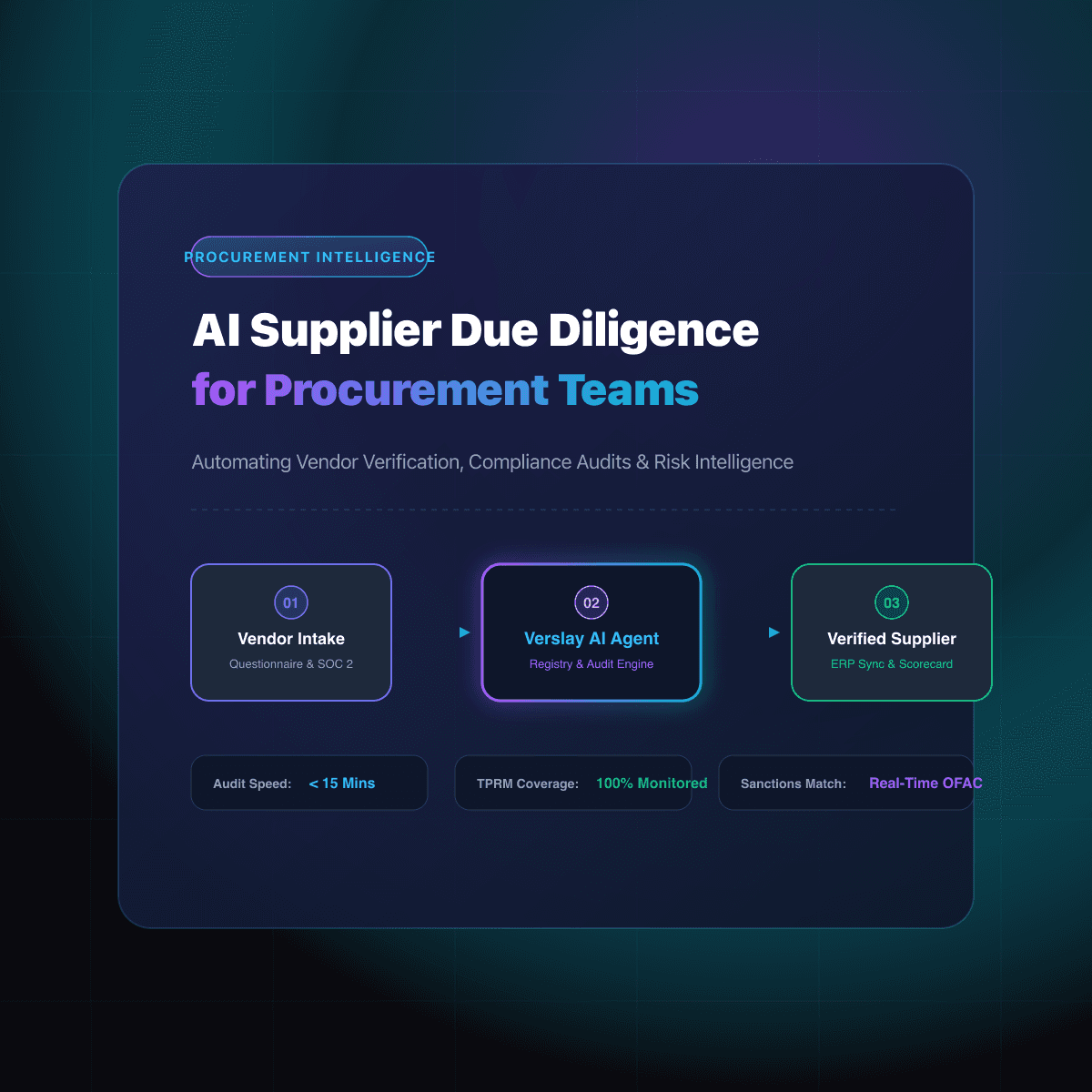
AI supplier due diligence software automates the end-to-end vetting, validation, and continuous risk monitoring of third-party vendors by deploying autonomous AI agents across procurement, legal, and security workflows. By eliminating manual questionnaire reviews, disconnected compliance spreadsheets, and stale annual audit cycles, enterprise procurement teams compress vendor evaluation timelines from weeks to minutes while enforcing exhaustive regulatory governance. Connecting directly with ERP repositories, risk registries, and vendor documentation via Model Context Protocol (MCP), AI agents transform third-party due diligence from a bureaucratic bottleneck into a real-time risk intelligence shield.
As global supply chains grow increasingly digital and interconnected, enterprise exposure to third-party vulnerabilities has reached unprecedented levels. Organizations now rely on hundreds or thousands of external vendors for cloud hosting, software tooling, physical logistics, and outsourced business processes. Yet every external relationship introduces operational, legal, cybersecurity, and compliance risks. A single compromised software supplier, an undisclosed sub-processor breach, or an unflagged sanctions violation can trigger multi-million dollar regulatory fines, catastrophic business disruptions, and lasting reputational damage.
Despite the critical stakes, traditional procurement operations remain bogged down by manual administrative workflows. Procurement specialists spend up to 50% of their evaluation cycle copying information from vendor security questionnaires, chasing suppliers for updated ISO 27001 certificates or SOC 2 Type II reports, manually searching regulatory watchlists, and attempting to reconcile conflicting risk assessments across internal stakeholders.
By deploying autonomous AI Agents connected through open integration protocols, modern procurement organizations establish continuous, touchless supplier due diligence. AI agents automatically ingest complex vendor disclosures, verify claims against public registries and real-time threat telemetry, calculate multi-dimensional risk scores, and orchestrate approval escalations with complete auditability.
The Operational Reality: Why Traditional Supplier Due Diligence Fractures
Traditional supplier due diligence operates under a fragmented, reactive model designed decades ago for static physical supply chains. In modern enterprise environments characterized by rapid SaaS adoption and distributed cloud ecosystems, this approach breaks down across five critical operational failure points:
[Inbound Supplier RFP/Bid] ──► [Manual Intake Forms] ──► [Static PDF Questionnaires]
                                                                  │
                                                                  ▼
[Annual Re-Audit Backlog] ◄── [Fragmented GRC Silo] ◄── [Ad-Hoc Email Follow-Ups]
         │
         ▼
[Stale Point-in-Time Scorecard] (Weeks to Complete)
1. The Security Questionnaire Bottleneck
Enterprise procurement teams frequently mandate standardized questionnaires—such as the Standardized Information Gathering (SIG) questionnaire, the Cloud Security Alliance Consensus Assessments Initiative Questionnaire (CAIQ), or bespoke corporate assessments—spanning hundreds of technical questions. Sifting through vendor answers, cross-referencing attached policy documents, and identifying boilerplate evasions consumes dozens of analyst hours per vendor, delaying time-to-contract for mission-critical tooling.
2. Static Point-in-Time Assessments
Legacy due diligence assesses a supplier once during initial onboarding and then files the assessment away until a formal annual or bi-annual renewal. However, vendor risk profiles fluctuate constantly: a vendor may suffer a cybersecurity breach, change key executive leadership, violate emerging data privacy standards, or face severe financial distress mid-contract without the buyer ever being notified.
3. Opaque Multi-Tier Supply Chains (Fourth-Party Risk)
Modern SaaS and technology vendors rarely build monolithic systems; they rely on complex webs of sub-processors, open-source libraries, and outsourced infrastructure providers. Manual due diligence rarely penetrates beyond direct tier-one suppliers, leaving organizations blind to systemic vulnerabilities lurking within downstream fourth-party dependencies.
4. Regulatory Expansion and Stricter Enforcement
Regulatory requirements governing third-party risk have multiplied exponentially. From the European Union's Corporate Sustainability Due Diligence Directive (CSDDD) and Digital Operational Resilience Act (DORA) to the EU AI Act, California Privacy Rights Act (CPRA), and NIST Cybersecurity Framework 2.0, procurement teams face intense legal scrutiny. Manually tracking evolving compliance requirements across global supplier portfolios is mathematically impossible without intelligent automation.
5. Cross-Functional Silos and Approval Delays
A comprehensive due diligence review requires input from procurement, information security (InfoSec), legal counsel, finance, and ESG teams. Without centralized agentic orchestration, evaluation tasks sit idle in departmental email inboxes, leading to repetitive vendor inquiries and prolonged procurement cycles that frustrate internal business stakeholders.
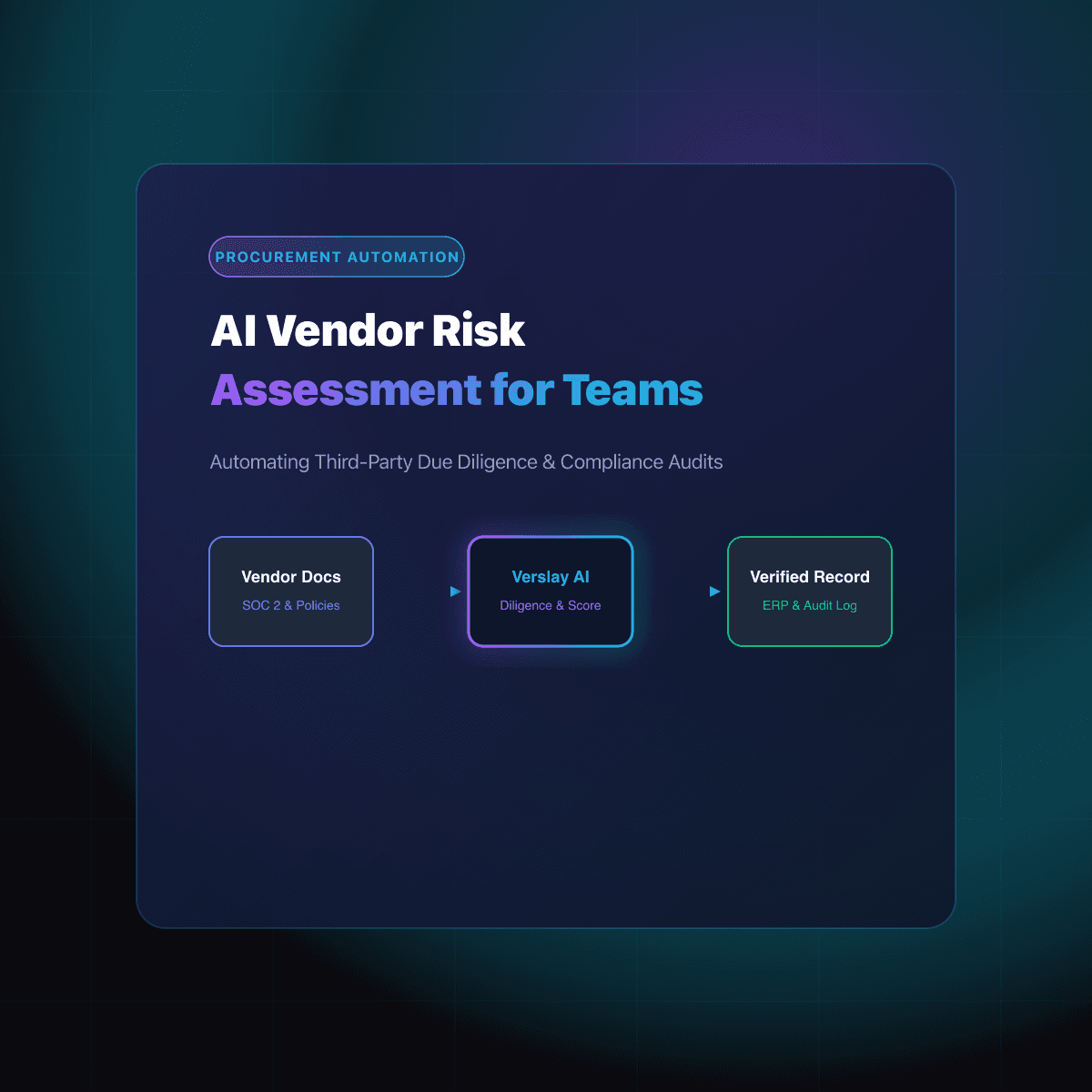
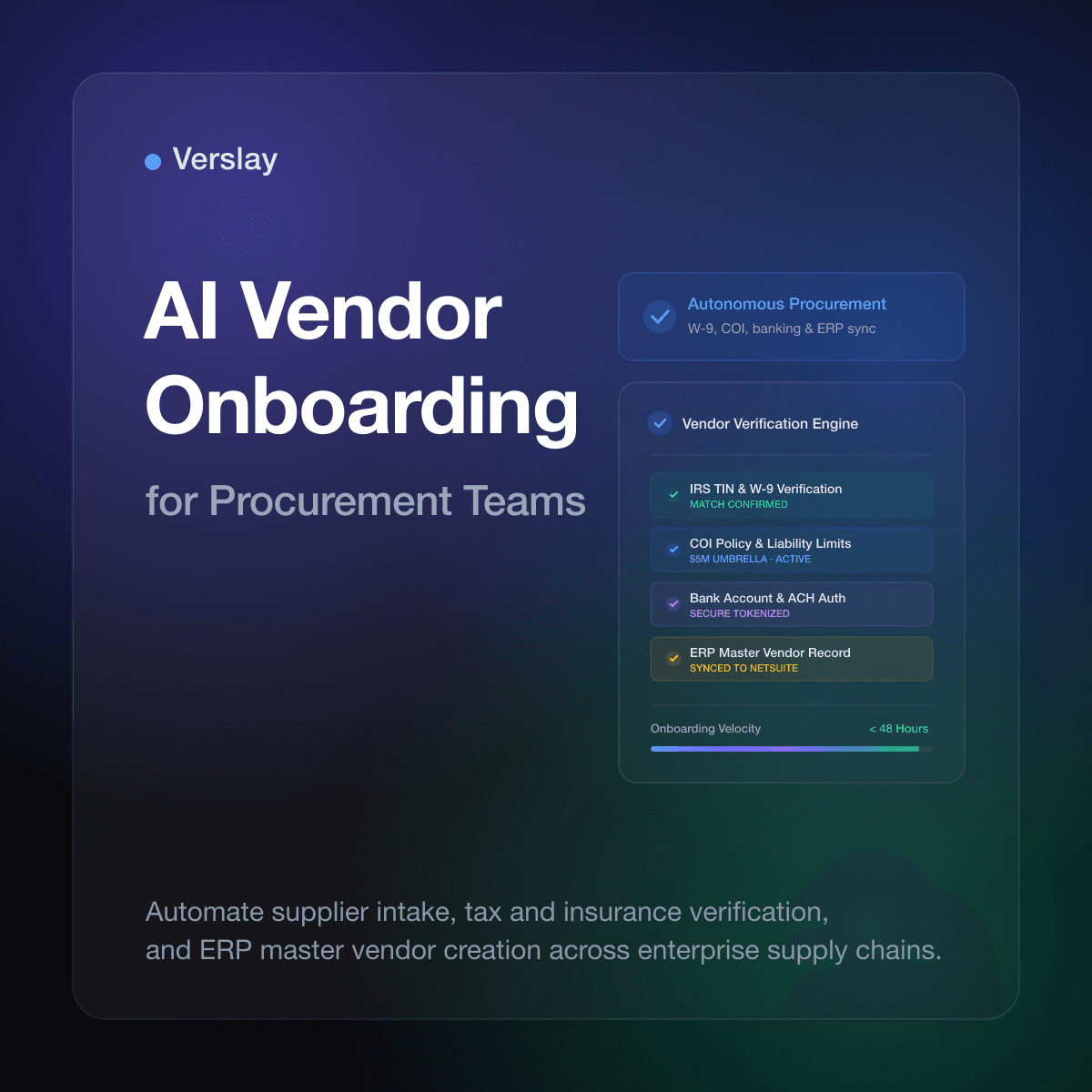
To explore how automated workflows bridge upstream sourcing and onboarding processes, read our detailed guides on AI vendor risk assessment for procurement teams and AI vendor onboarding for procurement teams.
Architectural Blueprint: Autonomous AI Supplier Due Diligence
Autonomous AI supplier due diligence operates as an intelligent coordination layer between external supplier data streams, internal enterprise systems, and global regulatory registries. Utilizing the Model Context Protocol (MCP), AI agents execute multi-step analysis, validation, and synchronization workflows securely without human data entry:
┌────────────────────────────────────────────────────────────────────────────────────────┐
│                   VERSLAY AI SUPPLIER DUE DILIGENCE ENGINE                             │
└────────────────────────────────────────────────────────────────────────────────────────┘
          ▲                                    ▲                                    ▲
          │ (1) Ingest & Extract               │ (2) Verify & Corroborate           │ (3) Monitor & Sync
          ▼                                    ▼                                    ▼
┌───────────────────┐               ┌───────────────────────┐            ┌───────────────────────┐
│ External Inputs   │               │ Autonomous AI Agents  │            │ Core Enterprise Stack │
├───────────────────┤               ├───────────────────────┤            ├───────────────────────┤
│ • SIG / CAIQ PDFs │               │ • Document Parser     │            │ • Coupa / SAP Ariba   │
│ • SOC 2 / ISO 27k │ ────────────► │ • Registry Validator  │ ─────────► │ • NetSuite ERP        │
│ • Watchlists & D&B│               │ • Risk Scoring Engine │            │ • ServiceNow GRC      │
│ • Security Portals│               │ • Remediation Drafter │            │ • Slack / Teams Alert │
└───────────────────┘               └───────────────────────┘            └───────────────────────┘
                                               │
                                               ▼
                                    ┌───────────────────────┐
                                    │ Cryptographic Audit   │
                                    │ Trail & Human Gate    │
                                    └───────────────────────┘
Rather than relying on basic optical character recognition (OCR) or keyword matching, vision-native reasoning models analyze unstructured vendor documentation contextually. The AI agent examines SOC 2 Type II audit exception logs, tests whether penetration test findings were remediated within required windows, and checks whether vendor sub-processor agreements guarantee equivalent data protection standards.
The 5 Core Pillars of AI Supplier Due Diligence
An enterprise-grade AI due diligence framework unifies vendor onboarding, continuous assessment, and contract lifecycle management across five fundamental pillars:
Pillar 1: Zero-Template Intake & Evidence Extraction  ──► Automated parsing of SIG, SOC 2, and ISO certifications
Pillar 2: Real-Time Sanctions & Legal Due Diligence   ──► Instant checks against OFAC, PEP, SEC, and international registries
Pillar 3: AI Governance & Data Privacy Auditing       ──► Compliance verification for GDPR, EU AI Act, and model training
Pillar 4: Financial Health & Operational Resilience   ──► Continuous solvency monitoring, credit scoring, and SLA tracking
Pillar 5: Continuous Threat Telemetry & Re-Audits     ──► Automated breach alerts, adverse media scans, and contract renewal gates
Pillar 1: Zero-Template Intake & Evidence Extraction
Inbound supplier disclosures arrive in arbitrary layouts, ranging from proprietary Excel workbooks to hundred-page PDF security packages:
- Multimodal Document Parsing: AI agents ingest complex due diligence questionnaires, vendor policy documents, and third-party auditor reports regardless of layout.
- Evidence Cross-Referencing: Instead of blindly trusting self-attested checkbox answers, the agent searches accompanying audit documentation (such as SOC 2 reports or bridge letters) to substantiate every vendor claim.
- Automated Deficiency Detection: If a supplier claims data encryption at rest but fails to provide cryptographic cipher specifications, the agent flags the gap and automatically drafts a targeted clarification request to the vendor contact.
Pillar 2: Real-Time Sanctions, Anti-Bribery, and Legal Screening
Before entering into commercial commitments, organizations must verify the legal and ethical standing of potential suppliers:
- Global Watchlist & Sanctions Checks: Automatically screens vendor legal entities, parent companies, and beneficial owners against OFAC, UK HM Treasury, EU Sanctions, and INTERPOL watchlists in real time.
- Politically Exposed Persons (PEP) & Adverse Media: Uses semantic search to scan international news databases, court dockets, and corporate registries for allegations of fraud, bribery, modern slavery violations, or environmental penalties.
- Entity Verification & Ultimate Beneficial Ownership (UBO): Validates corporate registration numbers against official government registries (such as SEC EDGAR, UK Companies House, or GLEIF) to uncover undisclosed corporate parentage and geopolitical risk.
Pillar 3: AI Governance, Cybersecurity, and Data Privacy Auditing
With the explosion of third-party AI software and cloud infrastructure, procurement teams must audit how vendors handle sensitive corporate data:
- Model Training Disclosures: Scans vendor terms of service and technical documentation to verify whether customer data is used to train proprietary or public machine learning models.
- Data Residency and Cross-Border Transfers: Confirms whether supplier data storage architectures comply with local data sovereignty mandates (e.g., GDPR Chapter V, HIPAA, or Australian Privacy Principles).
- Vulnerability & Penetration Test Analysis: Examines third-party penetration test executive summaries, checking remediation timelines and validating bug bounty policies against industry benchmarks.
Pillar 4: Financial Solvency & Operational Resilience Scoring
A vendor suffering severe financial distress represents a dangerous single point of failure in business continuity:
- Predictive Solvency Scoring: Ingests vendor financial statements, audited balance sheets, and credit bureau feeds (Dun & Bradstreet, CreditSafe) to calculate predictive bankruptcy indicators (e.g., Altman Z-Score, Days Beyond Terms).
- Operational Redundancy Audits: Reviews vendor Business Continuity Plans (BCP) and Disaster Recovery (DR) documentation, verifying Recovery Time Objectives (RTO) and Recovery Point Objectives (RPO) against enterprise procurement standards.
- Key-Person & Concentration Risk: Evaluates vendor organizational stability, customer churn rates, and geographic concentration of critical engineering teams to prevent sudden service abandonment.
Pillar 5: Continuous Monitoring & Automated Contract Gates
Supplier due diligence is never a one-time event; it requires perpetual vigilance:
- Real-Time Threat Telemetry: Continuously ingests external cybersecurity ratings (SecurityScorecard, BitSight) and Dark Web breach monitors, alerting procurement managers if a vendor domain or credential leak occurs.
- Contract Milestone Synchronization: Integrates with contract management tools to trigger automated re-assessment workflows 90 days before annual renewals, ensuring renegotiations leverage fresh compliance intelligence.
- Automated Scorecard Archival: Compiles all findings, certificates, audit notes, and communication logs into an immutable compliance briefcase, ready for internal and external auditors on demand.
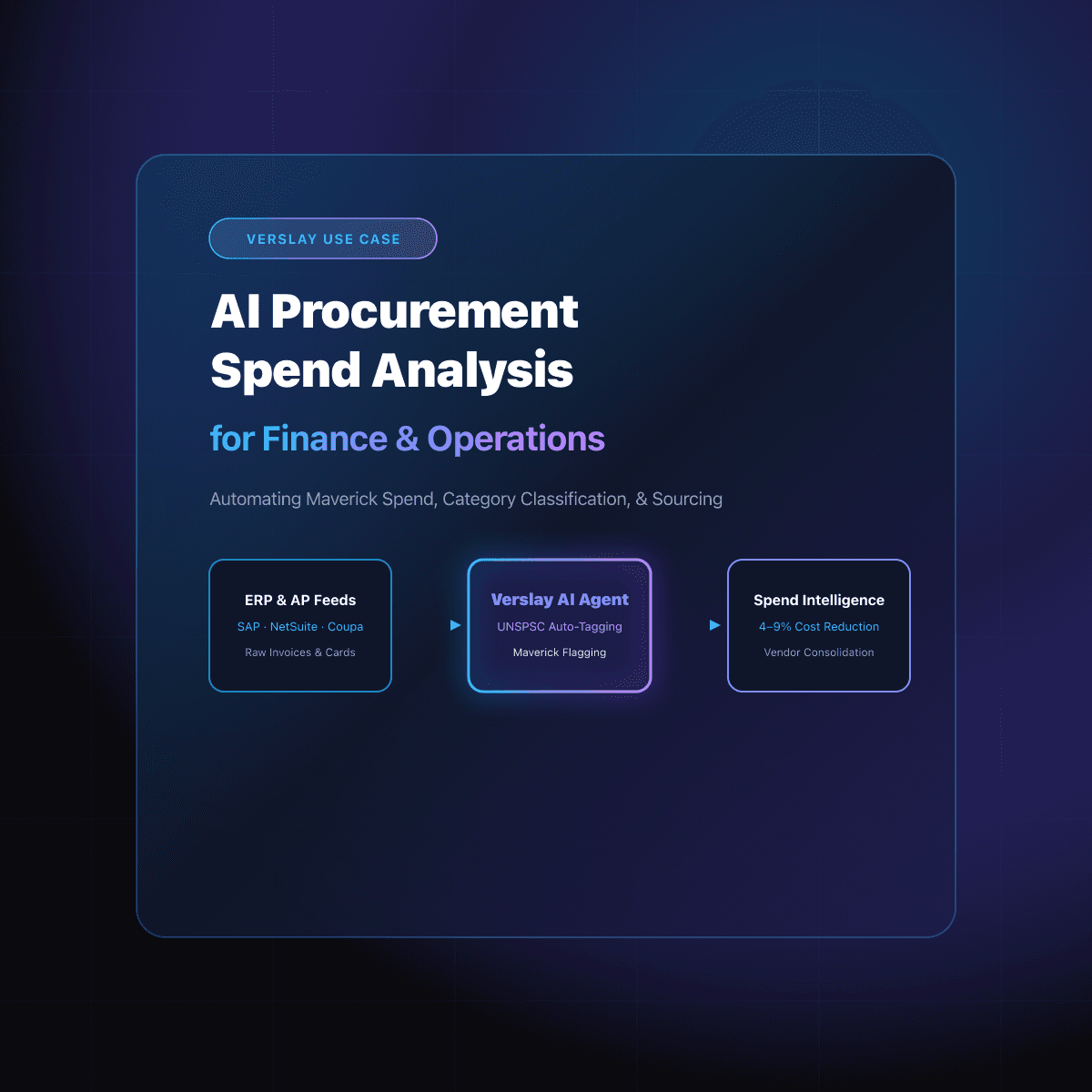
Discover how autonomous agents streamline enterprise procurement and financial analysis in our guide on AI procurement spend analysis for finance and operations teams.
Comparison Matrix: Manual Audits vs. Legacy GRC Portals vs. Autonomous AI Due Diligence
| Capability | Manual Analyst Review | Legacy GRC Portals | Autonomous AI Agents (Verslay) | | :--- | :--- | :--- | :--- | | Questionnaire Processing | 10 to 25 business days | 5 to 10 days (rigid portals only) | < 15 minutes (unstructured parsing) | | Evidence Corroboration | Manual reading of SOC 2 PDFs | None (relies on vendor self-attestation) | Multi-document cross-referencing & citation | | Sanctions & PEP Screening | Sporadic manual web searches | Batch nightly queries against static lists | Real-time API query + adverse media synthesis | | AI Governance Audits | Ad-hoc, lacks standard guidelines | Checkbox questions only | Deep clause extraction & model training audits | | Fourth-Party Visibility | Neglected due to resource limits | Basic vendor-entered sub-processor lists | Autonomous dependency & cloud infra mapping | | Continuous Monitoring | Non-existent until annual review | Dashboard alerts without context | Real-time risk recalculation & auto-remediation | | Audit Readiness | Scattered across local folders | Centralized static repository | Append-only cryptographically verifiable logs |
Technical Integration: MCP Workflow for Supplier Verification
Modern procurement workflows require deep integration across enterprise systems without brittle custom middleware. The Model Context Protocol (MCP) enables AI agents to read documentation, interact with compliance databases, and synchronize approved vendor states into ERP ledgers deterministically.
Example: Automated Vendor Risk Scoring and ERP Certification Hook
// Pseudocode: Autonomous AI Supplier Due Diligence & Approval Orchestration
interface SupplierIntakePayload {
  vendorId: string;
  legalEntityName: string;
  jurisdiction: string;
  questionnaireUrl: string;
  soc2ReportUrl: string;
  financialReportUrl?: string;
  contactEmail: string;
}

async function orchestrateSupplierDueDiligence(intake: SupplierIntakePayload) {
  // Step 1: Ingest and Parse Unstructured Compliance Documents
  const parsedDocumentation = await mcp.execute('parse_compliance_dossier', {
    questionnaireFile: intake.questionnaireUrl,
    auditReportFile: intake.soc2ReportUrl,
    extractControls: ['access_control', 'encryption', 'incident_response', 'ai_training'],
  });

  // Step 2: Query Real-Time Sanctions and Legal Watchlists
  const legalScreening = await mcp.execute('screen_sanctions_and_pep', {
    entityName: intake.legalEntityName,
    jurisdiction: intake.jurisdiction,
    deepCheckAdverseMedia: true,
  });

  if (legalScreening.hasSanctionsMatch) {
    return await mcp.execute('trigger_compliance_security_freeze', {
      vendorId: intake.vendorId,
      reason: 'OFAC_SANCTIONS_MATCH',
      evidence: legalScreening.matchDetails,
    });
  }

  // Step 3: Corroborate Security Claims Against Audit Evidence
  const riskAnalysis = await mcp.execute('corroborate_security_controls', {
    attestedAnswers: parsedDocumentation.questionnaire,
    auditorFindings: parsedDocumentation.auditExceptions,
    requiredStandards: ['SOC2_TYPE2', 'ISO27001', 'GDPR'],
  });

  // Step 4: Synthesize Composite Vendor Risk Score (0-100)
  const compositeScore = calculateCompositeRisk({
    securityRisk: riskAnalysis.securityScore,
    legalRisk: legalScreening.riskRating,
    evidenceConfidence: riskAnalysis.confidencePercentage,
  });

  // Step 5: Automated Decision Gate
  if (compositeScore >= 85 && riskAnalysis.criticalGaps.length === 0) {
    // Approve and synchronize clean vendor status to ERP
    const erpCommit = await mcp.execute('erp_update_vendor_status', {
      vendorId: intake.vendorId,
      status: 'APPROVED_CERTIFIED',
      dueDiligenceExpiresAt: getRenewalDate(365), // 1-year valid period
      scorecardUrl: riskAnalysis.reportUri,
    });

    return { status: 'SUPPLIER_APPROVED', score: compositeScore, erpCommitId: erpCommit.id };
  } else {
    // Escalate to Head of Procurement & InfoSec with Pre-Drafted Remediation
    const escalationBrief = await mcp.execute('generate_remediation_package', {
      vendorName: intake.legalEntityName,
      riskScore: compositeScore,
      identifiedGaps: riskAnalysis.criticalGaps,
      suggestedContractClauses: riskAnalysis.remediationClauses,
    });

    return await mcp.execute('notify_procurement_risk_committee', {
      brief: escalationBrief,
      requiresSignOff: ['ciso', 'head_of_procurement'],
    });
  }
}
By codifying due diligence rules into deterministic, testable tools, organizations ensure that every third-party relationship adheres to identical rigorous corporate security benchmarks.
Regulatory Compliance and Global Governance Alignment
Autonomous AI supplier due diligence ensures comprehensive compliance with modern international statutory frameworks:
- EU Corporate Sustainability Due Diligence Directive (CSDDD): Tracks human rights, environmental standards, and ethical governance across direct suppliers and upstream supply chain operations.
- Digital Operational Resilience Act (DORA): Mandates financial institutions and critical third-party technology providers maintain rigorous ICT risk management, penetration testing, and incident reporting.
- EU Artificial Intelligence Act: Ensures software vendors utilizing artificial intelligence systems disclose algorithmic risk classifications, training datasets, and human oversight mechanisms.
- Sarbanes-Oxley (SOX) Section 404 & SOC 2: Establishes immutable, time-stamped audit trails proving that every vendor approved for general ledger disbursements underwent validated risk screening.
Measuring Business Impact: The Operational ROI of Automated Due Diligence
Implementing autonomous AI supplier due diligence delivers measurable operational, risk, and financial returns across four key metrics:
┌─────────────────────────────────┬──────────────────────┬──────────────────────┐
│ Operational Metric              │ Manual Operations    │ Autonomous AI Agents │
├─────────────────────────────────┼──────────────────────┼──────────────────────┤
│ Vendor Review Turnaround Time   │ 14 to 21 Days        │ < 45 Minutes (-97%)  │
│ Cost per Supplier Assessment    │ ,800 to ,200     │ <  (-96%)         │
│ Supplier Portfolio Coverage     │ 15% (Tier 1 Only)    │ 100% (All Tiers)     │
│ Time to Detect Security Breach  │ 30 to 90 Days        │ Real-Time (< 1 Hour) │
│ Unvetted Spend Leakage          │ 8.5% of Sourcing     │ 0.0% (Enforced Gates)│
└─────────────────────────────────┴──────────────────────┴──────────────────────┘
1. Compressing Vendor Onboarding Velocity
Accelerating the due diligence cycle allows business units to deploy mission-critical software and engage specialized service providers without friction. Compressing review times from three weeks to less than an hour eliminates procurement friction while maintaining uncompromising governance standards.
2. Comprehensive 100% Supplier Portfolio Coverage
Due to budget and staffing constraints, manual procurement teams typically audit only the top 10% to 15% of vendors by annual spend. Long-tail software vendors, regional contractors, and specialized agencies go unvetted despite having access to corporate networks. AI automation scales effortlessly, enabling organizations to evaluate 100% of active suppliers with equal rigor.
3. Eliminating Maverick Spend and Unverified Suppliers
By integrating AI validation gates directly with corporate purchasing systems (such as Coupa or SAP Ariba), purchase orders cannot be issued to uncertified suppliers. This structural safeguard completely eliminates shadow IT spend and protects corporate cash flows.
Learn how leading enterprises build agile, autonomous operations across all departments with Verslay Use Cases and specialized Industry Solutions.
Frequently Asked Questions (FAQ)
What is supplier due diligence software?
Supplier due diligence software uses autonomous AI agents to automate vendor vetting, legal and financial verification, security compliance audits (SOC 2, ISO 27001), and ongoing ESG monitoring across enterprise supply chains. By parsing unstructured questionnaires, corroborating audit evidence, and checking international regulatory watchlists, it eliminates manual evaluation bottlenecks while ensuring regulatory compliance.
How do AI agents automate supplier due diligence questionnaires?
AI agents ingest vendor questionnaire responses across diverse formats (Excel, PDF, web forms), cross-reference answers against official security portals, SOC 2 reports, and public regulatory registries, verify certificate validity, and generate standardized risk scorecards without manual analyst intervention. The agent detects contradictory disclosures, flags missing security controls, and drafts targeted follow-up requests automatically.
What is the difference between vendor due diligence and third-party risk management (TPRM)?
Vendor due diligence is the intensive initial and periodic screening of a supplier financial, legal, operational, and security posture prior to contract signing or major renewals. Third-party risk management (TPRM) is the broader ongoing governance framework that continuously monitors, manages, and mitigates risks across the entire vendor lifecycle, including post-contract telemetry, performance tracking, and offboarding.
How does AI verify SOC 2 Type II audit reports and ISO certificates?
AI agents use multimodal document analysis to read full auditor reports, inspect auditor accreditation credentials, verify that testing dates fall within accepted renewal windows, and scan the "Section IV" control testing matrix. Any auditor exceptions, modified opinions, or recurring deficiencies are flagged immediately for procurement risk teams.
Getting Started with Autonomous Supplier Due Diligence
Transitioning from manual compliance spreadsheets to autonomous risk intelligence does not require massive IT replatforming. With Verslay's modular AI agent architecture, enterprise procurement teams deploy automated due diligence incrementally—starting with automated security questionnaire parsing or real-time sanctions screening—before expanding into full-lifecycle third-party risk governance.
Ready to protect your enterprise supply chain and accelerate vendor onboarding? Explore our comprehensive catalog of AI Agents, review live enterprise workflows in our use-case directory, and discover how Verslay powers the next generation of autonomous procurement operations.