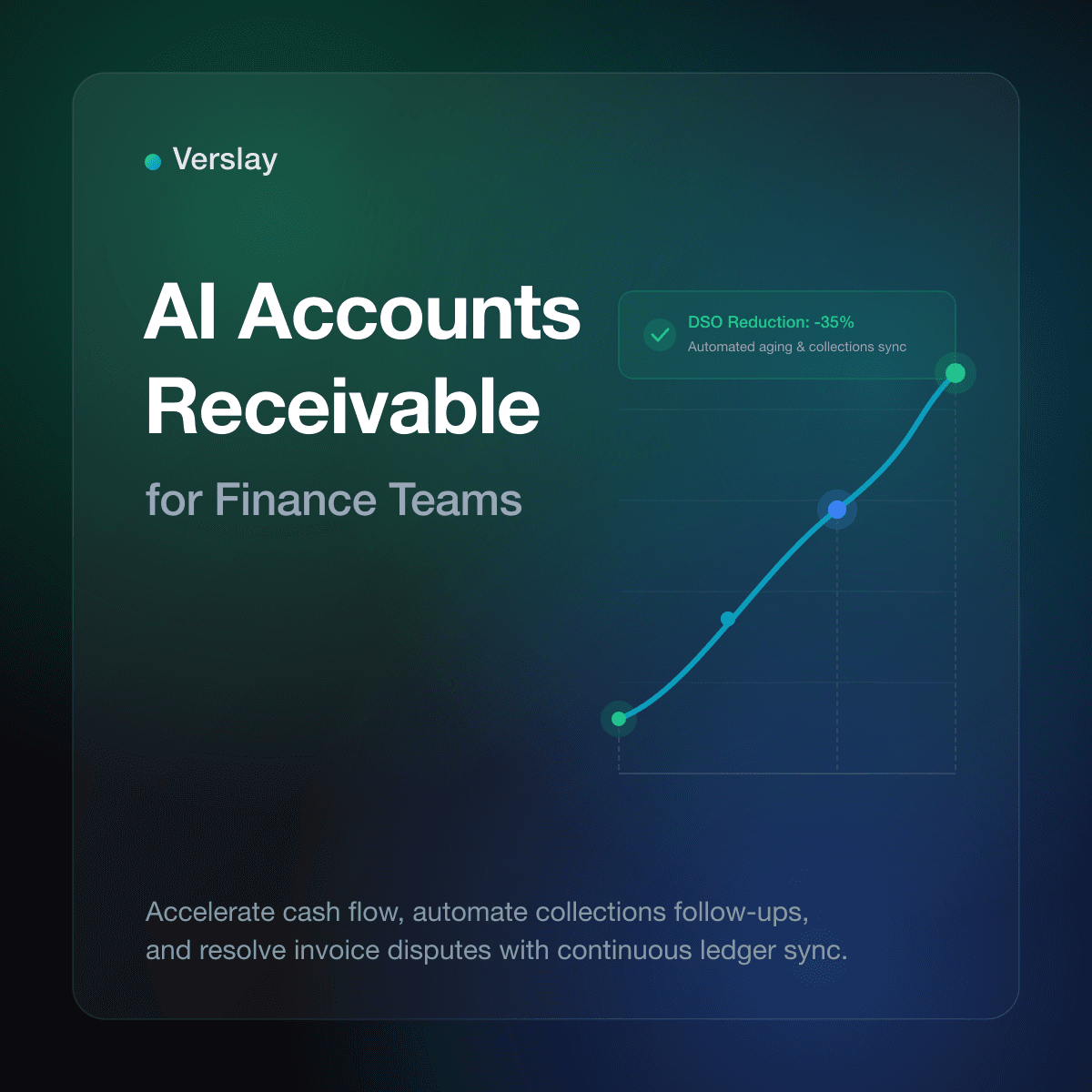
AI accounts receivable automation for finance teams uses autonomous AI agents to monitor aging ledgers, predict payment friction, orchestrate personalized collections outreach, and reconcile incoming cash against open invoices in real time. By connecting accounting ERPs like QuickBooks, NetSuite, and Xero with banking feeds and corporate communication channels, AI agents eliminate manual chasing, resolve billing disputes, and reduce Days Sales Outstanding (DSO) by 25% to 40% while preserving positive customer relationships.
How this maps to Verslay: the Invoice Chaser page covers this workflow. Unpaid Stripe invoices get polite, aging-appropriate reminders.
In high-growth companies and mid-market organizations, accounts receivable (AR) teams routinely juggle hundreds of outstanding invoices across diverse customer tiers. When collections workflows rely on manual spreadsheets, periodic aged-debt reports, and disjointed email threads, overdue balances accumulate, working capital gets trapped in unpaid receivables, and credit control teams spend over 70% of their working hours on administrative dunning rather than strategic cash management.
Deploying autonomous AI Agents integrated via Model Context Protocol (MCP) and financial system webhooks transforms credit control and collections from a reactive bottleneck into a continuous, intelligent cash acceleration engine.
Why Traditional Manual Accounts Receivable Stalls Cash Flow and Strains Teams
Finance and credit control operations face persistent structural friction across the entire invoice-to-cash lifecycle:
- Static Aging Silos and Delayed Detection: Traditional AR reviews rely on backward-looking 30/60/90-day aging reports generated once a week or month. By the time an invoice hits the 60-day overdue bucket, the likelihood of collection drops significantly.
- Generic and Ineffective Dunning: Standard automated reminder templates sound impersonal and robotic, frequently landing in spam folders or being ignored by accounts payable departments.
- Unresolved Disputes Stalling Entire Payments: A minor PO mismatch, tax discrepancy, or missing delivery confirmation on a single line item often causes an entire multi-thousand-dollar invoice to stall in customer AP queues for months.
- Disconnected Cash Application Drag: Reconciling incoming ACH, wire, and credit card payments against open invoices requires manual remittance extraction from fragmented PDF notices and bank statements.
- Customer Relationship Friction: Aggressive or poorly timed manual collection emails sent to VIP accounts risk damaging key commercial relationships and jeopardizing upcoming renewals.
Explore how AI invoice reconciliation for finance teams and AI invoice follow-up for service teams streamline accounts payable and billing communications across operations.
Core Capabilities: How Autonomous AI Agents Power Accounts Receivable Automation
Autonomous AI agents act as intelligent financial co-pilots, orchestrating continuous aging analysis, dispute resolution, and cash application across your accounting stack:
1. Continuous Aging Monitoring & Early Delinquency Prediction
AI agents analyze invoice status and buyer payment patterns in real time:
- Predictive Risk Scoring: Evaluates historical customer payment velocity, seasonal variance, and engagement signals to forecast which invoices are at risk of delinquency before their due dates.
- Real-Time ERP Sync: Continuously synchronizes invoice statuses, credit memos, and payment milestones across NetSuite, QuickBooks, Xero, Sage Intacct, and Salesforce.
- Prioritized Collections Queue: Automatically ranks daily outreach priorities based on invoice value, risk tier, and account strategic importance.
2. Multi-Channel Tiered Outreach & Tone-Adaptive Collections
Delivering tailored communications that accelerate response times without damaging client relationships:
- Dynamic Cadence Orchestration: Initiates courteous pre-due date reminders (e.g., net-5 days before due date to verify invoice receipt) and escalating tiers of follow-ups as aging progresses.
- Tone & Relationship Adaptation: Adjusts communication tone based on customer tier (e.g., high-touch executive tone for key accounts vs. direct self-service links for transactional SMB buyers).
- Multi-Channel Engagement: Reaches customer accounts payable contacts across verified channels, including email, customer billing portals, and automated SMS reminders.
3. Conversational Dispute Triage & Resolution
Handling customer objections and billing exceptions with contextual intelligence:
- Inbound Intent Parsing: Understands customer reply emails detailing reasons for non-payment (e.g., "PO number missing", "tax exemption certificate required", or "partial shipment received").
- Automated Evidence Retrieval: Queries CRM, contract repositories, and shipment tracking systems to automatically retrieve missing documentation and attach it to the reply within minutes.
- Human-in-the-Loop Escalation: Summarizes complex contractual disputes and routes an interactive triage card with suggested resolution paths to the finance controller or account executive.
4. Touchless Cash Application & Ledger Reconciliation
Closing the loop on incoming cash without manual data entry:
- Intelligent Remittance Extraction: Ingests payment advice PDFs, email notifications, and bank transaction statements to match payments against multiple open invoices.
- Automated Short-Pay & Fee Handling: Identifies minor bank fee deductions or prompt-payment discounts, applying automated write-off rules within approved company tolerance thresholds.
- Instant Ledger Posting: Posts cash receipts to general ledger accounts and updates invoice statuses to "Paid" in the ERP, freeing customer credit limits instantly.
5. Cash Flow Forecasting & Portfolio Health Analytics
Providing executive visibility into working capital performance:
- Dynamic Cash Inflow Projections: Generates 30-day, 60-day, and 90-day cash collection forecasts backed by machine learning models of debtor payment behavior.
- DSO & CEI Tracking: Continuously calculates Days Sales Outstanding (DSO) and Collections Effectiveness Index (CEI) metrics by customer cohort, product line, and sales team.
- Executive Digest Summaries: Dispatches weekly executive digests highlighting resolved balances, high-risk accounts, and cash acceleration milestones.
Discover how AI expense auditing for finance teams ensures continuous compliance across spend management.
Architecture of an Autonomous Accounts Receivable Pipeline
The diagram below illustrates how an AI collections agent ingests open invoices from ERP systems, orchestrates risk-tiered outreach, handles dispute triage, and synchronizes bank feeds:
[ERP Billing System] (NetSuite, QuickBooks, Xero, Stripe Billing)
                            │
                            ▼
          [AI AR & Collections Orchestrator]
       (Predictive Aging, Risk Scoring, Cadence Rules)
                            │
                            ▼
           ┌────────────────┴────────────────┐
           ▼                                 ▼
[Pre-Due & Due Date Outreach]       [Overdue Escalation Workflow]
(Courteous Reminders & Pay Links)   (Tone-Adaptive Multi-Channel Follow-Up)
           │                                 │
           └────────────────┬────────────────┘
                            │
                            ▼
             [Inbound Customer Response]
     (Dispute, Remittance Advice, Payment Confirmation)
                            │
           ┌────────────────┴────────────────┐
           ▼                                 ▼
   [Payment Completed]               [Dispute / Exception]
   (Bank Feed / Stripe Match)        (AI Doc Retrieval / Controller Escalation)
           │                                 │
           ▼                                 ▼
[Auto-Post to General Ledger]       [Dispute Resolved & Invoiced]
(Cash Applied, Invoice Marked Paid) (Credit Memo / Resent Invoice)
- Ingest & Predict: Ingest all newly generated invoices, analyze customer payment histories, and compute dynamic payment probability scores.
- Engage & Facilitate: Dispatch context-aware reminders with integrated one-click payment links and attached PDF invoices.
- Triage & Reconcile: Parse incoming customer replies, resolve documentation requests instantly, and reconcile incoming bank deposits.
- Post & Report: Update ERP records in real time and deliver executive cash flow intelligence to finance leadership.
Comparing Manual AR Collections vs. Autonomous AI Accounts Receivable
| Capability Dimension | Traditional Manual AR Process | Autonomous AI Accounts Receivable | | :--- | :--- | :--- | | Aging Detection | Weekly or monthly static aging reports | Continuous, real-time invoice and risk tracking | | Collections Outreach | Ad-hoc, manual emails or rigid mass blasts | Dynamic, multi-tiered outreach adapted to customer tier | | Dispute Resolution | Multi-week email ping-pong across departments | Automated document retrieval and instant dispute triage | | Cash Application | Manual matching of bank deposits against open bills | Touchless AI matching of remittances to ERP invoices | | DSO Impact | High DSO with cash trapped in 60+ day buckets | 25% to 40% reduction in Days Sales Outstanding | | Customer Experience | Frustrating generic dunning and mismatched records | Professional, timely, and friction-free payment journeys | | Staff Utilization | 70%+ of time spent on administrative chasing | Focus on strategic credit policies and VIP accounts |
Measurable Business and Financial ROI
Deploying autonomous AI accounts receivable automation delivers immediate, quantifiable returns for finance teams:
- 25%–40% Reduction in Days Sales Outstanding (DSO): Faster payment velocity accelerates cash conversion cycles and unlocks working capital.
- 85% Reduction in Manual Collections Effort: Credit control teams eliminate dozens of hours spent drafting repetitive emails and matching remittances.
- 99.5%+ Touchless Cash Application Rate: Automated remittance extraction reconciles incoming bank transfers with zero human data entry.
- Up to 60% Decrease in Bad Debt Write-Offs: Early identification of payment risks and proactive dispute resolution prevent accounts from aging into default.
- Enhanced Customer Retention: Professional, collaborative communication resolves billing issues smoothly without damaging account relationships.
Discover how AI agents for finance operations and business workflow automation streamline back-office operations from billing to general ledger reconciliation.
See it in Verslay
Verslay agents work through the tools you already connect and prepare drafts and staged actions for a person to approve. The Invoice Chaser page shows the real workflow. You can also browse all use cases or book a 30-minute walkthrough.
Frequently Asked Questions
What is AI accounts receivable automation for finance teams?
AI accounts receivable automation uses autonomous AI agents to monitor outstanding invoices, predict payment delays, send personalized collections reminders, reconcile incoming bank payments, and update accounting ERPs in real time.
How does AI accounts receivable automation reduce Days Sales Outstanding (DSO)?
By initiating proactive, tiered follow-ups before due dates, instantly resolving billing discrepancies, and offering frictionless payment links, AI agents accelerate customer payments and reduce DSO by 25% to 40%.
How do AI agents handle customer invoice disputes and billing exceptions?
When a customer replies with a billing dispute, the AI agent parses the email, extracts dispute reasons, cross-references contract terms and delivery receipts, drafts a context-aware resolution, and escalates complex edge cases to finance managers.
Accelerate Your Cash Flow with Verslay
Transform your accounts receivable from a manual administrative bottleneck into an automated cash acceleration engine. With Verslay, finance teams deploy intelligent AI agents that connect directly with ERPs, banking feeds, and customer communication channels to eliminate overdue balances and protect margins.
Explore Verslay's AI Agents and Finance Automation Solutions to optimize your working capital today.