AI churn prediction for customer success teams uses autonomous AI agents connected via Model Context Protocol (MCP) to analyze product usage, customer support tickets, and CRM interaction history, automatically flagging retention risks months before contract renewal dates. By converting raw operational telemetry into real-time health scores and automated playbooks, CS teams can intervene proactively, protect recurring revenue, and scale account coverage without expanding headcount.
In B2B SaaS and managed services, customer churn is rarely a sudden event. It is usually the outcome of months of silent decay: dropped user logins, unresolved technical debt, unread product updates, or executive sponsor transitions. Traditional customer success operations rely on quarterly manual reviews or static spreadsheets, which often surface churn risks only when a cancellation notice is submitted.
Deploying specialized AI Agents allows Customer Success Managers (CSMs) to transition from reactive troubleshooting to continuous risk detection.
Structural Failure Points in Traditional Churn Management
Most customer success operations attempt to track account health using static scoring formulas inside CRM software. However, these traditional models fail for three core reasons:
- Siloed Signal Telemetry: Product telemetry lives in data warehouses (Snowflake, BigQuery), support history lives in ticketing platforms (Zendesk, Intercom), and relationship logs live inside sales CRMs (Salesforce, HubSpot). Static systems cannot synthesize these cross-platform signals in real time.
- Lagging Indicator Dependence: Metrics like net promoter score (NPS) surveys or quarterly business reviews (QBRs) reflect historical sentiment rather than current behavior. Relying on lagging indicators leaves CSMs zero runway to turn around endangered accounts.
- Manual Analysis Overhead: When a CSM manages 30 to 50 accounts, manually checking usage logs, support thread sentiment, and billing status for every customer consumes up to 15 hours per week—leaving little time for high-value strategic consulting.
How AI Churn Prediction Works Across the Customer Lifecycle
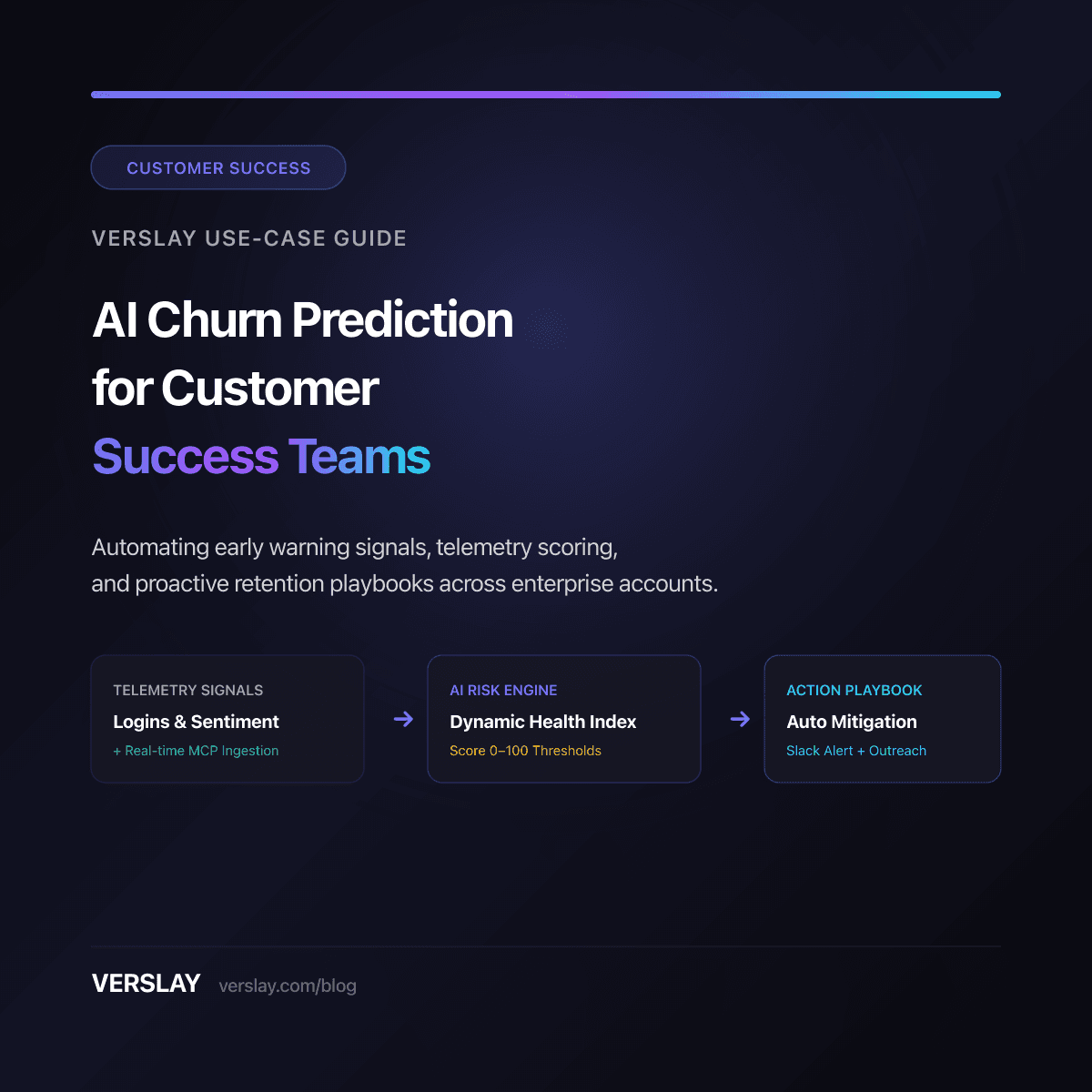
Modern AI churn prediction models move beyond simple rule-based alerts. By utilizing LLM-powered context synthesis and MCP server connections, automated systems process structured and unstructured signals simultaneously.
+-------------------+     +---------------------+     +----------------------+
| Product Usage     |     | Support Tickets     |     | CRM & Email Logs     |
| (Logins, Features)|     | (Volume, Sentiment) |     | (Cadence, Sponsors)  |
+---------+---------+     +----------+----------+     +----------+-----------+
          |                          |                           |
          +--------------------------+---------------------------+
                                     |
                                     v
                        +-------------------------+
                        | Verslay MCP Integration |
                        +------------+------------+
                                     |
                                     v
                        +-------------------------+
                        | AI Churn Risk Engine    |
                        | (Real-Time Scoring)     |
                        +------------+------------+
                                     |
                                     v
            +------------------------+------------------------+
            |                                                 |
            v                                                 v
  +-------------------+                             +-------------------+
  | High Risk (<50%)  |                             | Expansion (>85%)  |
  | Auto Slack Alert  |                             | Upsell Briefing   |
  | & Mitigation Plan |                             | Drafted for CSM   |
  +-------------------+                             +-------------------+
1. Unified Multi-Signal Telemetry Ingestion
Instead of reviewing isolated metrics, AI churn prediction models evaluate four distinct signal categories:
- Adoption Velocity: Tracking fluctuations in daily active users (DAU), key workflow completion rates, and module adoption width across departments.
- Support Ticket Sentiment: Analyzing natural language in support exchanges to detect emerging frustration, recurring bug reports, or negative sentiment trends.
- Executive Sponsor Stability: Cross-referencing LinkedIn and email communications to detect when a key decision-maker or project champion leaves the client organization.
- Contract Horizon Proximity: Weighting risk factors higher as the renewal window approaches (e.g., 90 days, 60 days, 30 days prior to expiration).
2. Autonomous Health Indexing and Alerting
The AI engine continuously recalculates an account's retention score (0–100). When an account's score drops below a pre-set threshold (e.g., falling below 60), the AI agent immediately:
- Generates a concise Root-Cause Analysis Brief summarizing recent usage drops and support tickets.
- Posts a targeted alert to the dedicated account team's Slack or Microsoft Teams channel.
- Pre-populates a re-engagement playbook customized to the customer's specific adoption bottleneck.
Explore how pre-built workflows accelerate deployment across customer success environments in our Verslay Use Cases hub.
3 Core Workflows Powered by AI Churn Prediction
Workflow 1: Multi-Signal Risk Detection  ---> Real-Time Alert & Root Cause Analysis
Workflow 2: Automated Retention Playbooks ---> Drafted Sponsor Email & QBR Prep Deck
Workflow 3: Renewal Horizon Protection   ---> 90-Day Pre-Renewal Health Audit
Workflow 1: Early-Warning Risk Detection and Incident Briefing
When a B2B SaaS client reduces admin logins by 45% over a two-week period while submitting three high-priority support tickets, the AI agent connects these dots immediately. Rather than waiting for the CSM to notice during a monthly check-in, the agent synthesizes the entire interaction history into an actionable briefing:
Account Alert: Acme Corp (Risk Score: 42/100 - High Risk)
- Primary Trigger: 45% drop in weekly active user seats over 14 days.
- Secondary Trigger: 3 unresolved tickets regarding API rate limiting.
- Executive Sponsor Status: Last recorded email interaction was 34 days ago.
- Recommended Action: Technical CSM intervention to resolve API configuration; sponsor check-in email queued for review.
Workflow 2: Automated Re-Engagement Playbook Generation
Intervention requires more than just alerting; it requires execution. Once a risk is identified, the AI churn prediction agent drafts tailored re-engagement materials:
- Sponsor Check-In Email: A personalized message highlighting underutilized features and proposing a targeted technical review.
- Tailored Executive Summary: A 1-page PDF overview of value delivered to date, active usage metrics, and pending resolutions.
- Technical Remediation Plan: Task assignments sent directly to solutions engineers or tier-3 support teams to resolve open platform issues.
Workflow 3: Proactive 90-Day Renewal Horizon Audits
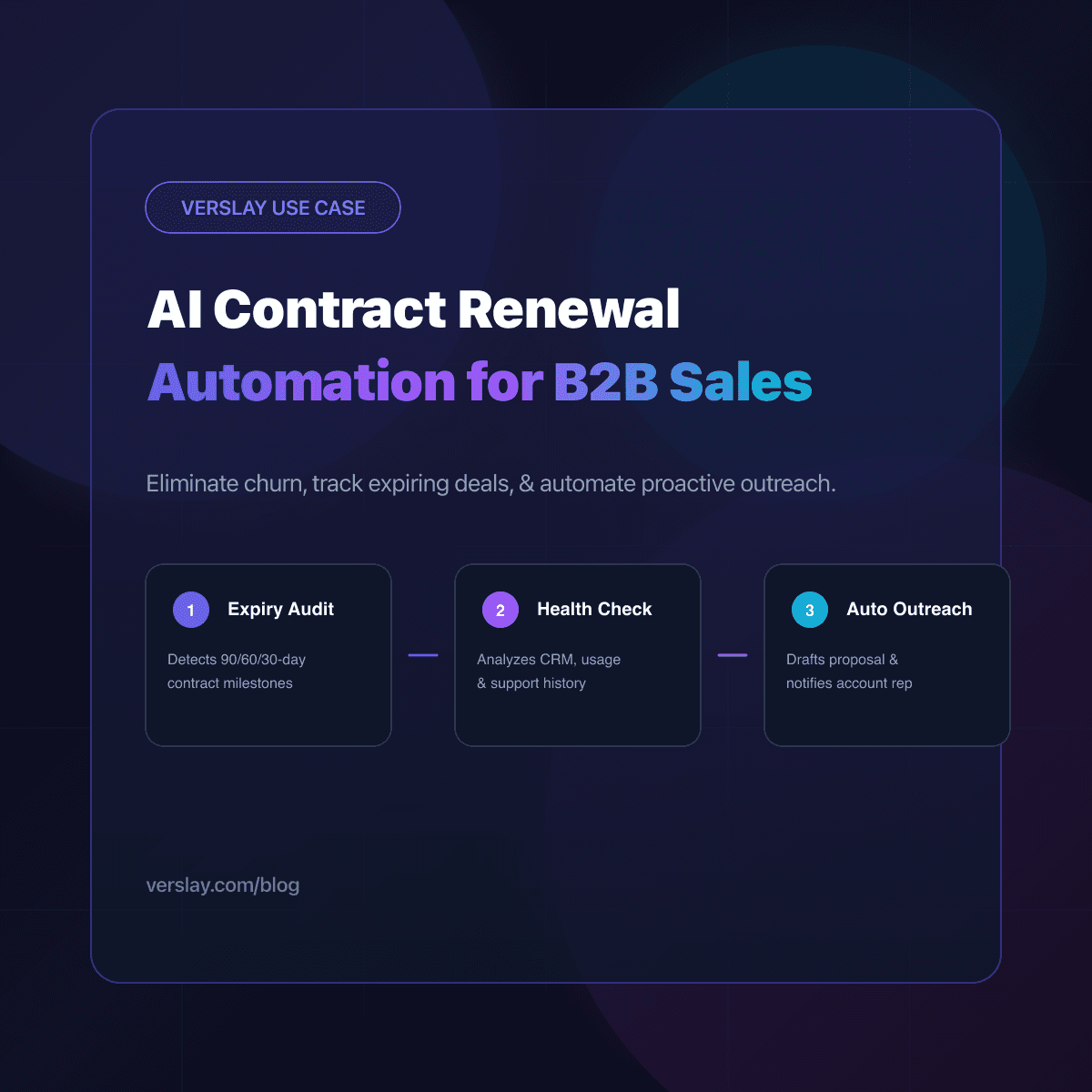
For high-value contracts renewing within the next quarter, the AI system automatically initiates a Pre-Renewal Health Audit:
- Validates that contract usage matches or exceeds license tiers.
- Checks whether open feature requests have been addressed or scheduled on the product roadmap.
- Calculates net expansion potential (cross-sell/upsell) versus churn likelihood.
- Generates an executive briefing deck for the CSM to review before scheduling the renewal conversation.
Learn more about tailored implementations for B2B tech and service providers in Industry Solutions.
Technical Foundation: MCP Server Integration for Customer Success
The key to effective AI churn prediction is seamless connectivity across your company's existing technology stack. Rather than requiring complex custom API integrations for every tool, Verslay leverages the open Model Context Protocol (MCP) standard.
Through MCP servers, AI agents securely access and update data across:
- CRMs & Billing: Salesforce, HubSpot, Stripe, Chargebee
- Support & Success: Zendesk, Intercom, Gainsight, Vitally
- Communication: Slack, Microsoft Teams, Gmail, Outlook
- Data Warehouses: Snowflake, BigQuery, PostgreSQL
This architecture ensures that customer data remains securely scoped, fully auditable, and accessible in real time without exposing internal infrastructure to security risks.
Frequently Asked Questions
How does AI churn prediction work for B2B customer success teams?
AI churn prediction systems analyze telemetry data, ticket volume, sentiment, and login trends across CRM and product databases to assign dynamic risk scores and alert account teams before a renewal is endangered.
What early signals indicate a B2B customer is at risk of churning?
Key indicators include declining daily active usage, unresolved high-priority support tickets, executive sponsor turnover, skipped QBRs, and decreased feature adoption.
How can customer success managers automate proactive retention workflows?
CSMs can configure AI agents to monitor customer health metrics, generate context-aware re-engagement playbooks, draft executive summaries, and schedule check-ins automatically when health scores drop below defined thresholds.