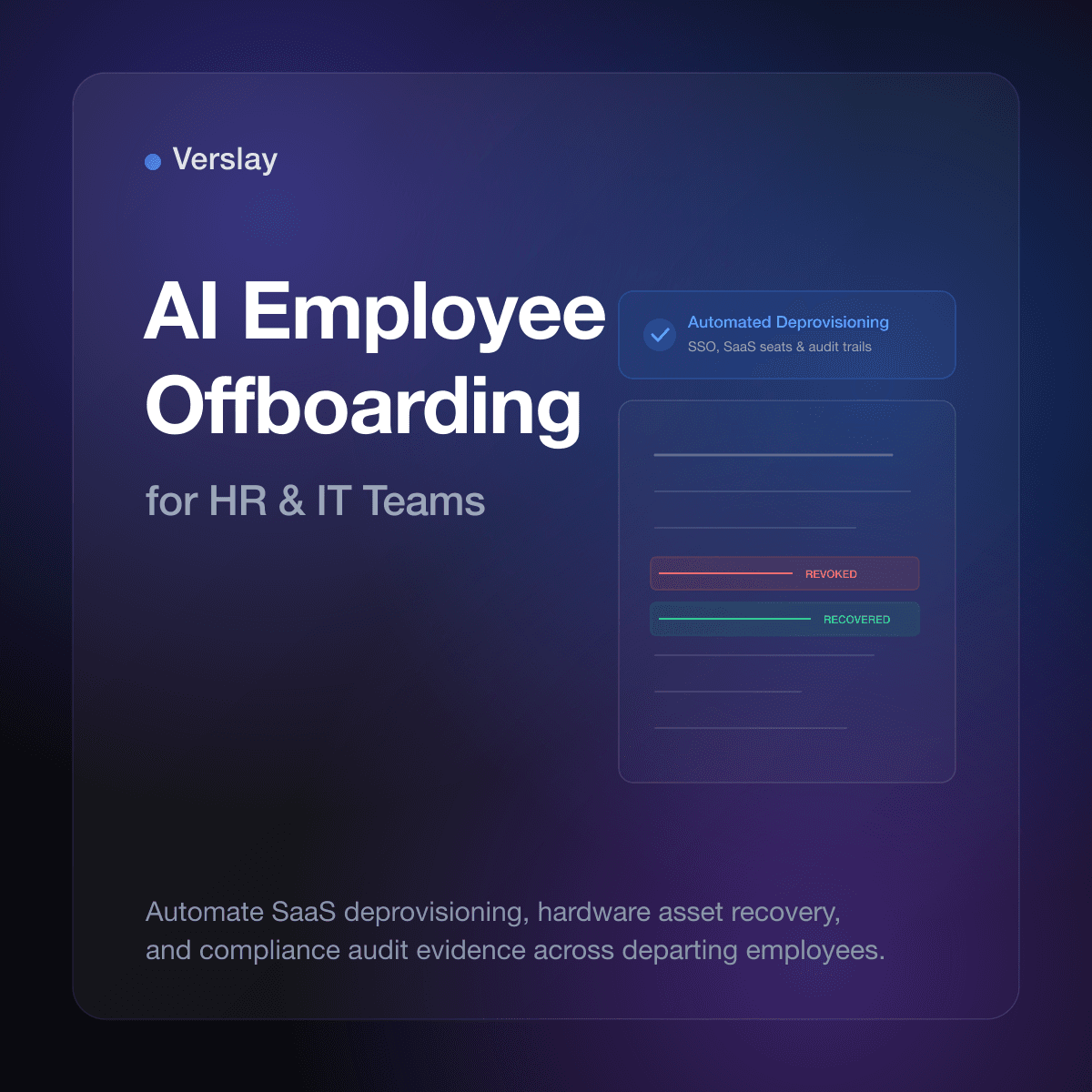
AI employee offboarding for HR and IT teams utilizes autonomous AI agents to orchestrate the entire employee separation lifecycle—from HRIS status triggers and multi-app SaaS deprovisioning to hardware asset recovery and compliance audit logging. By connecting directly with identity providers, human resources platforms, ticketing queues, and communication tools, AI agents eliminate orphaned accounts, mitigate insider data security risks, and reduce administrative offboarding overhead by up to 85%.
Closest Verslay page: SOP & Knowledge Curator. Recurring processes captured as living SOPs, with stale ones flagged. It is the nearest live match for this topic, not a one-to-one fit.
In modern business operations, offboarding a departing employee is rarely a single-step action. Instead, it involves a complex, time-sensitive matrix across human resources, IT operations, facilities, finance, and legal teams. When communication breaks down between departments, access privileges linger for weeks or months, confidential company data remains exposed, and expensive software licenses go unrecovered.
Why Traditional Manual Offboarding Creates Critical Security Vulnerabilities
Manual offboarding processes rely on static checklists, fragmented email handoffs, and disconnected admin portals, leading to recurring operational failures:
- Orphaned SaaS Accounts & Shadow Access: Employees accumulate access to dozens of unmanaged tools, cloud repositories, and third-party integrations. Without automated deprovisioning, accounts in services outside centralized SSO often remain active long after an employee departs.
- Cross-Departmental Coordination Gaps: HR logs the separation in the HRIS, but notification tickets sent to IT, security, and department leads often sit in unassigned queues, delaying critical revocation windows.
- Hardware Loss and Unrecovered Assets: Laptops, security tokens, monitors, and mobile devices frequently go uncollected without automated shipping label generation, return tracking, and device management wipes.
- Compliance and Audit Deficiencies: Frameworks like SOC 2, ISO 27001, and HIPAA mandate prompt revocation of all system access upon termination. Compiling proof across disjointed admin consoles for auditors is manual, stressful, and error-prone.
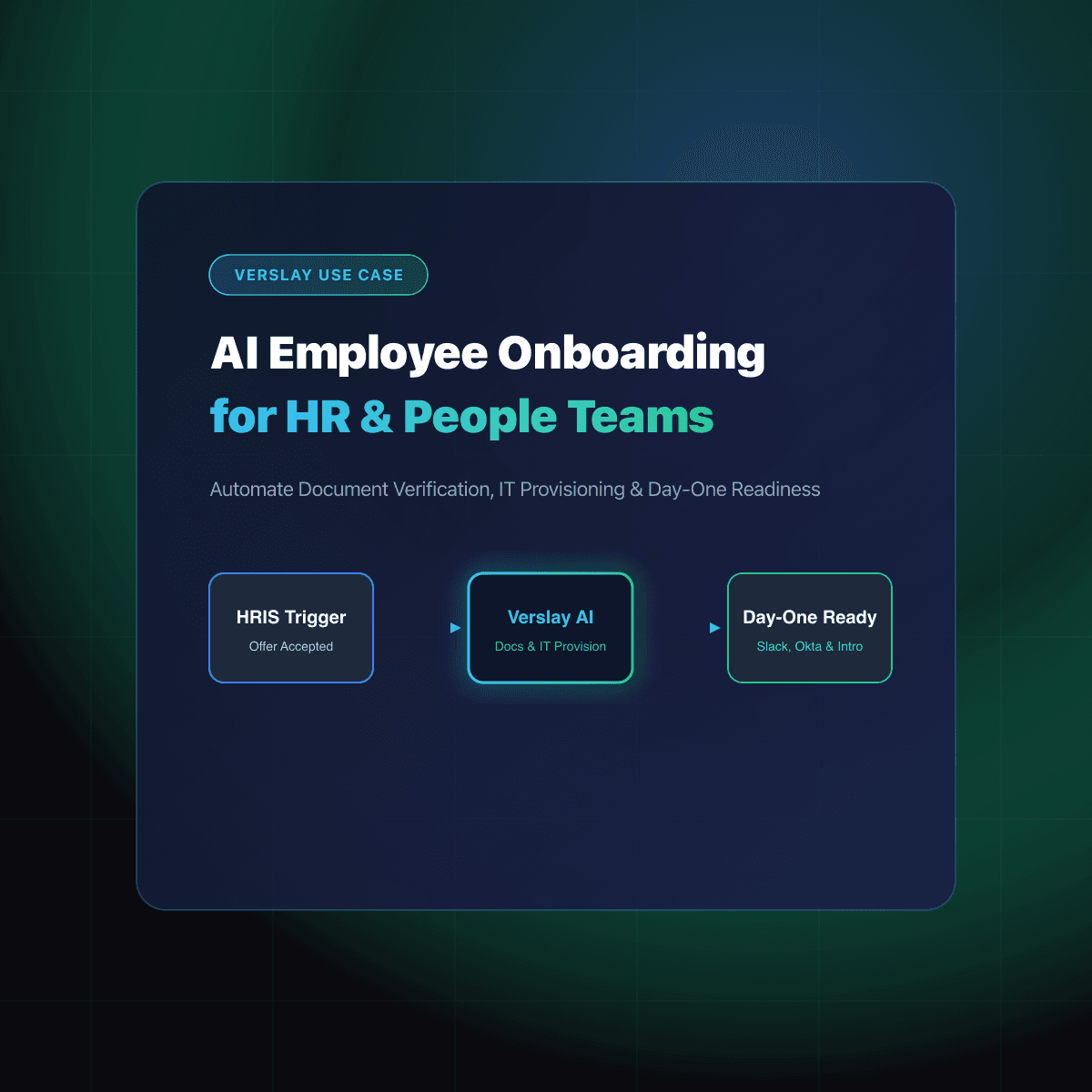
Discover how AI employee onboarding for HR teams and AI SLA tracking for internal IT teams establish automated operational foundations across earlier stages of the employee and service delivery lifecycle.
How Autonomous AI Agents Automate the Employee Offboarding Lifecycle
Deploying autonomous AI agents enables a synchronized, zero-touch offboarding pipeline that executes every operational step with precision and complete auditability:
1. HRIS Separation Trigger and Dynamic Workflow Initiation
The offboarding pipeline initiates automatically the moment an update is recorded in the core HR system:
- HRIS Webhook Ingestion: AI agents listen for termination events or scheduled departure dates in platforms like Workday, BambooHR, Rippling, or Gusto.
- Role-Based Offboarding Matrix: Determines the departed employee's department, clearance level, manager, assigned hardware, and active SaaS application inventory.
- Immediate vs. Scheduled Deprovisioning: Supports immediate instant-lock workflows for sensitive departures, or scheduled offboarding executed precisely at the end of the employee's final working day.
2. Automated Identity & SaaS Access Deprovisioning
Rather than requiring IT administrators to log into 20+ individual consoles:
- Centralized Identity Revocation: Triggers instant session termination, password resets, and account deactivation across identity providers (Okta, Microsoft Entra ID, Google Workspace).
- Deep SaaS Seat Reclaiming: Automatically revokes licenses and suspends accounts in standalone applications (Salesforce, GitHub, Jira, Figma, HubSpot, Slack) via direct API and MCP connectors.
- Multi-Factor Token Invalidation: Wipes registered hardware security keys, authenticator app enrollments, and active OAuth application grants.
3. Digital Asset Transfer and Inbox Archival
Ensuring business continuity and data integrity without manual file hunting:
- Cloud Drive Ownership Migration: Systematically transfers Google Drive or Microsoft OneDrive file ownership to the designated manager or project successor, preventing broken folder permissions.
- Email Forwarding and Auto-Responder Deployment: Configures standardized departure auto-responders and routes inbound client communications to the transition team.
- Code Repository & API Key Auditing: Audits personal access tokens (PATs), SSH keys, and pull request assignments in GitHub or GitLab to prevent orphaned deployment blocks.
4. Hardware Asset Recovery & MDM Device Lockdown
Bridging the physical-to-digital gap for remote and hybrid teams:
- MDM Device Remote Wipe & Lock: Issues remote lock or selective device wipe commands via mobile device management (MDM) platforms such as Jamf, Intune, or Kandji.
- Automated Return Logistics: Automatically generates prepaid return shipping labels, dispatches return kit boxes to the employee's residential address, and tracks courier transit status.
- Asset Ledger Reconciliation: Updates the IT asset management (ITAM) database as soon as the device delivery is scanned and checked in by warehouse operations.
5. Automated Compliance Audit Trail Generation
Producing verifiable proof for internal compliance and external certification:
- Immutable Timestamped Logging: Captures second-by-second timestamps for every revoked permission, changed password, and transferred file repository.
- Compliance Evidence Package: Compiles an executive offboarding certificate demonstrating compliance with SOC 2 CC6.2, ISO 27001 A.9.2.6, and HIPAA access control rules.
- Stakeholder Notifications: Delivers unified completion summaries to HR, IT management, and Legal through Slack, Teams, or secure email digests.
Explore how deploying specialized AI agents for business operations empowers HR, IT, and security leaders to eliminate administrative drag and enforce continuous company-wide governance.
Architecture of an AI-Powered Offboarding Pipeline
The following diagram illustrates how an autonomous offboarding agent coordinates HR events, identity deprovisioning, asset management, and compliance reporting:
[HRIS Separation Event] (Workday, BambooHR, Rippling)
                      │
                      ▼
        [AI Orchestration Engine]
   (Evaluates Role, Access Scope & Timing)
                      │
           ┌──────────┼──────────┐
           ▼          ▼          ▼
   [Identity & SSO] [SaaS Apps] [Hardware MDM]
   (Okta / Entra)  (GitHub/CRM) (Jamf / Intune)
           │          │          │
           ▼          ▼          ▼
   [Revoke Access] [Reclaim]   [Remote Lock]
   (Kill Sessions) (Licenses)  (Return Kit)
           │          │          │
           └──────────┼──────────┘
                      ▼
       [Data Migration & Handover]
    (Drive Transfer, Email Forwarding)
                      │
                      ▼
      [Compliance Evidence Package]
   (SOC 2 / ISO 27001 Timestamped Log)
- Trigger & Plan: Detect the separation event in the HRIS and build a customized revocation checklist based on user role and permissions.
- Execute & Reclaim: Terminate identity sessions, deprovision SaaS seats, lock remote devices, and ship return packaging.
- Audit & Certify: Compile cryptographic audit evidence of timely access removal for compliance and executive records.
Comparing Manual Offboarding vs. AI Agent Automation
| Capability | Manual Offboarding Process | Autonomous AI Agent Automation | | :--- | :--- | :--- | | Deprovisioning Speed | 2–5 business days across individual portals | Under 120 seconds across all SSO and connected apps | | SaaS License Reclaiming | Periodic manual audits; high license leakage | Immediate license recovery and cost optimization | | Data & Drive Handover | Frequently forgotten; leads to lost files and links | 100% automated file ownership transfer and mailbox routing | | Hardware Tracking | Manual spreadsheet logging and follow-up emails | Automated shipping label generation, courier tracking, and MDM lock | | Audit Evidence | Scrambled screenshots and email verification trails | Single-click, immutable compliance certificate with timestamped logs | | Human Error Risk | High likelihood of missed shadow apps or active tokens | Zero missed steps; deterministic execution according to company policy |
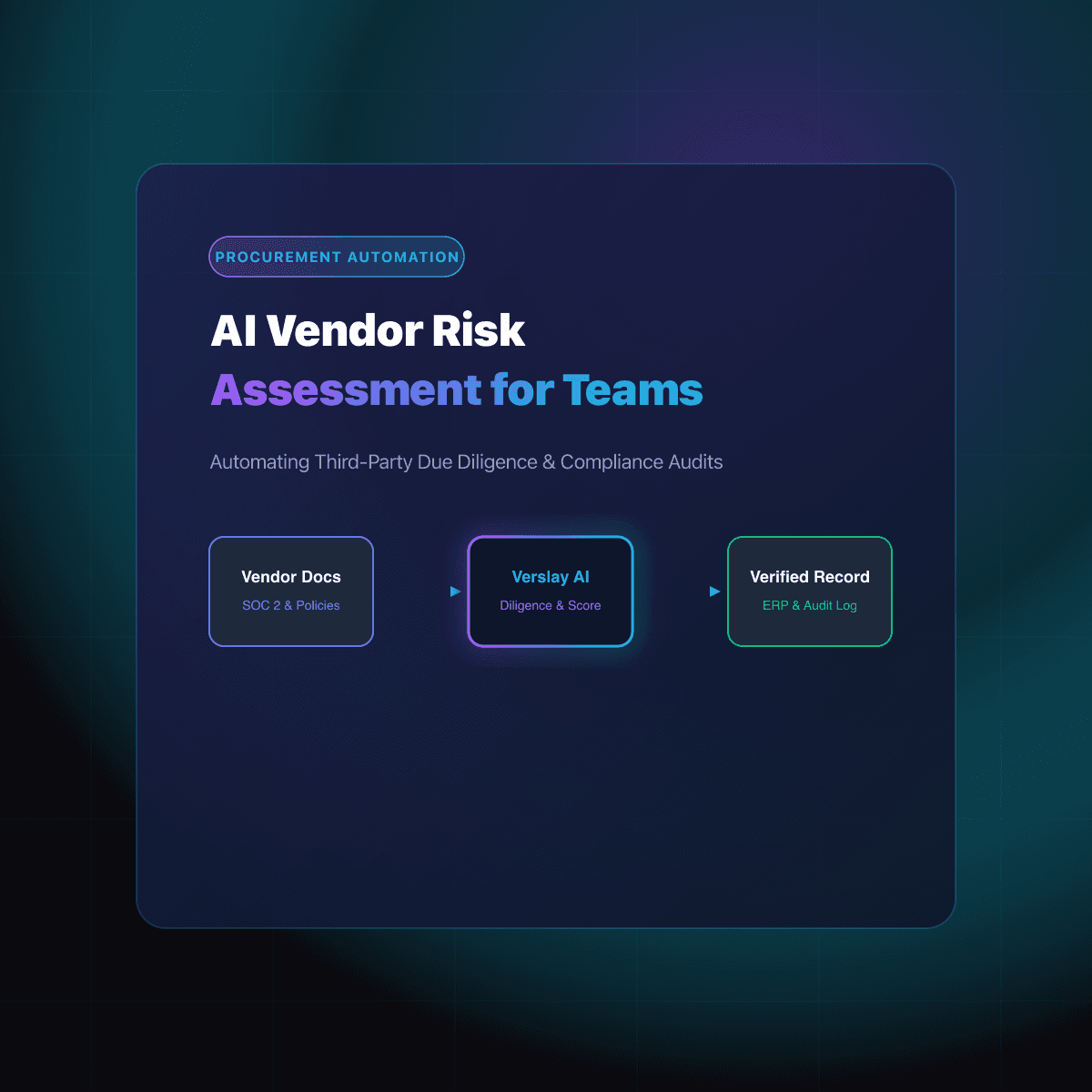
For comprehensive risk governance across external partners and vendors, see how AI vendor risk assessment for procurement teams automates diligence reviews and third-party security audits.
Measurable Operational ROI for HR and IT Teams
Implementing autonomous AI employee offboarding delivers quantifiable security and cost benefits across organizations:
- Up to 85% Reduction in Administrative Offboarding Hours: Liberates IT engineers and HR coordinators from repetitive manual portal clicks.
- Zero Orphaned Accounts: Enforces deterministic, 100% complete access revocation across all identity and cloud tools.
- Up to 15% Savings on Annual SaaS Spend: Instantly reclaims unused software seats for reallocation or subscription tier downgrades.
- Seamless SOC 2 & ISO 27001 Audit Readiness: Produces instant, defensible audit artifacts with zero last-minute scramble.
See it in Verslay
Verslay agents work through the tools you already connect and prepare drafts and staged actions for a person to approve. The SOP & Knowledge Curator page shows the real workflow. You can also browse all use cases or book a 30-minute walkthrough.
Frequently Asked Questions
What is AI employee offboarding for HR and IT teams?
AI employee offboarding uses autonomous AI agents to coordinate separation workflows across HRIS, IT identity providers, SaaS applications, and asset management systems—automating credential revocation, asset recovery logistics, and audit trail generation.
How does AI automate IT deprovisioning and SaaS access revocation?
AI agents integrate with identity providers like Okta, Microsoft Entra ID, and Google Workspace to instantly revoke session tokens, reassign licenses, transfer file ownership, and archive user mailboxes on a scheduled or immediate basis.
How does AI offboarding ensure SOC 2 and ISO 27001 compliance?
AI agents generate immutable, timestamped logs for every revoked permission, device wipe, and returned hardware asset—producing automated compliance evidence packages for SOC 2, ISO 27001, and HIPAA audits.