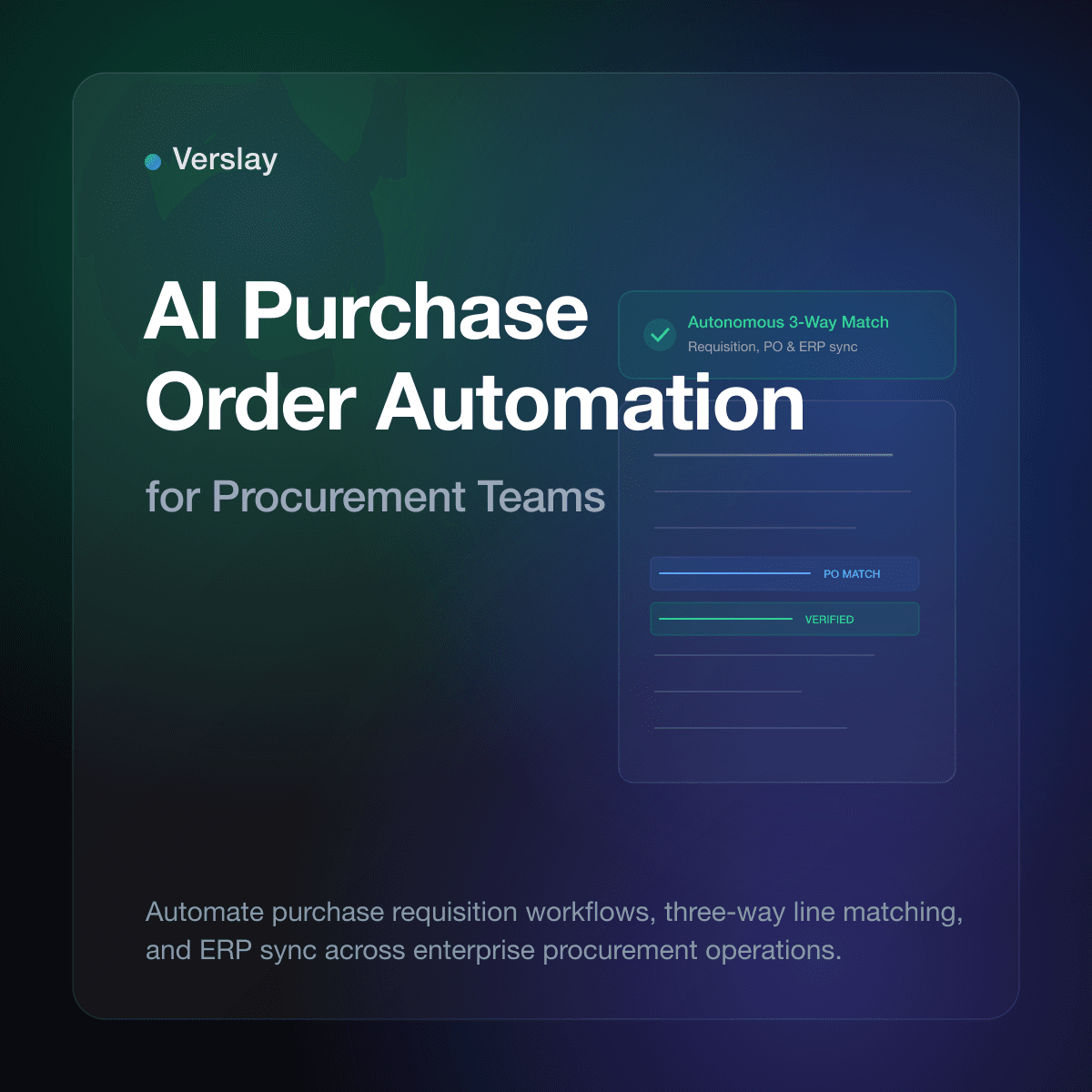
AI purchase order automation for procurement teams utilizes autonomous AI agents to parse inbound purchase requisitions, validate line items against vendor contracts, generate approved purchase orders, and conduct automated three-way matching with invoices and receiving receipts. By connecting directly with ERPs, contract databases, and communication channels, AI agents eliminate manual data entry backlogs, enforce purchasing compliance, and reduce PO processing cycle times by up to 80%.
How this maps to Verslay: the Purchase Order Tracker page covers this workflow. Every PO tracked from raised to paid.
In modern procurement and supply chain operations, manual purchase order workflows create significant operational drag. Procurement officers and buyers spend countless hours re-keying data between disparate requisition emails, supplier quotes, spreadsheets, and ERP systems. When discrepancies arise between initial quotes, issued purchase orders, and delivered goods, resolving line-item variances stalls delivery schedules and damages critical vendor relationships.
Why Traditional Purchase Order Workflows Bottleneck Procurement
Traditional PO processing relies heavily on manual intervention, static approval chains, and fragmented communication across departments:
- Slow Requisition-to-PO Turnaround: Purchase requisitions submitted via email, Slack, or ticketing forms often sit in approval queues for days, delaying essential equipment purchases and software licensing.
- Contract Price & Terms Leakage: Without automated contract lookup, buyers frequently issue POs at list prices or outdated rates rather than leveraging pre-negotiated volume discounts and master service agreement (MSA) terms.
- Three-Way Matching Delays: Comparing line-item quantities, unit prices, freight charges, and tax amounts across purchase orders, warehouse receiving slips, and accounts payable (AP) invoices is labor-intensive and prone to human error.
- Maverick Spending and Policy Non-Compliance: Employees often bypass standard procurement channels when PO generation is cumbersome, leading to unbudgeted expenses and rogue vendor onboarding.
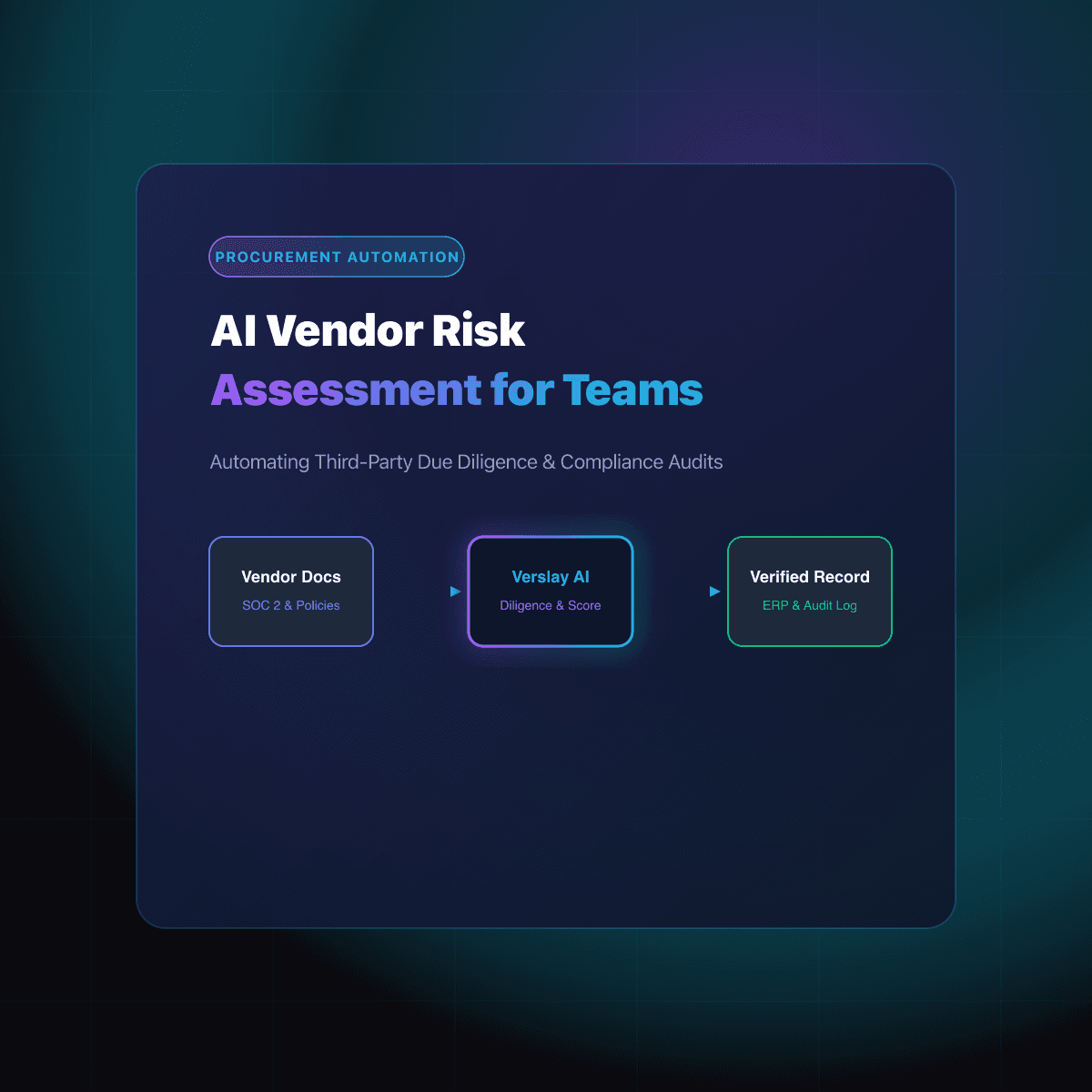
Discover how AI vendor risk assessment for procurement teams and AI invoice reconciliation for finance teams solve parallel operational bottlenecks across vendor diligence and accounts payable workflows.
How Autonomous AI Agents Automate the Purchase Order Lifecycle
Deploying autonomous AI agents for procurement creates an end-to-end, intelligent pipeline that governs requisitions, PO creation, multi-tier approvals, and receipt verification:
1. Requisition Ingestion and Policy Compliance Auditing
The moment an employee or department submits a purchase request:
- Multi-Channel Request Capture: AI agents ingest requisitions from ticketing tools, email inboxes, ERP portals, and team chat channels (Slack or Microsoft Teams).
- Vendor & Contract Verification: The agent checks the requested vendor against approved supplier lists, verifies active master contracts, and retrieves pre-negotiated tier pricing and payment terms.
- Budget & Category Allocation: Automatically maps the requisition to the correct general ledger (GL) code, department cost center, and project budget threshold.
2. Autonomous Purchase Order Generation
Once validated, the AI agent prepares a formal, standardized purchase order:
- Structured Data Extraction: Translates raw request specifications into itemized line items with exact part numbers, quantities, unit prices, required delivery dates, and delivery locations.
- Terms & Conditions Incorporation: Automatically binds relevant vendor-specific SLAs, warranty riders, and standard corporate payment terms (e.g., Net 30/60).
- ERP Record Creation: Generates a draft PO in your ERP system (such as SAP, Oracle NetSuite, Coupa, or Workday) via API and MCP connectors.
3. Dynamic Multi-Tier Approval Routing
Rather than relying on static, sequential email chains:
- Threshold-Based Routing: Requisitions under pre-approved spend limits are fast-tracked for immediate issuance, while high-value purchases are dynamically routed to department heads, finance leads, and executive approvers.
- Interactive Contextual Briefs: Provides approvers with one-click decision cards in Slack or email, highlighting budget impact, contract pricing comparisons, and vendor compliance status.
- Escalation Management: Proactively monitors approval SLAs, sending reminders to approvers and re-routing stalled requests to designated delegates.
4. Automated Three-Way Matching and Variance Resolution
When goods or services are delivered:
- Cross-Document Alignment: The AI agent extracts and cross-checks data points across three foundational documents: the issued Purchase Order, the Goods Received Note (GRN) or packing slip, and the supplier’s Accounts Payable Invoice.
- Tolerance & Discrepancy Checks: Validates unit costs, item counts, freight fees, and tax calculations against permissible variance thresholds (e.g., ±1%).
- Automated Exception Handling: Flags genuine discrepancies (such as partial shipments or unexpected price hikes) and drafts targeted clarification inquiries directly to the vendor.
Explore how deploying specialized AI agents for business operations empowers procurement and finance leaders to automate core back-office operations with zero operational friction.
Architecture of an AI-Powered PO Automation Pipeline
The following diagram illustrates how an autonomous procurement agent coordinates requisition intake, compliance checks, PO issuance, and three-way reconciliation:
[Purchase Requisition] (Slack, Email, Jira, or ERP Form)
                     │
                     ▼
       [AI Ingestion & Contract Lookup]
   (Vendor Master File, Active MSAs, GL Codes)
                     │
                     ▼
       [Budget & Policy Validation]
  (Spend Limits, Preferred Vendor Tiers)
                     │
          ┌──────────┴──────────┐
          ▼                     ▼
[Standard / Within Budget] [Out-of-Policy / Over Budget]
 (Generate Draft PO in ERP) (Route to Executive Approvers)
          │                     │
          └──────────┬──────────┘
                     ▼
          [Issue PO to Supplier]
        (PDF Delivery & Status Sync)
                     │
                     ▼
      [Autonomous 3-Way Matching Engine]
   (Compare PO vs. Receiving GRN vs. Invoice)
                     │
                     ▼
     [Auto-Approve & Release AP Payment]
- Intake & Standardize: Normalize requisition requests from any communication channel.
- Validate & Enforce: Compare requested line items against active contract rates and department budget caps.
- Dispatch & Settle: Distribute formal POs to vendors and automate reconciliation when delivery and invoice arrive.
Comparing Manual Procurement vs. AI Agent Automation
| Capability | Manual Procurement Process | Autonomous AI Agent Automation | | :--- | :--- | :--- | | PO Creation Time | 2–4 business days across emails and forms | Under 60 seconds from requisition approval | | Contract Pricing Compliance | Periodic manual spot checks against contracts | 100% automated contract rate and discount validation | | Three-Way Matching | Manual line-by-line spreadsheet comparisons | Real-time optical and semantic line matching across PO, GRN, and invoice | | Approval Tracking | Static email threads with frequent stalling | Dynamic multi-channel interactive cards with auto-escalation | | ERP Synchronization | Manual data entry across multiple tabs | Real-time bi-directional REST & MCP API synchronization | | Audit Readiness | Scattered email receipts and attachments | Centralized, timestamped immutable audit trails |
For comprehensive expense governance across non-PO employee spending, see how AI expense auditing for finance teams automates policy enforcement and receipt audit logs.
Measurable Operational ROI for Procurement and Finance Teams
Implementing autonomous AI purchase order automation delivers quantifiable operational gains across organizations:
- Up to 80% Reduction in PO Processing Cycle Times: Streamlines the journey from raw requisition to vendor-ready purchase order from days to minutes.
- Zero Maverick Spend: Enforces pre-approved supplier catalogs and contracts before any commitment is made.
- 95%+ First-Pass Three-Way Match Rate: Eliminates manual invoice disputes and late payment penalties by catching line-item variances before invoice processing.
- Improved Vendor Satisfaction: Accelerates order confirmation, delivery receipt tracking, and payment turnaround, positioning your company as a preferred commercial partner.
See it in Verslay
Verslay agents work through the tools you already connect and prepare drafts and staged actions for a person to approve. The Purchase Order Tracker page shows the real workflow. You can also browse all use cases or book a 30-minute walkthrough.
Frequently Asked Questions
What is AI purchase order automation for procurement teams?
AI purchase order automation uses autonomous AI agents to ingest purchase requisitions, validate vendor pricing and terms against master contracts, generate purchase orders (POs), and execute automated three-way matching before routing to ERPs.
How does AI automate three-way matching between POs, receiving slips, and invoices?
AI agents extract line-item quantities, unit prices, tax amounts, and delivery terms across purchase orders, warehouse receiving logs, and vendor invoices—flagging variance discrepancies in real time and auto-approving matched transactions.
Can AI procurement agents integrate with ERP systems like SAP, NetSuite, and Coupa?
Yes, autonomous AI agents integrate directly via REST APIs and MCP connectors with ERPs such as NetSuite, SAP S/4HANA, Coupa, and QuickBooks to update ledger entries, trigger vendor disbursements, and maintain audit trails.