AI Sales Battlecards for B2B Teams: Automating Competitor Intelligence and Rep Enablement
AI sales battlecards for B2B teams automatically aggregate competitor feature updates, pricing changes, win/loss insights, and objection handling scripts to equip revenue reps with real-time positioning guidance. By leveraging autonomous agents to continuously scan market changes and update enablement repositories, sales teams eliminate manual competitive research, accelerate deal velocity, and increase competitive win rates.
In fast-moving B2B sales environments, competitive dynamics evolve constantly. Competitors launch new capabilities, adjust pricing tiers, or target specific product weaknesses during sales conversations. When account executives rely on static, outdated battlecards stored in buried drive folders, they risk stumbling over technical objections or failing to highlight key product differentiators. Deploying specialized AI agents for competitive intelligence ensures sales reps always have accurate, up-to-date battlecards directly within their daily workflows.
The Challenge of Outdated Competitor Battlecards
Historically, product marketing teams spent weeks creating static PDF battlecards or Notion wiki pages to train account executives on competitive positioning. However, static battlecard models fail in high-growth B2B sectors due to fundamental operational bottlenecks:
- Rapid Staleness: Competitors update pricing, change feature packaging, or publish new case studies weekly, making static battlecards obsolete almost immediately upon publication.
- Low Rep Adoption: When reps have to search across disparate portals or drive folders during live sales calls, battlecards are frequently ignored in favor of memory or improvised responses.
- Siloed Field Feedback: Reps uncover new competitor objections and land counter-arguments during discovery calls, but those tactical insights rarely flow back into centralized enablement resources.
- Lack of Deal Context: Static documents present generic product comparisons rather than surfacing specific objections relevant to an active prospect's industry or technical environment.
By deploying an autonomous sales agent, organizations replace static enablement assets with dynamic, context-aware competitive battlecards that evolve with market realities.
How AI Battlecard Agents Automate Competitor Intelligence
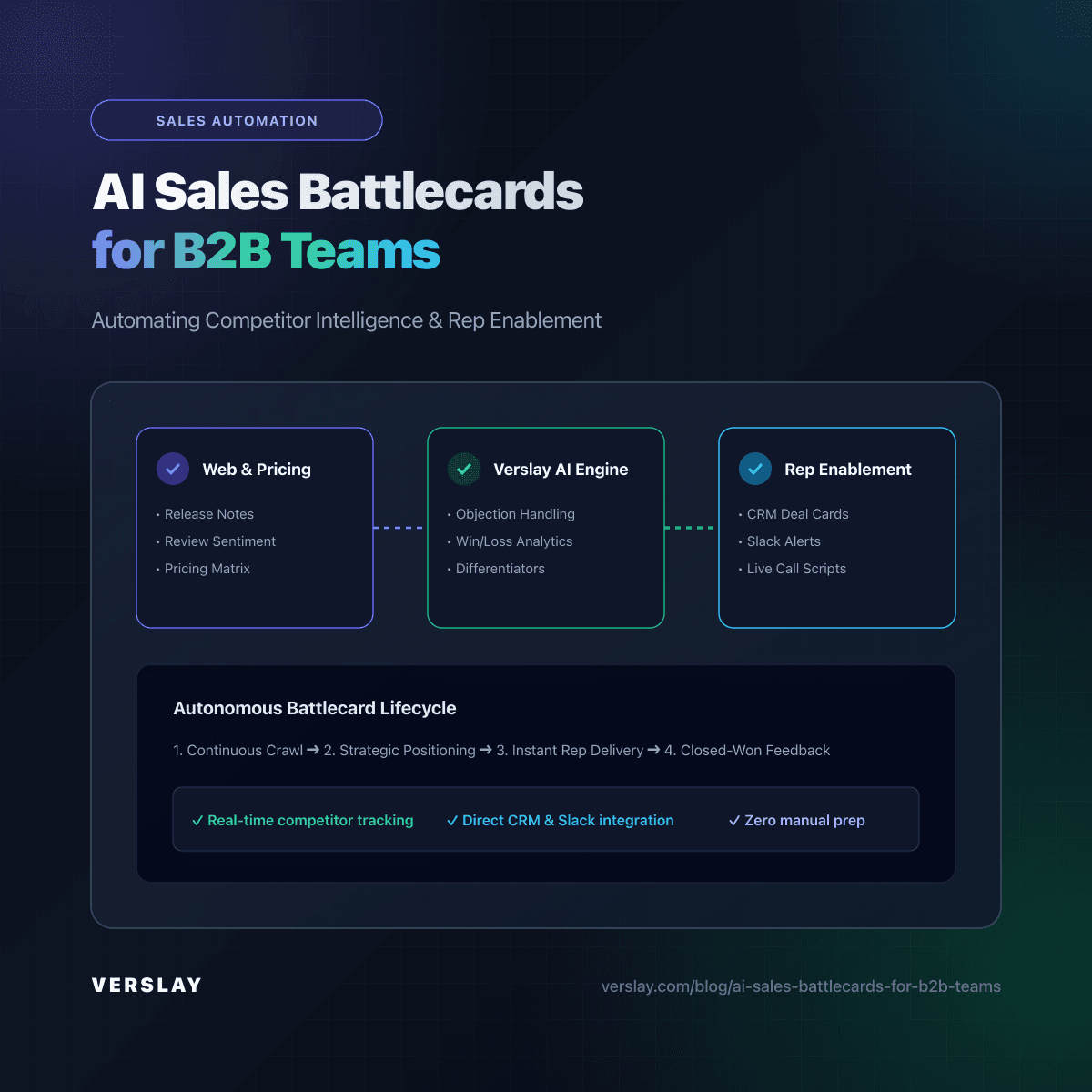
Autonomous AI battlecard agents operate as continuous intelligence engines that capture, analyze, and distribute competitive insights across your sales organization. The agent synthesizes competitive data across three key dimensions:
1. Continuous Web and Market Signal Monitoring
The battlecard agent automatically tracks external digital footprints to detect competitor shifts:
- Website changes, product release notes, and pricing page revisions.
- G2, Capterra, and TrustRadius review sentiment shifts regarding competitor drawbacks.
- Key executive hires, funding announcements, and strategic partnership updates.
2. CRM Win/Loss and Objection Extraction
By connecting to revenue platforms, the agent captures qualitative insights directly from customer touchpoints:
- Call transcript analysis identifying recurring competitor mentions and specific prospect objections.
- Win/loss CRM field data highlighting winning differentiators and losing reasons per competitor.
- Successful counter-positioning scripts used by top-performing account executives.
3. Contextual Delivery in Sales Workflows
Rather than waiting for reps to pull information, the agent proactively surfaces relevant battlecards:
- Instant battlecard pop-ups inside CRM deal records based on competitor fields.
- Real-time Slack or Microsoft Teams alerts when a tracked competitor updates product pricing or messaging.
- Custom battlecard summaries generated for specific buyer personas and deal stages.
Step-by-Step: Deploying AI Sales Battlecards in Your Tech Stack
Integrating AI sales battlecards into your revenue enablement workflow requires establishing data pipelines between competitive intelligence sources, CRMs, and communication hubs.
Here is how an automated battlecard workflow operates end-to-end:
- Competitor Signal Capture: The Verslay battlecard agent monitors specified competitor domains and review sites for structural changes or new feature releases.
- AI Analysis & Synthesis: Upon detecting a meaningful update, the agent analyzes the change, generates updated objection handling guidance, and scores the impact level (Minor, Moderate, Critical).
- Knowledge Base Update: The agent automatically updates central battlecard records, maintaining version control and tracking historical positioning changes over time.
- CRM & Communication Push: Updated battlecards sync to CRM deal records, while high-priority competitive alerts drop directly into designated sales enablement Slack channels.
Explore how tailored workflows across different industries accelerate competitive deal execution and pipeline conversion.
Measurable Impact on Win Rates and Sales Productivity
B2B revenue organizations that adopt autonomous AI sales battlecards achieve significant gains in rep performance and competitive execution:
- 32% Higher Competitive Win Rates: Account executives address technical objections confidently with verified, up-to-date counter-positioning.
- 5+ Hours Saved Per Rep Weekly: Reps eliminate manual prep time spent researching competitor features before discovery calls.
- 100% Enablement Accuracy: Enablement managers ensure reps across global territories deliver unified, accurate competitive messaging.
By automating competitive intelligence, sales teams turn market changes into revenue opportunities.
Frequently Asked Questions
What are sales battlecards in B2B sales?
Sales battlecards are quick-reference enablement guides that equip account executives with competitor strengths, weakness positioning, feature comparisons, and objection handling tactics.
How do AI agents automate competitor battlecard updates?
AI battlecard agents continuously monitor competitor websites, release notes, pricing changes, and customer reviews, instantly updating battlecards inside CRM records and sales channels.
Can AI sales battlecards integrate with CRM platforms like HubSpot and Salesforce?
Yes, AI battlecard agents connect directly to CRMs, surface battlecard insights based on active deal opportunity fields, and deliver real-time guidance via Slack or CRM deal views.