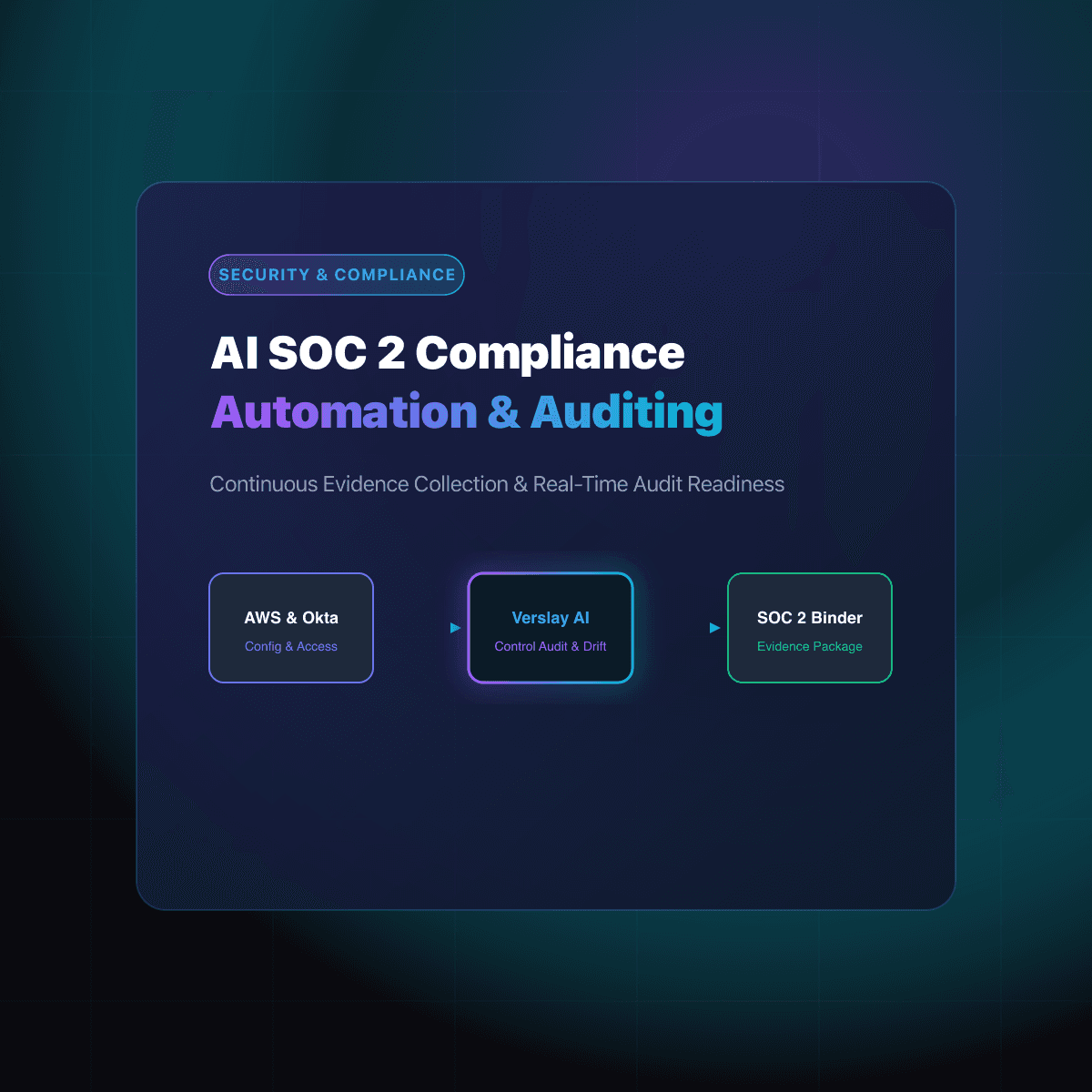
AI SOC 2 compliance automation for security teams utilizes autonomous AI agents to continuously monitor cloud infrastructure, pull immutable access and configuration evidence, verify policy enforcement, and maintain 24/7 audit readiness. By replacing manual screenshot compilation with automated API integrations across cloud providers, identity systems, code repositories, and HR platforms, AI agents eliminate compliance drift, reduce audit preparation time by up to 80%, and ensure continuous adherence to AICPA Trust Services Criteria.
Closest Verslay page: SOP & Knowledge Curator. Recurring processes captured as living SOPs, with stale ones flagged. It is the nearest live match for this topic, not a one-to-one fit.
Achieving and maintaining SOC 2 Type II certification is a critical requirement for modern B2B SaaS and technology companies. However, traditional compliance workflows are notoriously resource-intensive, pulling engineering, DevOps, and security leaders away from core product innovation to capture manual evidence across dozens of disconnected tools.
Why Traditional Manual SOC 2 Audits Create Operational Fatigue and Compliance Gaps
Manual SOC 2 compliance processes rely heavily on periodic assessments, manual spreadsheets, and ad-hoc screenshot gathering. This point-in-time approach introduces major vulnerabilities and inefficiencies:
- Point-in-Time Blind Spots & Configuration Drift: An audit captures a snapshot in time, but cloud environments change continuously. Security groups, S3 bucket permissions, or database encryption settings modified between audits create compliance drift that goes undetected until an auditor flags it.
- Manual User Access Review (UAR) Bottlenecks: Security and IT managers must manually cross-reference HR rosters against active user lists in AWS, GitHub, Google Workspace, and internal admin panels to verify the principle of least privilege.
- Change Management Audit Overhead: Proving that every production deployment had an approved pull request, passed automated CI/CD security scans, and avoided unauthorized developer bypasses requires hours of manual commit log parsing.
- Scattered Personnel Evidence: Tracking background check verifications, signed security policy acknowledgments, and annual security awareness training across disparate HR and LMS systems leads to missing documentation during audit periods.
Explore how AI employee offboarding for HR and IT teams and AI security questionnaire automation for B2B sales reinforce automated security governance across the organization.
How Autonomous AI Agents Automate SOC 2 Type II Compliance
Deploying autonomous AI agents shifts compliance from an exhausting annual fire drill to a continuous, self-healing governance engine that operates in real time:
1. Continuous Multi-Cloud & Infrastructure Evidence Harvesting
AI agents connect directly to infrastructure providers (AWS, Google Cloud, Microsoft Azure) and container orchestration environments:
- Automated Configuration Auditing: Continuously checks S3 bucket public access blocks, RDS database encryption at rest, TLS certificate validity, and KMS key rotation schedules.
- Immutable Timestamped Snapshots: Periodically records signed JSON state snapshots of cloud configurations directly into an encrypted compliance vault, eliminating manual screenshot collection.
- Instant Drift Alerts & Auto-Remediation: Notifies security engineers in Slack or Microsoft Teams when an infrastructure resource deviates from SOC 2 Common Criteria baselines.
2. Automated User Access Reviews & Role-Based Access Control
Eliminate manual access certification spreadsheets with intelligent role matching:
- HRIS-to-Identity Reconciliation: Reconciles active accounts in Okta, Microsoft Entra ID, and Google Workspace against employee records in Workday, Rippling, or BambooHR.
- Privileged Access & MFA Verification: Audits root and administrator accounts across all production environments, ensuring multi-factor authentication (MFA) is strictly enforced with zero exceptions.
- Automated Deprovisioning Verification: Confirms that separated employees have had all credentials and API tokens revoked within SLA windows.
3. Change Management & CI/CD Security Verification
Enforcing SOC 2 CC8.1 change control criteria autonomously across the software development lifecycle:
- Pull Request & Branch Protection Auditing: Scans GitHub and GitLab repositories to ensure every merged commit to main required peer approval, passing CI test suites, and automated dependency vulnerability scans.
- Deployment Traceability: Maps every production release tag back to approved Jira or Linear issue tickets and authorized change request logs.
- Separation of Duties Verification: Verifies that developers who write code cannot single-handedly deploy to production environments without second-person authorization.
4. Continuous Vendor Risk & Subprocessor Oversight
Managing third-party dependencies without administrative overhead:
- Subprocessor SOC 2 Tracking: Automatically tracks the SOC 2 report validity dates of all upstream vendors and third-party SaaS tools.
- Automated Review Alerts: Initiates vendor risk review workflows before vendor certifications expire.
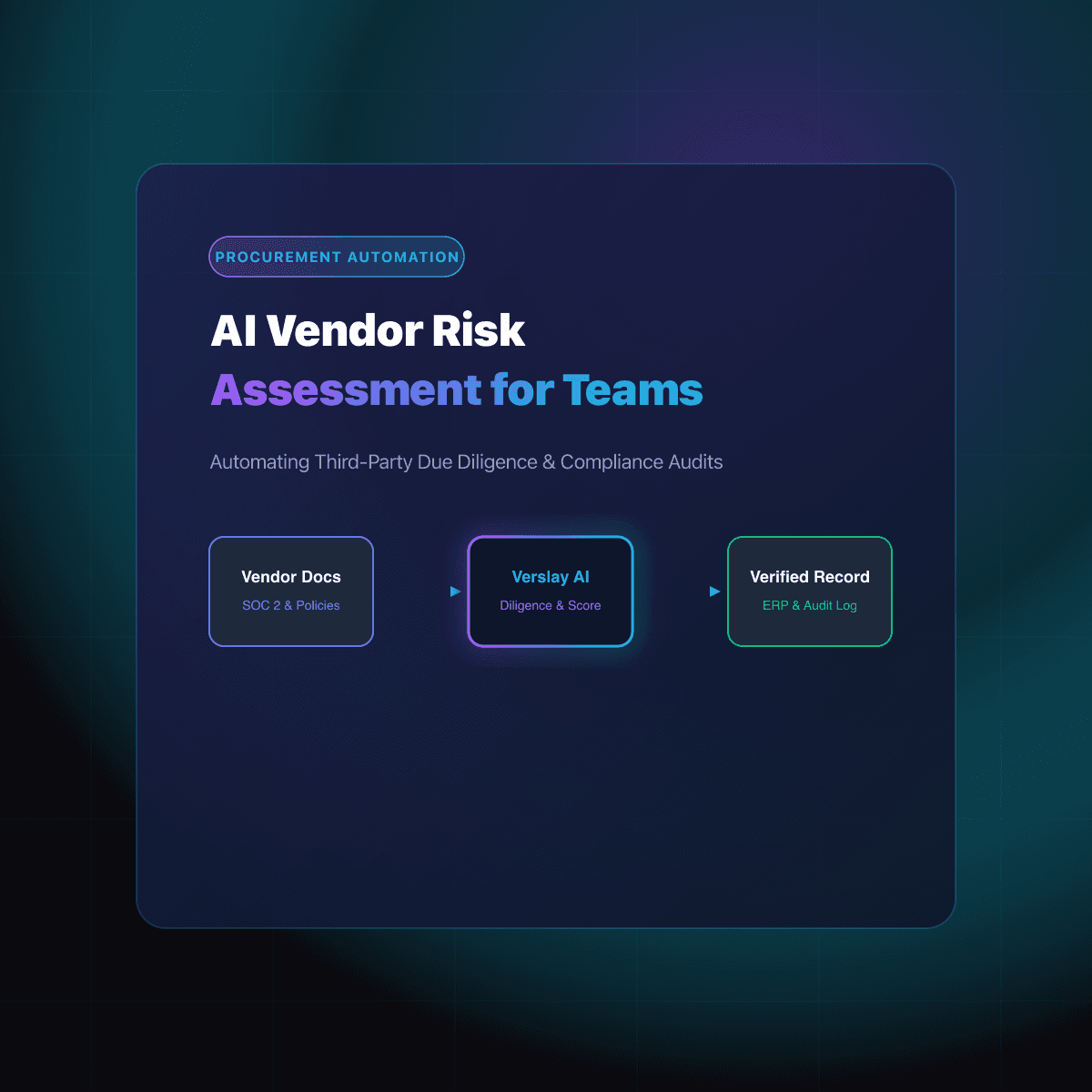
Discover how AI vendor risk assessment for procurement teams automates vendor diligence and subprocessor compliance tracking.
5. Automated Audit Binder Compilation & Auditor Q&A
Empowering compliance teams during active SOC 2 examination windows:
- Structured Trust Services Criteria Mapping: Automatically packages evidence files categorized by AICPA Trust Services Criteria (Security, Availability, Processing Integrity, Confidentiality, and Privacy).
- Auditor Evidence Package Generation: Generates organized, cryptographically verifiable evidence binders ready for external CPA audit firms.
- Compliance Gap Identification: Flags potential control exceptions weeks ahead of the formal audit period, allowing teams to remediate issues proactively.
Learn how deploying specialized AI agents for business operations enables engineering and security leaders to automate complex compliance workflows with zero manual overhead.
Architecture of an AI-Powered SOC 2 Continuous Compliance Engine
The following diagram illustrates how an autonomous SOC 2 compliance agent aggregates telemetry, verifies controls, detects drift, and prepares audit-ready documentation:
[Cloud & SaaS Telemetry] (AWS, GCP, GitHub, Okta, Workday)
                      │
                      ▼
        [AI Compliance Orchestrator]
  (Evaluates Controls vs. AICPA Criteria)
                      │
         ┌────────────┼────────────┐
         ▼            ▼            ▼
 [Infrastructure] [User Access]  [Change Control]
 (KMS, S3, RDS)  (MFA, UAR, RBAC) (PRs, CI/CD, Jira)
         │            │            │
         ▼            ▼            ▼
 [Drift Detection][Role Audit]   [Commit Proof]
 (Instant Alert) (Auto-Revoke)   (Traceability)
         │            │            │
         └────────────┼────────────┘
                      ▼
     [Continuous Evidence Repository]
   (Immutable Timestamped JSON & Logs)
                      │
                      ▼
       [Auditor Evidence Package]
   (SOC 2 Type II Ready Binder & Report)
- Ingest & Monitor: Collect continuous configuration logs and access states via native APIs and secure MCP connectors.
- Evaluate & Verify: Test configurations against SOC 2 Common Criteria controls and identify anomalous drift.
- Package & Prove: Generate immutable audit artifacts, automated access review sign-offs, and auditor-ready compliance binders.
Comparing Manual SOC 2 Audits vs. Autonomous AI Agent Automation
| Capability | Manual SOC 2 Audit Process | Autonomous AI Agent Automation | | :--- | :--- | :--- | | Evidence Collection | Weeks of manual screenshot taking and CSV exporting | Continuous, real-time API harvesting with timestamped proof | | Monitoring Frequency | Annual or bi-annual sampling (point-in-time) | 24/7 continuous control monitoring and instant drift detection | | User Access Reviews | Error-prone spreadsheet reconciliation | Automated HRIS-to-IdP matching with 100% precision | | Change Management Auditing | Manual sampling of pull requests and ticket logs | 100% automated traceability for every production release | | Engineering Time Spent | 200+ hours per audit cycle across engineering leads | Under 20 hours of high-level review and sign-off | | Audit Window Readiness | Last-minute scramble to locate missing logs | Permanent 365-day audit readiness with structured binders |
Measurable Operational ROI for Security and Engineering Teams
Deploying autonomous AI agents for SOC 2 compliance automation produces immediate operational and financial returns:
- Up to 80% Reduction in Audit Preparation Time: Eliminates hundreds of hours spent chasing evidence, taking screenshots, and building manual matrices.
- Zero Undetected Security Configuration Drift: Detects and alerts on unencrypted databases, exposed buckets, or missing MFA within minutes.
- Accelerated B2B Deal Cycles: Rapidly provide verifiable compliance evidence and clean SOC 2 Type II reports to prospective customers.
- Continuous 365-Day Governance: Replace anxiety-inducing annual audit crunches with transparent, continuous compliance confidence.
See it in Verslay
Verslay agents work through the tools you already connect and prepare drafts and staged actions for a person to approve. The SOP & Knowledge Curator page shows the real workflow. You can also browse all use cases or book a 30-minute walkthrough.
Frequently Asked Questions
What is SOC 2 compliance automation for security teams?
AI SOC 2 compliance automation uses autonomous AI agents to continuously collect system evidence, monitor access controls, audit infrastructure configurations, and generate audit-ready documentation across cloud providers, SaaS tools, and identity platforms.
How do AI agents automate continuous evidence collection?
AI agents connect to AWS, GitHub, Okta, Jira, and MDM systems via APIs to capture timestamped configuration snapshots, pull commit verification logs, track employee security training, and verify access deprovisioning without manual screenshot gathering.
Can AI agents assist during annual SOC 2 Type II audit windows?
Yes, AI agents compile structured auditor-ready evidence binders, cross-reference controls against Trust Services Criteria (Security, Availability, Confidentiality), identify compliance gaps ahead of time, and draft responses for auditor inquiries.