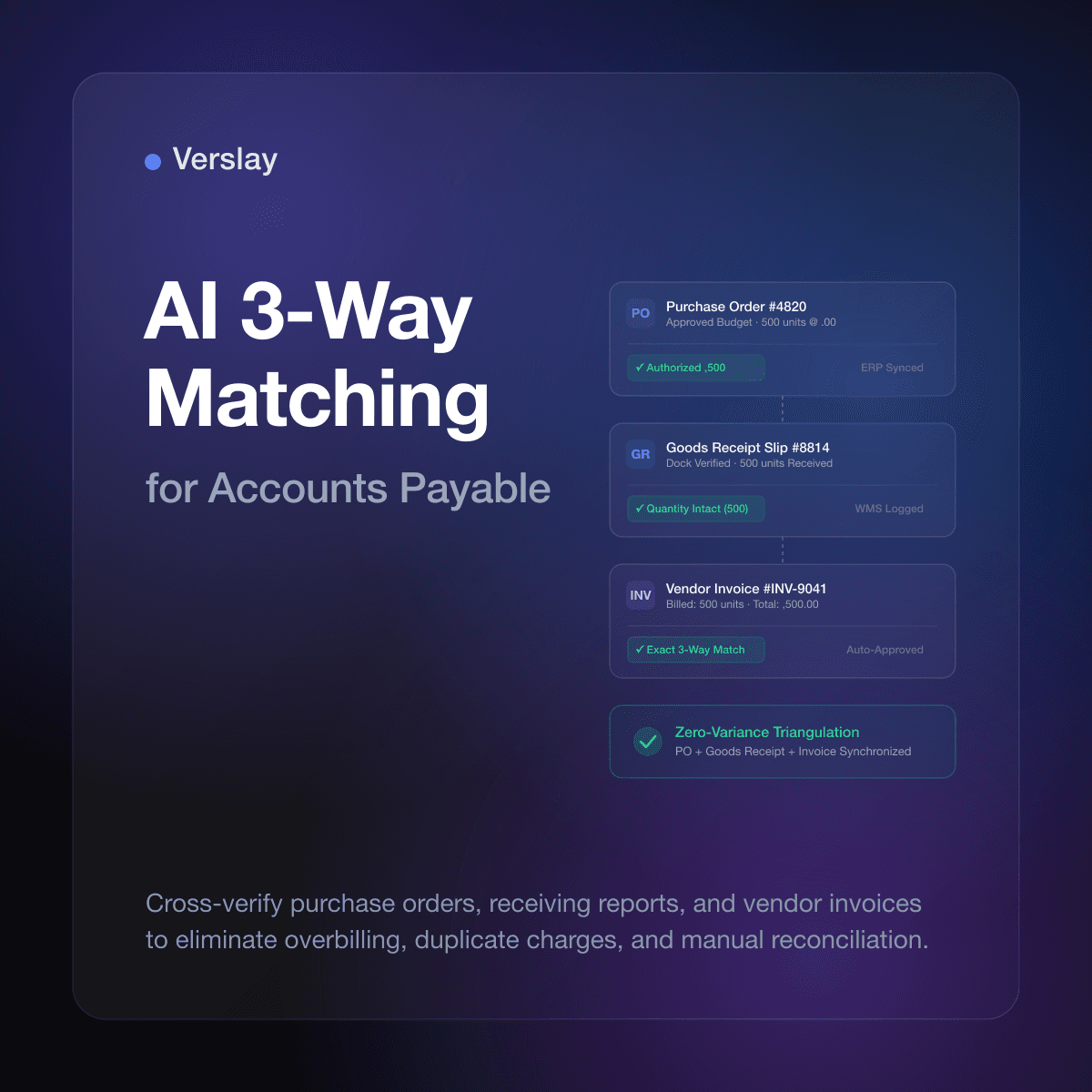
AI 3-way matching for accounts payable automates the systematic verification of vendor invoices against approved purchase orders (POs) and goods receipt notes (receiving slips) using autonomous AI agents. By extracting unstructured line-item data and cross-referencing records across ERP, procurement, and warehouse management systems, AI agents eliminate manual data entry, prevent duplicate or fraudulent disbursements, and accelerate invoice approval cycles from weeks to minutes.
Closest Verslay page: Reconciliation Checker. Payment-invoice reconciliation. It is the nearest live match for this topic, not a one-to-one fit.
For modern finance and accounts payable (AP) departments, processing thousands of supplier invoices each month remains one of the most resource-intensive operational overheads. When matching must be performed manually across disparate systems, AP teams face backlogs, delayed payments, missed early-payment discounts, and costly payment errors.
The Operational Bottleneck of Manual 3-Way Matching
In traditional accounting workflows, 3-way matching serves as the primary internal audit control to verify that a business only pays for goods and services that were formally authorized and physically received. However, executing this control manually creates severe friction:
- Unstructured Document Formats: Invoices arrive via email as PDFs, scanned images, paper receipts, or EDI feeds, each with distinct layout conventions, header fields, and line-item descriptions.
- Line-Item and SKU Inconsistencies: Vendor part numbers often differ from internal inventory SKUs, requiring human specialists to manually interpret abbreviations, package units, and item descriptions.
- Partial Shipments and Split Deliveries: When an order is fulfilled across multiple shipments over time, matching a single composite invoice against multiple receiving slips becomes computationally complex and error-prone.
- Exception Overload: Small rounding differences, unexpected freight surcharges, or minor tax rate variations force AP clerks to manually investigate routine discrepancies rather than focusing on strategic cash management.
To see how automated workflows solve adjacent finance challenges, explore AI invoice reconciliation for finance teams and AI purchase order automation for procurement teams.
How Autonomous AI Agents Automate the 3-Way Match Lifecycle
Autonomous AI agents transform the accounts payable workflow by orchestrating the entire triangulation process from document ingestion to general ledger posting:
1. Ingestion and Deep Line-Item Extraction
The agent monitors designated AP inboxes, vendor portals, and ERP queues:
- Computer Vision & OCR: Ingests multi-page PDFs, scans, and electronic invoices, extracting structured metadata including invoice numbers, tax IDs, payment terms, currency, line-item quantities, and unit rates.
- Semantic Entity Mapping: Normalizes vendor names, billing addresses, and line-item descriptions to match master vendor records and internal product catalogs.
2. Multi-Document Triangulation Engine
The agent connects directly to ERP and inventory systems (such as SAP, Oracle NetSuite, Microsoft Dynamics 365, or QuickBooks):
- Purchase Order Verification: Pulls the corresponding approved PO to confirm that the items, rates, and terms were authorized by procurement.
- Goods Receipt Note (GRN) Correlation: Validates against warehouse receiving logs, bill of lading documentation, or service delivery sign-offs to confirm proof of receipt and accepted quantities.
- Three-Way Arithmetic Reconciliation: Compares
Quantity Billed × Unit PriceagainstQuantity Received × PO Pricedown to individual line items.
3. Tolerance Validation and Fraud Detection
Configurable business rules govern automated validation:
- Price and Quantity Variance Checks: Automatically validates invoices within acceptable variance thresholds (e.g., ±1% or under for rounding and minor freight adjustments).
- Duplicate & Fraud Prevention: Checks invoice numbers, PO references, vendor bank account details, and historical payment logs to prevent duplicate billing or unauthorized banking change attacks.
4. Autonomous Posting and Exception Routing
- Touchless Straight-Through Processing: Invoices with zero variance or within acceptable tolerances are automatically approved, scheduled for payment, and posted to the general ledger.
- Targeted Exception Handling: Discrepancies (such as unreceived items or price markups) are isolated into dedicated workflows, with the agent automatically drafting clarification emails to vendors or routing approval requests to procurement managers with full contextual evidence attached.
Learn more about how deploying AI agents for business operations empowers finance organizations to achieve end-to-end process automation.
Architecture of an Automated 3-Way Match Pipeline
The diagram below shows how an autonomous AP agent ingests vendor documentation, coordinates verification across backend systems, and executes automated payment posting:
[Inbound Vendor Invoice] (PDF, Email, EDI, Portal)
                     │
                     ▼
       [AI Document OCR & Extraction]
   (Line Items, SKUs, Unit Rates, Tax)
                     │
                     ▼
       [3-Way Triangulation Engine]
   ┌─────────────────┴─────────────────┐
   ▼                                   ▼
[ERP Purchase Order]          [WMS Goods Receipt]
(Authorized Quantity & Price)  (Verified Delivered Quantity)
   └─────────────────┬─────────────────┘
                     │
                     ▼
         [Tolerance & Policy Gate]
          /                         [Match Clean]          [Variance Detected]
          │                         │
          ▼                         ▼
[Auto-Post to ERP Ledger]   [Autonomous Clarification]
[Schedule Payment Batch]    (Email Vendor / Escalate to Buyer)
- Trigger on Inbound Invoice: Autonomous listeners process incoming documents in real time.
- Retrieve Authoritative Records: Query ERP and warehouse databases for corresponding POs and receiving slips.
- Execute Line-by-Line Match: Perform deterministic arithmetic checks alongside semantic entity reconciliation.
- Post or Remediate: Commit clean records directly to the financial system while managing exceptions proactively.
Document Triangulation Matrix: Key Verification Points
An effective 3-way matching system enforces precise field-level checks across all three core accounting artifacts:
| Document Source | Key Verification Fields | Common Failure Modes Handled by AI Agents | | :--- | :--- | :--- | | Purchase Order (PO) | PO Number, Vendor ID, Approved Unit Price, Line-Item SKUs, Payment Terms | Price increases not pre-authorized by procurement; expired order commitments | | Receiving Slip / GRN | Packing Slip Number, Received Quantity, Delivery Date, Condition Report | Short shipments, damaged freight, goods pending inspection at loading dock | | Vendor Invoice | Invoice Number, Tax Breakdown, Freight Surcharges, Total Amount Due | Duplicate invoice numbers, incorrect sales tax calculations, unagreed handling fees |
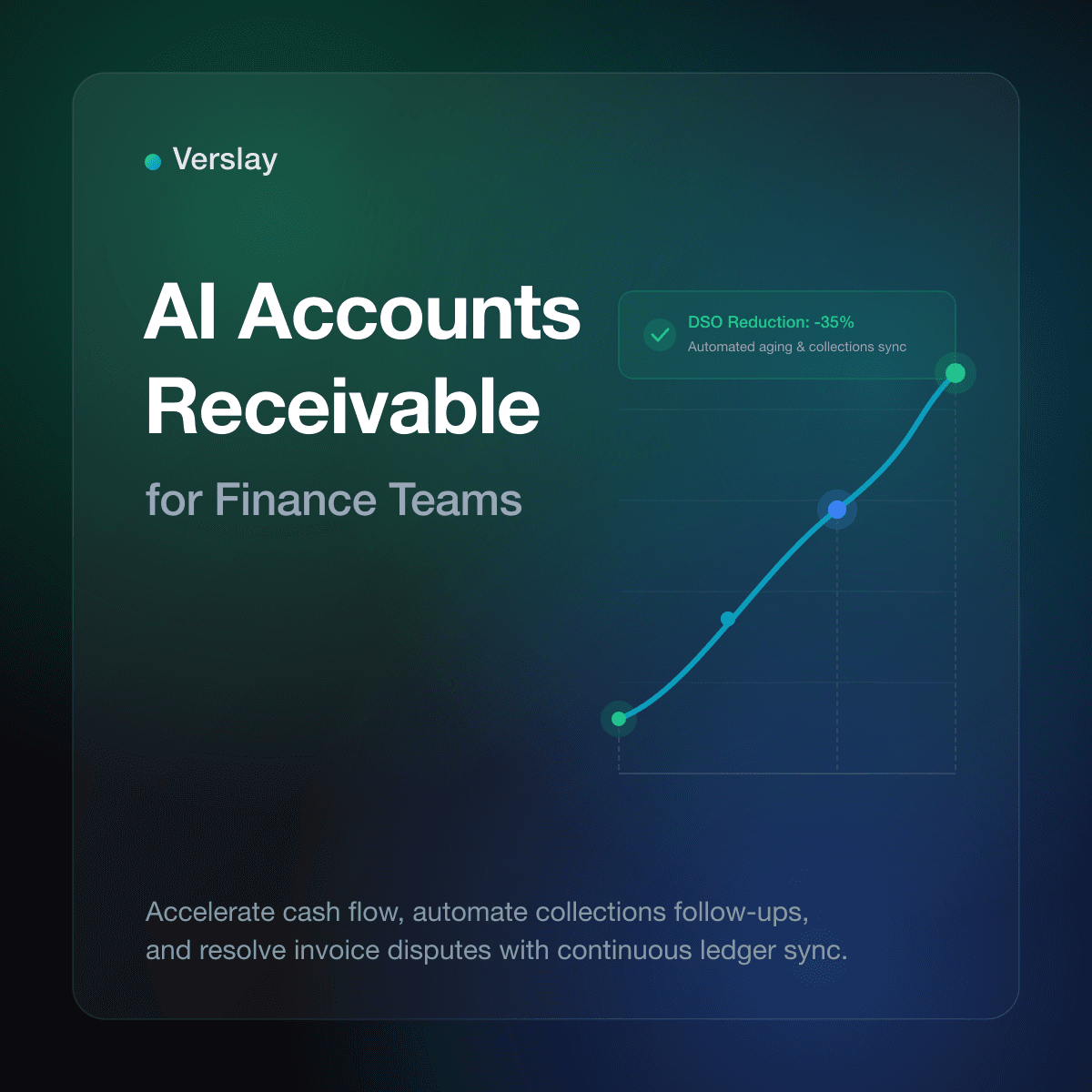
For receivables management on the customer side, discover how AI accounts receivable automation for finance teams streamlines collections and dispute resolution.
Handling Complex AP Edge Cases Autonomously
High-volume accounts payable operations frequently encounter complex invoicing scenarios that traditional rules-based OCR software fails to resolve:
- Partial Shipments and Staggered Invoicing: When a vendor delivers 300 units out of a 1,000-unit purchase order, the AI agent dynamically creates a partial match record, approves payment for the 300 delivered units, and keeps the PO active for subsequent shipments.
- Unit of Measure (UOM) Conversions: Automatically converts differing vendor and internal measurement standards—such as cases versus individual units, or metric versus imperial weights—without generating false positive exceptions.
- Freight, Duty, and Ancillary Surcharges: Parses incidental shipping fees and assesses whether they comply with contracted Incoterms or need allocation across individual inventory line items.
- Vendor Bank Account Integrity: Scrutinizes invoice remittance details against authorized vendor master files, immediately flagging sudden routing number shifts to protect against business email compromise (BEC).
Quantifiable Benefits of AI-Driven Accounts Payable Automation
Deploying autonomous 3-way matching delivers measurable operational and financial advantages:
- Over 85% Touchless Invoicing: Eliminates manual intervention for the vast majority of standard commercial invoices.
- 90% Faster Cycle Times: Reduces invoice processing turnaround from an average of 12 days to under 4 hours, ensuring supplier satisfaction and reliable supply chain operations.
- Capture of Early-Payment Discounts: Enables organizations to routinely take advantage of 1/10 Net 30 or 2/10 Net 30 terms, turning accounts payable into a source of working capital optimization.
- Comprehensive Audit Readiness: Automatically associates the invoice, purchase order, receiving confirmation, and approval trail into an immutable digital record for GAAP, SOX, and external auditor verification.
See it in Verslay
Verslay agents work through the tools you already connect and prepare drafts and staged actions for a person to approve. The Reconciliation Checker page shows the real workflow. You can also browse all use cases or book a 30-minute walkthrough.
Frequently Asked Questions
What is 3-way matching in accounts payable?
Three-way matching in accounts payable is an internal control mechanism that cross-verifies vendor invoices against corresponding purchase orders (POs) and receiving reports (proof of delivery) before payment release to ensure companies only pay for verified goods and agreed pricing.
How do AI agents automate 3-way matching across ERPs?
Autonomous AI agents extract line items, SKU codes, quantities, and unit prices from vendor invoices via OCR and semantic parsing, cross-reference them against ERP purchase orders and warehouse receiving logs, and automatically approve matched invoices while isolating exceptions.
How does automated 3-way matching handle price and quantity discrepancies?
When a discrepancy exceeds configured tolerance thresholds (such as unit price increases or short shipments), the AI agent isolates the variance, automatically notifies the procurement lead or vendor for clarification, and holds payment on disputed items without delaying clean lines.