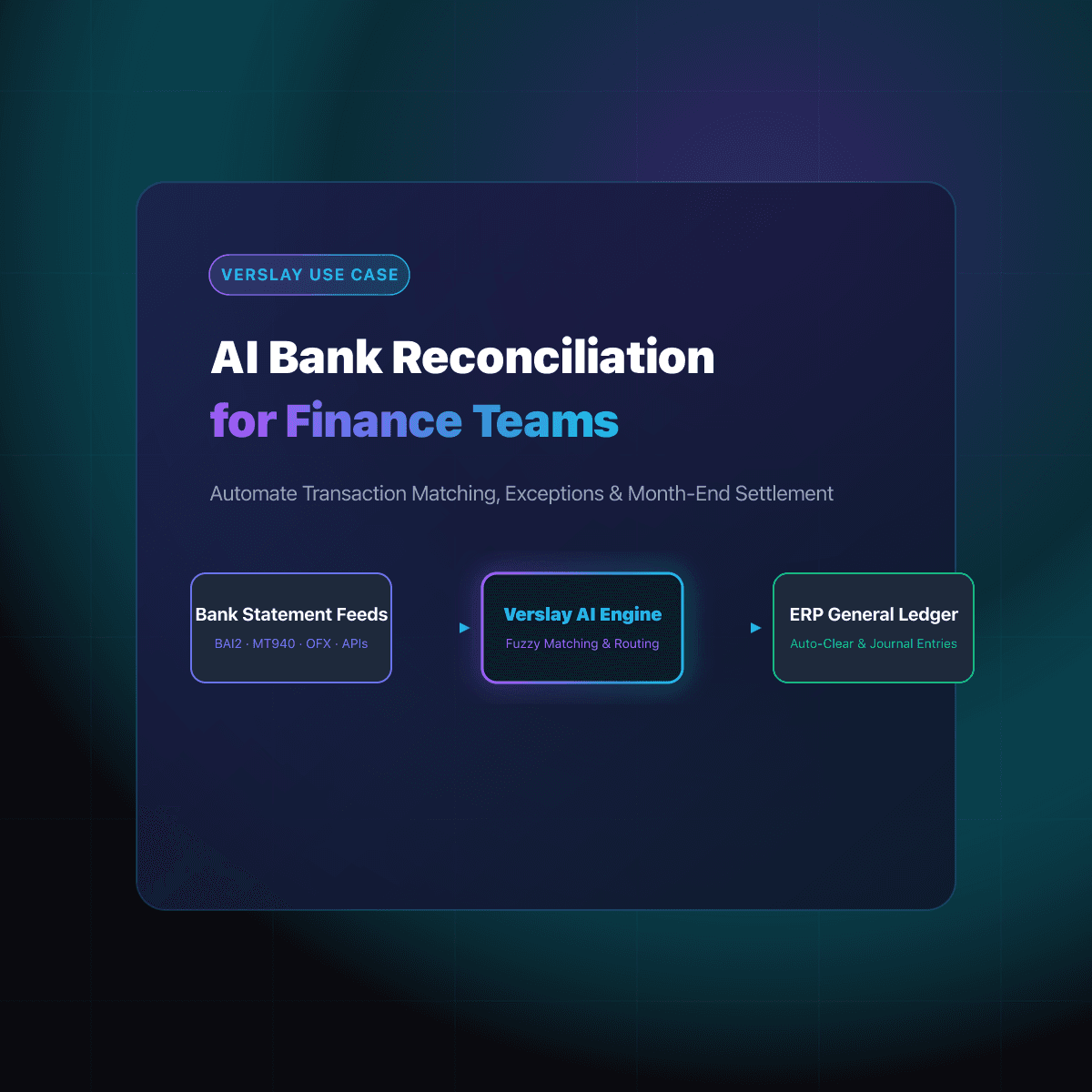
AI bank reconciliation automates transaction matching, ledger exception handling, and cash balance verification by deploying autonomous AI agents across banking feeds and enterprise accounting systems. By continuously ingesting electronic statement records and reconciling them against general ledger transactions using semantic reasoning and fuzzy matching, AI agents eliminate manual spreadsheet cross-referencing, surface timing differences instantly, and compress the month-end financial close from days to hours.
For corporate accounting and treasury departments managing multiple operating accounts, merchant gateways, and foreign currency subsidiaries, manual bank reconciliation is a persistent operational bottleneck. When accountants must manually trace batches of credits, ACH transfers, wire fees, and split disbursements, reconciliation becomes a reactive month-end crunch characterized by unallocated balances, delayed financial reporting, and increased audit risk.
The Operational Friction in Manual Bank Reconciliation
Bank reconciliation serves as the foundational internal control proving the completeness and accuracy of a company's reported cash position. In high-volume business environments, maintaining daily or weekly reconciliation manually presents major structural challenges:
- Volume and Source Disparities: Treasury teams operate dozens of bank accounts across geographic entities, receiving statement data in fragmented standards—including MT940, BAI2, OFX files, CSV downloads, and direct Open Banking APIs.
- Many-to-One and One-to-Many Batching: Payment processors (such as Stripe, Adyen, and PayPal) deposit net settlements that combine hundreds of individual customer invoices minus variable transaction fees and chargebacks, obscuring direct one-to-one ledger correspondence.
- Timing and Transit Asymmetries: Checks in transit, outstanding electronic fund transfers, weekend settlement windows, and varying international clearing cadences create floating differences that require labor-intensive manual tracking.
- Omitted Bank Activity: Unrecorded transactions—such as automatic loan interest payments, merchant processing fees, currency exchange adjustments, and wire charges—remain invisible until bank statements are manually reviewed and retroactively adjusted via manual journal entries.
- Error Propagation: Small discrepancies that remain unresolved at month-end compound across reporting periods, forcing controllers to spend valuable days investigating historical variances rather than delivering strategic insights.
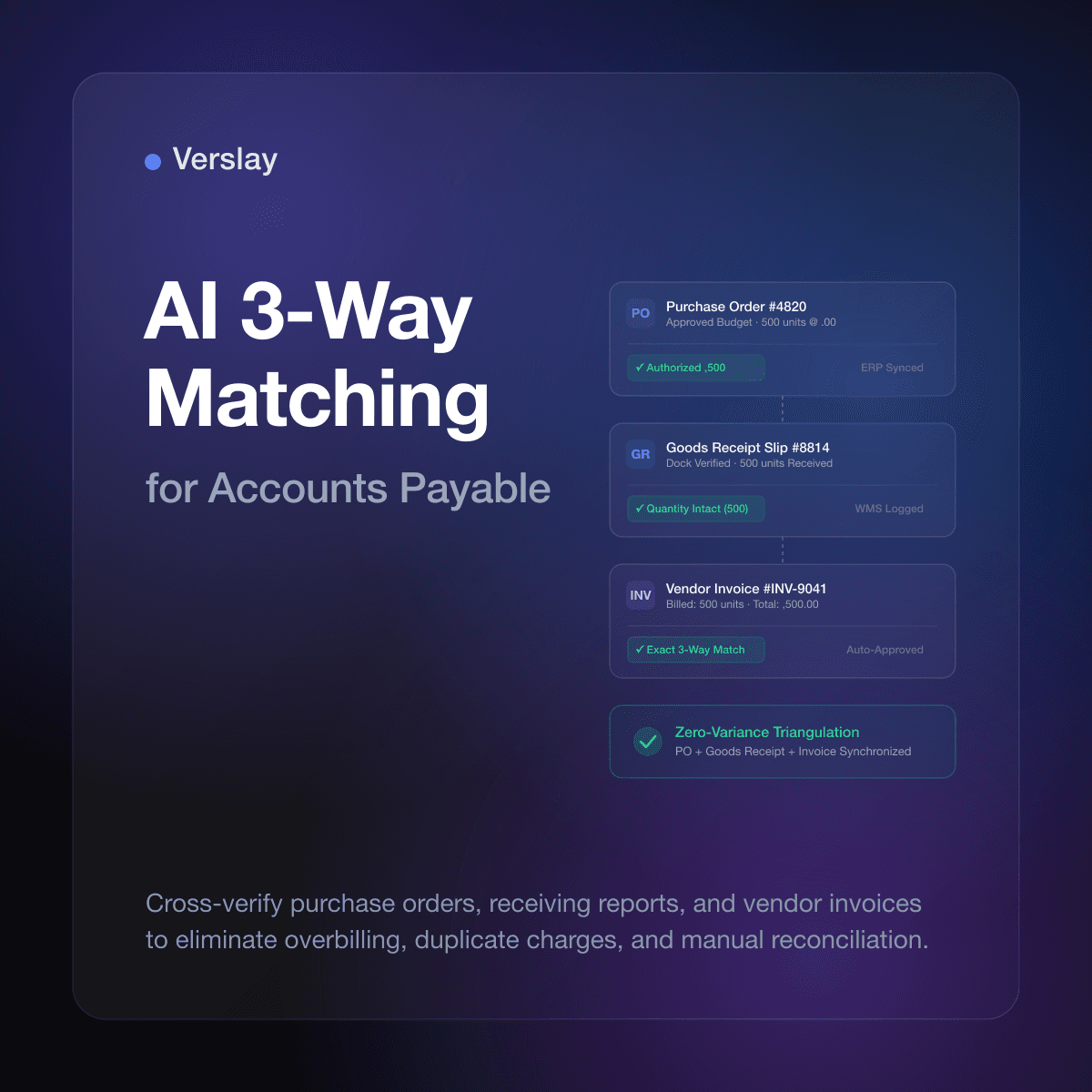
To understand how intelligent automation addresses related accounting processes, read about AI invoice reconciliation for finance teams and AI 3-way matching for accounts payable.
How Autonomous AI Agents Automate Bank Reconciliation
Autonomous AI agents transform bank reconciliation from a retrospective month-end scramble into a continuous, real-time verification process. Operating around the clock, AI agents coordinate across treasury platforms and enterprise ERPs:
1. Unified Feed Ingestion and Normalization
The AI agent connects to bank accounts, treasury management portals, and payment gateways via secure protocols:
- Universal Statement Parsing: Normalizes BAI2, MT940, OFX, and electronic banking feeds into standardized, structured transaction schemas.
- Multi-Entity Context Mapping: Automatically maps incoming account transactions to corresponding legal entity ledgers, subsidiary structures, and operational bank accounts.
2. Intelligent Multi-Tier Matching Engine
Unlike rigid rules-based tools that break on minor string variances, AI agents deploy multi-tiered matching strategies:
- Exact Deterministic Matching: Instantly settles transactions with matching reference identifiers, dates, and amounts (e.g., cleared check numbers or matched wire references).
- Semantic and Fuzzy Matching: Reconciles counterparties whose names appear in varying formats (e.g., "Google Cloud" on the bank statement versus "Alphabet Inc." in the vendor ledger) using contextual language models and historical clearance patterns.
- Batch Disaggregation: Deconstructs consolidated payment processor batch deposits into individual receivables, factoring in merchant commission rates, reserve holds, and processing deductions automatically.
3. Automated Adjustment Drafting and Journal Entry Creation
For legitimate bank-side charges that lack prior ledger entries:
- Recurring Fee Recognition: Categorizes recurring bank fees, monthly service charges, interest income, and merchant discount rates.
- Draft Journal Entries: Pre-populates balanced general ledger entries with appropriate GL account codes, cost centers, and department tags according to corporate accounting policies.
- Pre-Approval Routing: Submits proposed adjustment entries to accounting supervisors with supporting calculation rationale and statement lines attached.
4. Anomaly Detection and Exception Isolation
- Suspicious Transaction Identification: Flags unusual transaction patterns, unexpected withdrawal amounts, uncharacteristic counterparty accounts, or duplicate charges in real time.
- Root-Cause Annotation: When a variance cannot be reconciled within configured tolerance rules, the agent compiles a diagnostic brief detailing the discrepancy, potential causes, and suggested remediation steps for human accountants.
Explore how deploying AI agents for business operations allows finance organizations to achieve end-to-end automation across critical workflows.
Architecture of an AI-Driven Bank Reconciliation Engine
The architecture below illustrates how an autonomous agent reconciles banking feeds with general ledger accounts:
[Bank Feeds & Payment Processors]        [ERP General Ledger]
(BAI2, MT940, OFX, Stripe, Adyen)      (NetSuite, SAP, QuickBooks)
                │                                    │
                ▼                                    ▼
      [Statement Normalizer]               [Ledger Activity Stream]
                │                                    │
                └─────────────────┬──────────────────┘
                                  │
                                  ▼
                    [AI Transaction Match Engine]
                    ┌─────────────┴─────────────┐
                    ▼                           ▼
          [Exact & Deterministic]     [Semantic & Fuzzy Matching]
          (Ref#, Amount, Date)        (Vendor Alias, Batch Netting)
                                  │
                                  ▼
                      [Variance Analysis Gate]
                      /                      \
            [Clean Match]                  [Exception Detected]
                  │                                  │
                  ▼                                  ▼
      [Mark Cleared in Ledger]             [Classify Variance]
      [Update Cash Balance]               ┌──────────┴──────────┐
                                          ▼                     ▼
                                 [Routine Fee / FX]    [Unidentified Item]
                                 (Auto-Draft Entry)    (Escalate with Dossier)
- Continuous Data Streaming: Transactions stream directly into the reconciliation pipeline as soon as bank statements or clearing webhooks fire.
- Deterministic & Contextual Passes: Clean transactions clear automatically without human touch, while complex multi-line transactions undergo semantic analysis.
- Automated Balance Settlement: Cleared records update real-time cash availability metrics in connected dashboards.
- Targeted Escalation: Only true exceptions requiring human judgment reach the controller's inbox, complete with pre-gathered transaction context.
Reconciliation Matching Matrix: Transaction Types & Resolution Logic
Enterprise bank accounts process a wide variety of credit and debit types, each demanding specialized reconciliation logic:
| Transaction Category | Bank Statement Representation | General Ledger Representation | AI Agent Resolution Logic | | :--- | :--- | :--- | :--- | | Vendor Wire Payments | Consolidated wire debit with transaction fee | Individual AP disbursement and separate bank fee line | Links wire reference ID, matches principal amount to vendor payment, and isolates wire surcharge for automated fee expense entry. | | Merchant Processor Payouts | Net daily deposit from Stripe or Adyen | Multiple customer invoices / AR collections | Retrieves payout balance details via processor API, reconciles gross sales against invoices, and posts merchant fees to designated expense GL. | | Customer ACH Credits | Inbound deposit with truncated company identifier | Open Accounts Receivable invoice | Uses semantic entity resolution to match truncated bank narrative to customer master file, closing open AR entries. | | Direct Debit Utilities / Taxes | Recurring debit without PO or invoice reference | Pre-paid expense or unbilled accrued liability | Correlates recurring cadence and counterparty account number, drafts matching amortization or expense entry for approval. | | Foreign Currency (FX) Settlements | Local currency deposit vs. foreign currency invoice | Foreign currency invoice booked at transaction date spot rate | Calculates realized gain/loss on foreign exchange variance and generates corresponding adjusting ledger entry. |
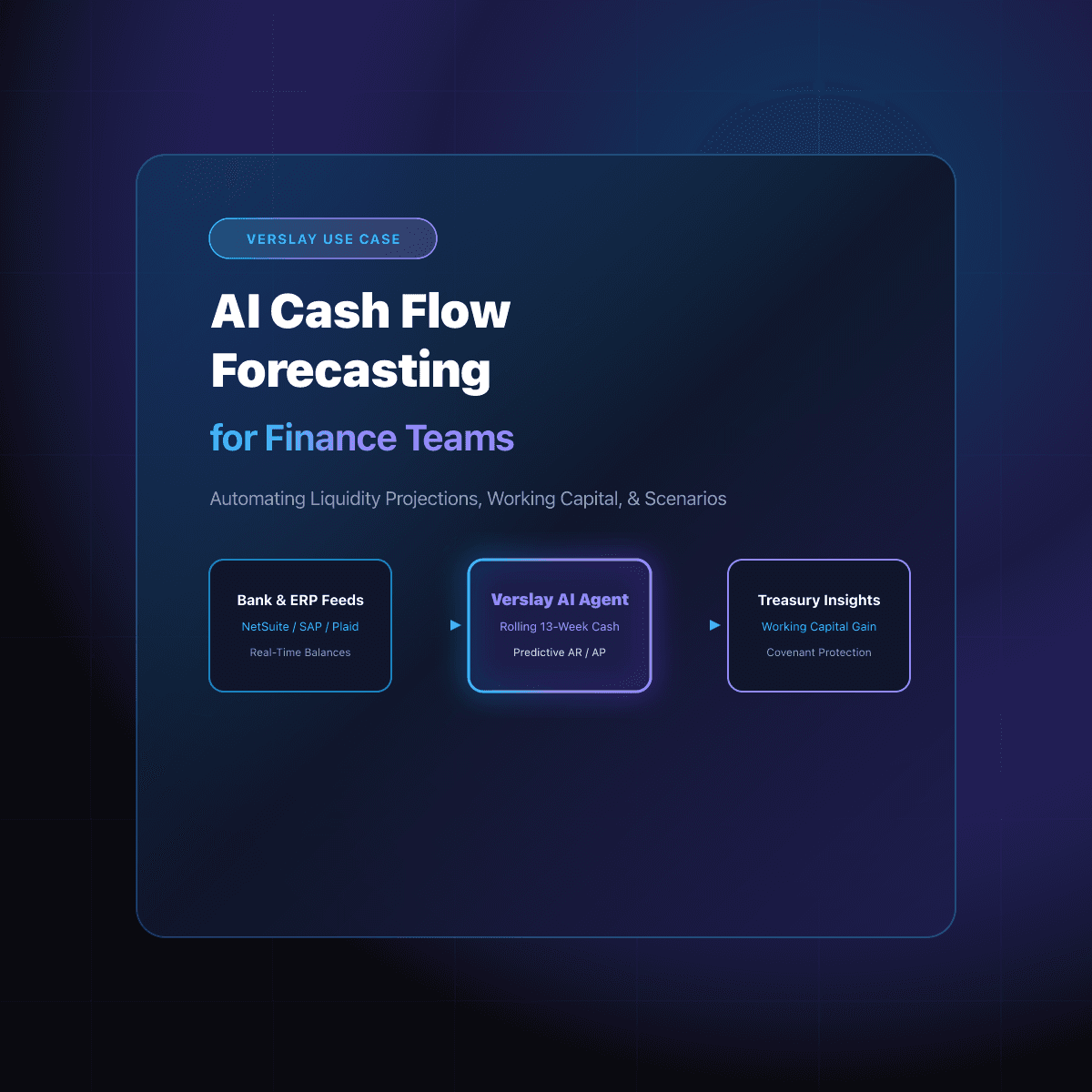
To see how real-time cash tracking enhances financial foresight, explore AI cash flow forecasting for finance teams.
Resolving High-Complexity Banking Edge Cases Autonomously
Standard rules-based accounting software frequently stumbles on edge cases, creating exception queues that demand hours of manual research. AI agents resolve these scenarios through contextual understanding:
- Split Payments and Multi-Invoice Settlements: When a single enterprise customer wires a lump sum covering three open invoices and deducting an unapproved trade allowance, the AI agent evaluates customer payment history, calculates combinations of open receivables, and identifies the exact allocation structure.
- Timing Windows and Weekend Settlements: When cash leaves an operational account on Friday afternoon and lands in a treasury concentration account on Monday morning, the agent tracks intercompany transfers in-transit, preventing erroneous cash deficit flags.
- Merchant Processing Discrepancies: In cases where payment processors withhold rolling reserves or process mid-cycle chargebacks, the agent pulls granular transaction logs directly from payment gateways, reconciling net bank deposits down to the penny.
- Multi-Currency Hedging and FX Variances: For international transactions involving volatile exchange rates between invoice issue dates and settlement dates, the agent automatically applies standard accounting rules (such as ASC 830 or IAS 21) to calculate and book realized foreign exchange gains or losses.
Business and Compliance Impact for Finance Organizations
Implementing autonomous AI bank reconciliation provides tangible operational, strategic, and governance benefits:
- Up to 90% Reduction in Manual Reconciliation Time: Eliminates manual line-by-line checking across banking portals and ERP screens, freeing staff accountants for analytical and advisory work.
- Accelerated Month-End Close: Shifts reconciliation from a compressed 3-day post-period sprint to an ongoing daily discipline, enabling financial statements to close faster and with higher confidence.
- Real-Time Cash Visibility: Guarantees that executive cash balances reflect true cleared funds rather than estimated book balances, improving treasury deployment and liquidity management.
- Immutable Audit Trail: Every match, deduction, and proposed journal entry is recorded with timestamped rationale and source document links, satisfying SOX 404 and GAAP internal control standards.
Frequently Asked Questions
Can bank reconciliation be automated with AI?
Yes, AI agents automate bank reconciliation by ingesting live bank feeds and ERP ledgers, matching transactions via fuzzy logic and semantic rules, and isolating exceptions for review.
How does AI handle unmatched transactions or bank fees?
AI agents identify recurring patterns like merchant processing fees, currency conversions, and timing delays, suggesting or applying automated journal entries while flagging true anomalies.
How does automated bank reconciliation accelerate the month-end close?
Continuous, daily automated transaction matching eliminates the traditional month-end reconciliation backlog, reducing closing cycles from weeks to hours with full audit trails.