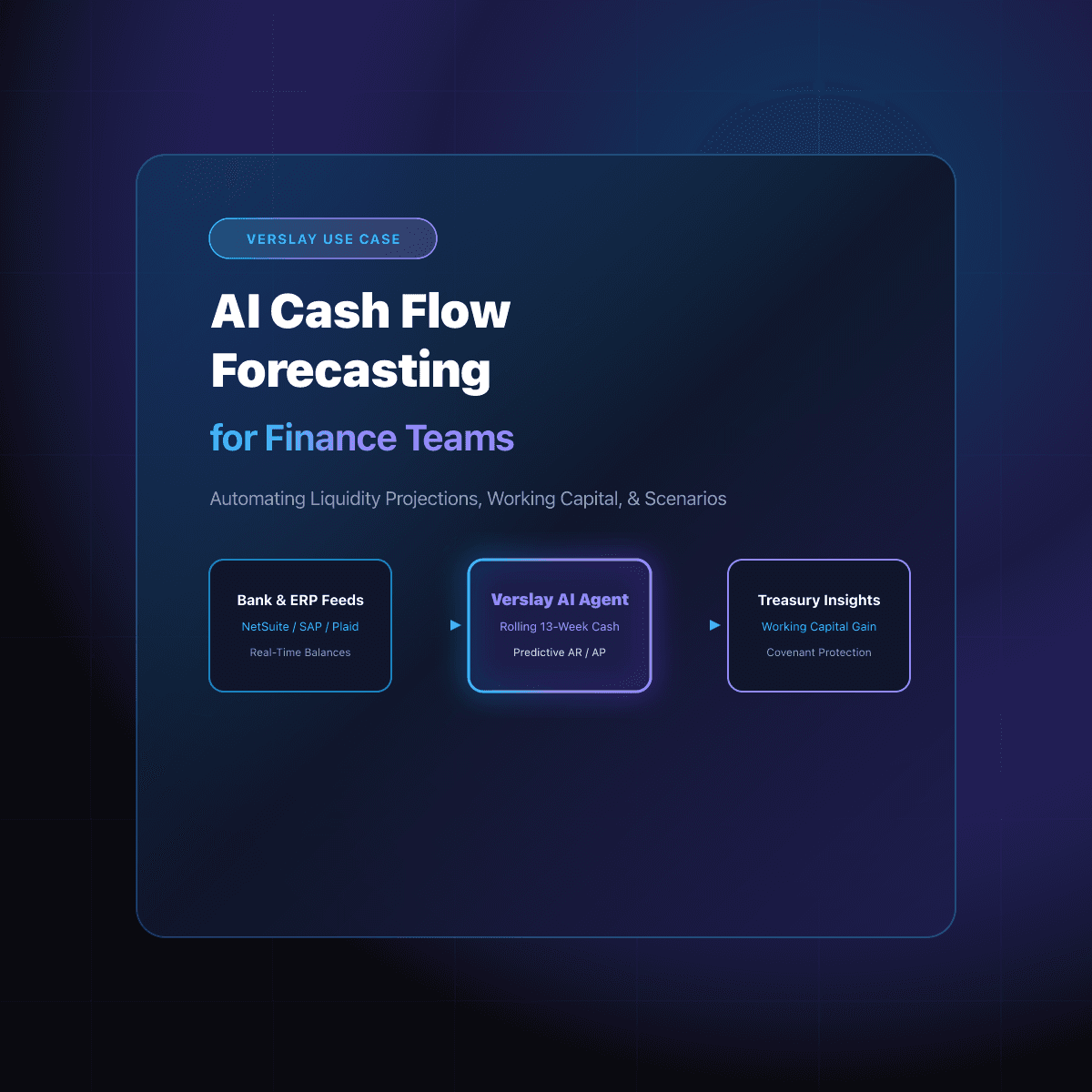
AI cash flow forecasting automates liquidity projections, receivables tracking, and scenario modeling for finance teams using autonomous AI agents. By connecting multi-bank transaction feeds, ERP ledgers, accounts payable queues, and CRM sales pipelines through continuous data pipelines, AI agents replace brittle manual spreadsheets with real-time rolling 13-week cash forecasts. This automated treasury intelligence reduces forecast variance by over 60% while giving CFOs and finance leaders proactive control over working capital, debt covenants, and liquidity buffers.
Closest Verslay page: Weekly Cash Brief. What came in, what went out, refunds, fees, and MRR movement every week. It is the nearest live match for this topic, not a one-to-one fit.
In an economic climate defined by volatile interest rates, shifting credit cycles, and compressed operating margins, cash visibility is no longer a backward-looking month-end luxury—it is an existential operational requirement. Yet, corporate finance, FP&A, and treasury teams in mid-market and larger organizations remain trapped in manual forecasting loops: exporting static CSVs from disparate banking portals, stitching together macro-laden spreadsheets, and estimating debtor payment timings with rough percentage assumptions.
By deploying autonomous AI Agents integrated via Model Context Protocol (MCP) and financial system webhooks, finance organizations replace static quarterly guesswork with dynamic, self-calibrating liquidity models that adapt in real time as invoices are cleared, purchase orders are cut, and market conditions fluctuate.
The Liquidity Blindspot: Why Manual Spreadsheet Cash Forecasting Fails
Corporate treasurers and FP&A leaders spend hundreds of hours each quarter assembling short-term and medium-term cash forecasts. Despite this manual effort, executive forecasts are notoriously fragile, suffering from persistent structural vulnerabilities:
- Fragmented Multi-Entity Bank Feeds: Businesses operating across multiple subsidiaries, regions, and currency accounts face severe visibility lags. Logging into multiple proprietary banking portals to download PDF statements or balance sheets produces fragmented snapshots that are already out of date by the time they are consolidated.
- Flawed Customer Payment Timing Assumptions: Traditional forecasts rely on contractual payment terms (e.g., Net 30 or Net 60) or static Days Sales Outstanding (DSO) averages. In reality, debtor behavior fluctuates widely: large buyers regularly pay on specific bi-weekly cycles, hold payments for missing purchase order numbers, or delay payment during disputed line items. Static models fail to capture these micro-behavioral nuances.
- Disconnected Payables and Capital Expenditure Surprises: Accounts payable (AP) obligations, recurring SaaS subscriptions, quarterly tax obligations, and equipment leases live in separate departmental silos. When unexpected vendor debits occur without pre-reconciliation, buffer cash gets depleted, forcing emergency short-term credit utilization.
- Latency in Variance Analysis: By the time finance controllers reconcile last month's actual cash balance against the projected forecast, weeks have elapsed. Identifying whether a liquidity shortfall stemmed from delayed customer collections, inventory stock builds, or unplanned operating expenses happens too late to take corrective action.
- Fragile Scenario and Stress-Testing Limitations: Spreadsheets collapse under the weight of complex, multi-variable scenario modeling. Stress-testing what happens if your top three accounts delay payment by 45 days while supplier payment terms shorten requires hours of manual formula adjustment and introduces catastrophic calculation errors.
To understand how AI resolves adjacent operational bottlenecks across working capital, explore our guides on AI accounts receivable automation for finance teams and AI 3-way matching for accounts payable teams.
Core Capabilities of Autonomous AI Cash Flow Forecasting Agents
Autonomous AI cash flow forecasting agents act as tireless treasury intelligence analysts, continuously streaming financial data, recalibrating machine learning liquidity models, and alerting leadership to emerging cash constraints:
1. Multi-Bank & ERP Telemetry Aggregation
Eliminating manual statement downloads and ledger exports:
- Real-Time Open Banking & Plaid Sync: Continuously streams intraday transaction data, settled balances, and uncleared debits across global banking partners and treasury management systems.
- Bidirectional ERP Ledger Ingestion: Pulls open accounts receivable, pending accounts payable, unbilled purchase orders, and payroll liabilities from NetSuite, SAP, Workday, QuickBooks, and Sage Intacct.
- Multi-Currency Normalization: Automatically converts and hedges cross-border balances using real-time FX spot and forward rates, giving multinational finance teams a consolidated base-currency view.
2. Predictive AR & AP Timing Synthesis
Replacing nominal invoice due dates with behavioral intelligence:
- Buyer-Specific Payment Probability: Analyzes historical transaction logs for each customer, evaluating seasonal payment cadences, dispute histories, and executive approval cycles to predict the exact calendar week an invoice will convert to cash.
- Vendor Payment Optimization: Evaluates accounts payable schedules to recommend optimal disbursement timing—maximizing prompt-payment early discounts while preserving working capital buffers before major tax or payroll deadlines.
- Dynamic Cash Flow Impact Scoring: Automatically flags high-value invoices where payment delays would cause liquidity strain, triggering proactive outreach workflows via our collections agents.
3. Dynamic Rolling 13-Week Direct Cash Forecasting
Providing granular operational liquidity projection:
- Direct Method Cash Inflow/Outflow Modeling: Details weekly operational receipts, vendor disbursements, capital expenditures, debt servicing, and tax remittances on a line-item basis.
- Continuous Rolling Updates: Eliminates rigid quarterly batch cycles. The 13-week forecast automatically rolls forward every morning based on overnight banking settlement telemetry.
- Automated Root-Cause Variance Reconciliation: When actual cash balances deviate from the previous forecast, the AI agent instantly isolates the variance down to the specific customer, invoice, or unbudgeted expenditure.
4. Autonomous Scenario Modeling & Macro Stress Testing
Empowering leadership to make confident strategic investments:
- Multi-Variable Monte Carlo Simulations: Models thousands of liquidity paths under varying assumptions of sales pipeline conversion, customer churn spikes, and extended supplier lead times.
- Covenant Breach Early Warning: Monitors dynamic debt service coverage ratios (DSCR), minimum liquidity floors, and credit facility covenants, warning finance leaders weeks before thresholds risk breach.
- M&A and CapEx Capital Planning: Simulates the exact liquidity drain and post-transaction working capital recovery curves for planned hiring expansions, capital asset acquisitions, or strategic mergers.
5. Intelligent Working Capital Optimization
Turning forecasting data into automated treasury actions:
- Dynamic Yield Sweeping: Identifies idle operational cash across checking accounts and proposes automated sweeps into high-yield treasury instruments or money market funds.
- Credit Line Drawdown Optimization: Recommends the exact timing and quantum of revolving credit drawdowns to minimize net interest expenses.
- Executive Liquidity Digests: Delivers conversational, plain-language cash briefings directly to the CFO's Slack or email, summarizing runway, upcoming obligations, and working capital surplus.
Learn how AI invoice reconciliation for finance teams and AI expense auditing for finance teams maintain pristine financial data pipelines.
Technical Architecture: How an Autonomous Cash Forecasting Engine Operates
The diagram below illustrates how an autonomous AI forecasting agent ingests raw financial telemetry, performs predictive behavioral synthesis, and powers real-time treasury decisioning:
[Data Ingestion Layer]
┌────────────────────────────────────────────────────────┐
│  Banking APIs (Plaid, Open Banking, SWIFT)             │
│  ERP Financials (NetSuite, SAP, QuickBooks, Xero)      │
│  CRM Sales Pipeline (Salesforce, HubSpot Opportunities)│
│  AP/AR Billing Queues (Stripe, Bill.com, Tipalti)      │
└───────────────────────────┬────────────────────────────┘
                            │
                            ▼
           [Verslay Cash Intelligence Engine]
┌────────────────────────────────────────────────────────┐
│  • Intraday Ledger Reconciliation & Normalization      │
│  • Debtor Behavioral Scoring & AR Timing Prediction   │
│  • AP Disbursement & Early Discount Optimization       │
│  • Anomaly Detection & Unplanned Debit Flagging        │
└───────────────────────────┬────────────────────────────┘
                            │
                            ▼
          [Predictive Treasury Modeling Core]
┌────────────────────────────────────────────────────────┐
│  • Rolling 13-Week Direct Method Cash Flow Engine      │
│  • Multi-Variable Monte Carlo Scenario Simulator       │
│  • Continuous Rolling Variance Attribution Analysis    │
└───────────────────────────┬────────────────────────────┘
                            │
                            ▼
            [Actionable Treasury Outputs]
┌───────────────────────────┴────────────────────────────┐
▼                                                        ▼
[Executive Dashboards & Alerts]            [Automated Cash Actions]
• Daily CFO Liquidity Brief                • High-Yield Treasury Sweeps
• Debt Covenant Breach Warnings            • AP Early Discount Captures
• 13-Week Rolling Cash Waterfall           • AR Collections Escalations
- Ingest: The system pulls live transactional data from banking feeds, accounting ledgers, and sales pipeline opportunities.
- Predict: Machine learning models replace nominal payment terms with empirical debtor and supplier timing predictions.
- Simulate: The core engine constructs rolling 13-week projections and executes multi-variable scenario stress tests.
- Act: The platform delivers proactive executive intelligence and coordinates automated cash optimization workflows.
Manual Spreadsheets vs. Legacy FP&A Software vs. Autonomous AI Forecasting Agents
| Evaluation Dimension | Manual Spreadsheets | Legacy FP&A Tools | Autonomous AI Forecasting Agents | | :--- | :--- | :--- | :--- | | Data Refresh Cadence | Monthly or bi-weekly manual export | Weekly scheduled batch sync | Real-time continuous intraday streaming | | Cash Inflow Prediction | Nominal Net 30/60 invoice terms | Historical moving averages | Granular debtor behavioral AI models | | Forecast Granularity | High-level monthly P&L proxies | Top-down departmental budgets | Daily/weekly direct method transactional cash | | Scenario Modeling | Brittle formulas, error-prone | Static pre-configured templates | Dynamic multi-variable Monte Carlo simulations | | Variance Analysis | Hours of manual spreadsheet audits | Retrospective end-of-period reports | Instant automated root-cause line item isolation | | Maintenance Burden | 15–25 hours/week of analyst time | Heavy IT consulting & admin overhead | Autonomous zero-maintenance pipeline | | Covenant Protection | Reactive detection after period close | Periodic static threshold alerts | Proactive multi-week breach forecasting |
Measurable Financial and Operational Outcomes for Finance Teams
Deploying autonomous AI cash flow forecasting delivers tangible ROI across corporate liquidity, interest optimization, and team productivity:
- Over 60% Reduction in Forecast Variance: By modeling empirical customer payment habits rather than contract dates, finance teams achieve unparalleled projection accuracy within a 13-week operational window.
- 80% Reduction in FP&A and Treasury Hours: Eliminating manual CSV consolidation and spreadsheet debugging frees corporate finance leaders to focus on capital strategy, commercial negotiations, and growth investments.
- 15% to 25% Reduction in Idle Working Capital: Precise liquidity projections allow treasurers to safely reduce non-interest-bearing cash cushions, redeploying trapped funds into yield-bearing instruments or strategic initiatives.
- Zero Surprise Covenant Breaches: Proactive scenario modeling provides early visibility into covenant pressures weeks in advance, enabling orderly debt management and proactive lender communications.
- Dynamic Capture of AP Early Payment Discounts: Automated payables optimization identifies when available liquidity allows teams to capture 1%–2% supplier discounts without threatening operational cash cushions.
See it in Verslay
Verslay agents work through the tools you already connect and prepare drafts and staged actions for a person to approve. The Weekly Cash Brief page shows the real workflow. You can also browse all use cases or book a 30-minute walkthrough.
Frequently Asked Questions
What is AI cash flow forecasting?
AI cash flow forecasting uses autonomous machine intelligence to ingest real-time banking, ERP, AP/AR, and pipeline data to project future liquidity and working capital with rolling accuracy.
How does AI improve cash flow projections over static spreadsheets?
AI agents continuously synchronize transaction telemetry across multi-bank feeds and ERP ledgers, replacing monthly manual spreadsheet models with real-time rolling 13-week forecasts and automated variance analysis.
Can AI cash flow forecasting simulate macroeconomic and credit scenarios?
Yes, AI forecasting agents run automated Monte Carlo and multi-variable stress tests, modeling delayed customer payments, interest rate shifts, and supply chain disruptions to protect cash reserves.
Optimize Your Working Capital and Automate Cash Forecasting with Verslay
Do not let spreadsheet blindspots jeopardize your company's liquidity. Verslay's autonomous AI agents connect directly to your banking feeds, accounting ERPs, and revenue systems to deliver accurate, continuous cash flow intelligence on autopilot.
Explore Verslay's AI Agents to transform your financial forecasting and treasury operations today.