AI Contract Redlining for Legal Teams: Automating Playbook Markup, Clause Negotiation, and Risk Mitigation
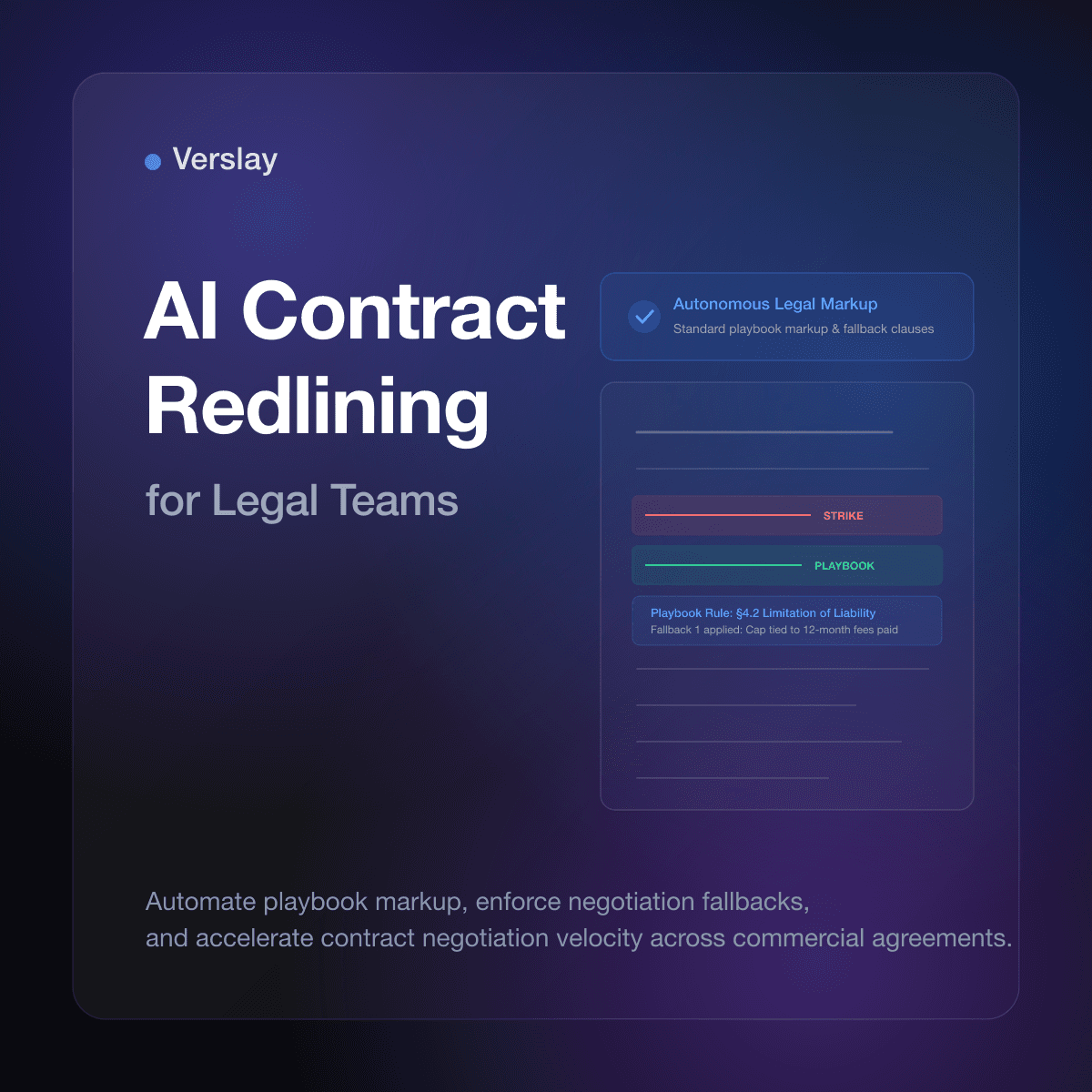
Contract redlining is the process of reviewing and editing a legal agreement by marking additions, deletions, and modifications with tracked changes during commercial negotiations. AI contract redlining automates this workflow by evaluating third-party agreements against institutional legal playbooks, automatically inserting pre-approved fallback language, and scoring contract risk before an attorney ever opens the document. By transitioning in-house legal teams from tedious word-by-word markup to high-leverage exception review, autonomous AI agents reduce contract review cycles from days to minutes while eliminating institutional compliance blind spots.
In high-growth B2B companies and enterprise organizations, commercial contracting represents one of the most critical operational throughput gates. Every customer win, software procurement, and vendor engagement requires mutual agreement on complex legal terms. While high-volume standard agreements (like non-disclosure agreements or click-through terms of service) can be standardized on internal templates, enterprise deals and major vendor purchases almost invariably require negotiating on "third-party paper"—the counterparty's bespoke contract form.
When in-house counsel and legal operations specialists are forced to manually comb through 40-page master services agreements (MSAs), data processing agreements (DPAs), and statements of work (SOWs), deal momentum grinds to a halt. In-house attorneys spend up to 70% of their working hours performing repetitive mechanical markups: modifying uncapped liability clauses, striking one-sided indemnification language, and ensuring standard governing law provisions. As quarter-end deal volume surges, legal bottlenecks delay revenue recognition, strain customer relationships, and increase reliance on expensive outside counsel.
By deploying autonomous AI Agents integrated across enterprise contract workflows via the Model Context Protocol (MCP), legal departments transform reactive, manual redlining into a deterministic, automated negotiation engine. AI agents instantly parse incoming agreements, identify clause variations, enforce corporate negotiation playbooks, and export clean, track-changed documents complete with objective negotiation commentary.
The Negotiation Bottleneck: Why Manual Contract Redlining Fails at Scale
Manual contract negotiation on third-party paper presents structural operational challenges that compound as an organization scales:
- Inconsistent Playbook Adherence: In large legal departments or teams relying on rotating outside counsel, different reviewers apply differing negotiation standards. One attorney might accept a 2x annual fee liability cap, while another strictly demands a 1x cap. Without centralized, automated enforcement, contract risk drifts significantly across business units.
- Third-Party Paper Camouflage: Sophisticated commercial counterparties frequently disguise unfavorable terms through creative sentence structures, split definitions, or burying onerous obligations in obscure exhibits and schedules. Human reviewers facing fatigue can easily overlook subtle omissions, such as the exclusion of gross negligence carve-outs from liability caps.
- Deal Drag and Revenue Bottlenecks: In enterprise sales cycles, contract negotiation is frequently the longest single stage. When the legal team takes five to seven business days to turn around an initial redline, prospective buyers lose enthusiasm, procurement cycles slip into subsequent quarters, and sales rep productivity plummets.
- Lost Negotiation Context and Friction: Counterparties frequently reject raw redlines that lack clear explanations. When attorneys make extensive deletions without providing respectful, context-aware negotiation notes explaining the business or regulatory necessity of the change, counterparties push back, initiating multi-week email debates over minor phrasing.
- Version Control Chaos: Multi-party negotiations involving simultaneous edits from procurement, finance, information security, and legal counsel frequently result in merged document errors, overwritten edits, or unapproved terms accidentally slipping into execution drafts.
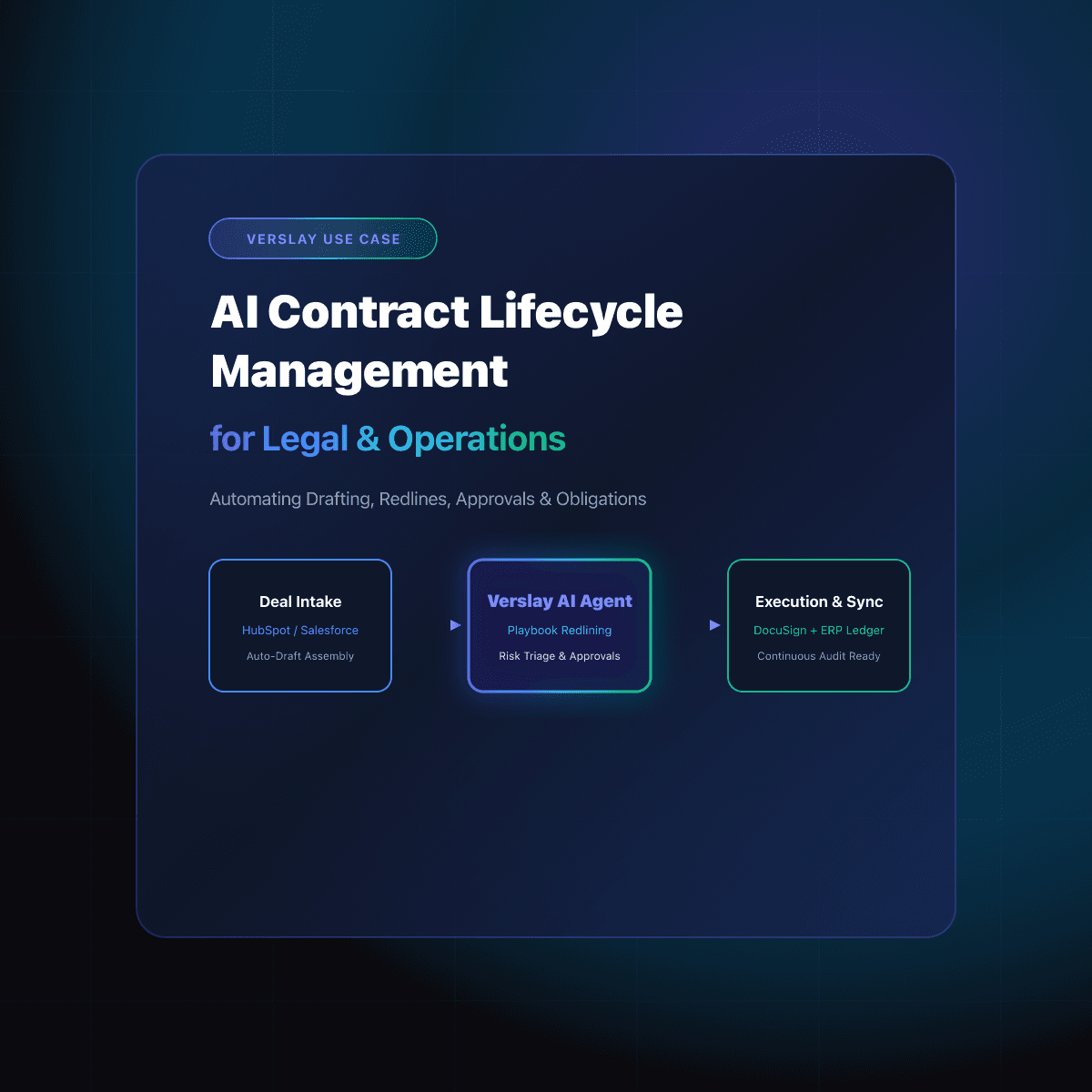
To see how automated analysis integrates with broader legal operations, explore our companion guides on AI contract review for legal teams and AI contract lifecycle management for legal teams.
Core Capabilities of Autonomous AI Contract Redlining Agents
Modern AI contract redlining goes far beyond basic keyword matching or heuristic regex search. By leveraging large language models trained on commercial legal reasoning paired with deterministic rule engines, AI agents execute high-precision markups:
+-----------------------------------------------------------------------------------+
|                        Incoming Contract Document Ingestion                       |
|           (Third-Party Paper: DOCX, PDF via Email, Slack, CLM, or Drive)          |
+-----------------------------------------+-----------------------------------------+
                                          |
                                          v
+-----------------------------------------------------------------------------------+
|                     Model Context Protocol (MCP) Security Layer                   |
|       - Zero-Data Retention Vault         - Document Structure Sanitization       |
+-----------------------------------------+-----------------------------------------+
                                          |
                                          v
+-----------------------------------------------------------------------------------+
|                        Semantic Clause Decomposition Engine                       |
|   - Clause Identification    - Risk Variance Scoring    - Omission Detection      |
+-----------------------------------------+-----------------------------------------+
                                          |
                                          v
+-----------------------------------------------------------------------------------+
|                       Corporate Legal Playbook Orchestrator                       |
|   - Primary Standard Position       - Secondary Fallback       - Hard Red-Lines   |
+-----------------------------------------+-----------------------------------------+
                                          |
                                          v
+-----------------------------------------------------------------------------------+
|                        Automated Tracked-Changes Generation                       |
|   - Strikethrough Deletions     - Approved Insertions     - Negotiation Notes     |
+--------------------+------------------------------------+-------------------------+
                     |                                    |
                     v                                    v
     +-------------------------------+    +--------------------------------+
     | Low Risk (< Threshold):       |    | High Risk / Non-Standard:      |
     | Auto-Export to Sales / Vendor |    | Escalate with Context Brief to |
     | via CLM / Email               |    | Senior In-House Legal Counsel  |
     +-------------------------------+    +--------------------------------+
1. Semantic Clause Ingestion & Decomposition
AI agents parse complex legal agreements into structured clause objects regardless of the document's typography, layout, or numbering hierarchy:
- Heading-Agnostic Classification: Correctly classifies an indemnification obligation whether it appears under "Indemnity," "Defense of Claims," "Third-Party Liabilities," or is tucked inside a miscellaneous warranty paragraph.
- Omission Detection: Analyzes what is missing from the agreement. If a vendor contract fails to include standard audit rights, data deletion commitments upon termination, or mutual confidentiality protections, the agent flags the omission and drafts the missing clause.
- Defined Term Verification: Validates that all capitalized terms in the markup are properly defined in the document, catching orphan cross-references and broken section links.
2. Deterministic Legal Playbook Enforcement
Every enterprise maintains distinct commercial preferences and legal risk tolerances. AI redlining agents execute custom, tiered playbooks with mathematical consistency:
- Tier 1: Preferred Position: The organization's ideal contract language (e.g., "Mutual 12-month trailing fee liability cap, excluding confidentiality and IP indemnification").
- Tier 2: Acceptable Fallback: Pre-approved secondary positions that the agent can apply automatically when the counterparty rejects Tier 1 (e.g., "Fixed liability cap of $500,000 or 2x annual contract value").
- Tier 3: Escalation Triggers: Terms that cannot be accepted under any circumstances without explicit General Counsel or CFO sign-off (e.g., uncapped indemnification for indirect damages, or agreeing to foreign governing law).
3. Native Tracked-Changes Generation (DOCX)
Rather than producing a disconnected summary report that attorneys must manually transfer into Word, the AI agent directly manipulates the native OpenXML format:
- Clean Revision Markers: Inserts authentic Microsoft Word revision objects (
<w:ins>and<w:del>) matching the standard tracked-changes format used by corporate law firms. - Attribute Matching: Preserves original document typography, font styles, indentations, paragraph margins, and numbering conventions.
- Clean Acceptance Options: Allows counterparties to accept or reject edits natively in Microsoft Word, Google Docs, or CLM platforms without software lock-in.
4. Contextual Negotiation Comments & Justification Drafting
Effective contract negotiation requires persuasion and diplomacy. AI redlining agents append polite, professional margin comments to every substantial edit:
- Objective Business Rationale: Explains why a change was made (e.g., "We have modified the limitation of liability to reflect mutual fee-based caps aligned with prevailing enterprise SaaS market standards and our internal risk framework.").
- Statutory & Regulatory Citations: References specific compliance mandates (such as GDPR Article 28 requirements for sub-processor notifications) when marking up data privacy clauses.
- Compromise Language Suggestions: Proposes middle-ground alternatives directly in the margin comments to give the counterparty an immediate path to agreement.
5. Multi-Factor Risk Scoring and Triage
Not all contracts warrant the same level of legal scrutiny. AI agents score incoming agreements along a 0–100 risk spectrum based on clause deviations and total contract value (TCV):
- Green Route (Low Risk / Standard Deviations): Routine NDAs or standard low-dollar vendor agreements with minor variations are redlined and dispatched directly to the business owner or counterparty.
- Amber Route (Moderate Risk / Fallback Applied): Mid-tier commercial agreements where fallback positions were successfully applied are routed to legal specialists with an executive summary highlighting the specific compromises made.
- Red Route (High Risk / Policy Breaches): Contracts containing non-negotiable red-lines or severe liability exposures are flagged with an immediate escalation memo detailing the operational, financial, and legal implications.
Discover pre-configured workflows tailored for enterprise operations in our Verslay Use Cases catalog.
5 Critical Clauses Automated by AI Redlining
In commercial contracting, the vast majority of negotiation friction concentrates around five core legal provisions. Here is how autonomous AI redlining agents evaluate and modify these clauses against standard corporate playbooks:
+---------------------------+-----------------------------------+-----------------------------------+
| Clause Type               | Counterparty Proposed Paper       | AI Agent Playbook Redline         |
+---------------------------+-----------------------------------+-----------------------------------+
| 1. Limitation of Liability| Uncapped liability or aggregate   | Struck out; replaced with mutual  |
|                           | cap equal to 5x annual fees       | cap tied to 12 months fees paid   |
+---------------------------+-----------------------------------+-----------------------------------+
| 2. Indemnification Scope  | One-sided indemnity covering all  | Made strictly mutual; limited to  |
|                           | third-party claims and negligence | IP infringement & breach of data  |
+---------------------------+-----------------------------------+-----------------------------------+
| 3. Warranty Disclaimers   | Express performance warranties    | Standard "AS IS" disclaimer with  |
|                           | without sole remedy limitations   | exclusive repair/replace remedy   |
+---------------------------+-----------------------------------+-----------------------------------+
| 4. Data Breach Notice     | "Prompt notification" without any | Replaced with explicit "within 48 |
|                           | concrete time commitment          | hours of confirmed incident"      |
+---------------------------+-----------------------------------+-----------------------------------+
| 5. Governing Law          | Counterparty's local state court  | Standardized to corporate home    |
|                           | with jury trial rights preserved  | jurisdiction; mutual jury waiver  |
+---------------------------+-----------------------------------+-----------------------------------+
1. Limitation of Liability (LoL)
The limitation of liability is the single most negotiated clause in commercial software and services agreements. Counterparty paper frequently attempts to uncap customer liabilities or establish disproportionate multiples.
- The Deviation: The vendor's draft states that the customer's aggregate liability for all claims shall be unlimited, while the vendor's liability is capped at the fees paid in the preceding three months.
- The AI Playbook Markup: The agent immediately strikes the asymmetrical clause, inserting mutual language that caps both parties' aggregate liability to total fees paid during the preceding twelve months. Furthermore, the agent ensures that exclusions from the liability cap are strictly confined to breaches of confidentiality, gross negligence, willful misconduct, and intellectual property indemnification.
2. Mutual Indemnification and Defense of Claims
Indemnity provisions allocate financial responsibility for third-party lawsuits. Overly broad indemnification obligations expose companies to catastrophic litigation costs.
- The Deviation: A supplier agreement requires the customer to "indemnify, defend, and hold harmless" the supplier from any and all claims arising out of the customer's use of the software, including general business operations.
- The AI Playbook Markup: The agent narrows the customer's indemnity obligation strictly to claims resulting from the customer's gross negligence or direct infringement of third-party IP rights. Simultaneously, the agent inserts a reciprocal vendor indemnity protecting the customer against intellectual property infringement claims arising from the core product, accompanied by standard procedural protections (prompt written notice, sole control of defense, and reasonable settlement authority).
3. Confidentiality and Trade Secret Protections
Confidentiality terms govern how proprietary business data, source code, and commercial negotiations are protected.
- The Deviation: The counterparty paper provides a one-sided NDA or defines "Confidential Information" so narrowly that verbal disclosures or un-marked technical specifications are excluded.
- The AI Playbook Markup: The agent converts the provision into a robust mutual confidentiality framework. It expands the definition to encompass all non-public information that reasonably should be understood to be confidential given the nature of the disclosure, ensures a standard three-to-five year survival period (with indefinite protection for trade secrets), and inserts standard statutory exclusions (information already public, independently developed, or required by subpoena).
4. Data Privacy, Security, and Incident Notification
In an era of stringent global privacy regimes (GDPR, CCPA, HIPAA), vague data security clauses pose existential regulatory liability.
- The Deviation: A vendor agreement promises only "reasonable commercial efforts" to maintain data security and agrees to report security incidents "as soon as commercially practicable."
- The AI Playbook Markup: The agent replaces ambiguous wording with concrete industry benchmarks: requiring SOC 2 Type II compliance, encryption in transit and at rest using AES-256 standards, and a binding commitment to notify the customer in writing within 48 to 72 hours of any confirmed security incident or unauthorized access.
5. Termination for Convenience & Transition Assistance
Exit provisions dictate how cleanly an organization can untangle itself from an underperforming partnership.
- The Deviation: The contract imposes a multi-year lock-in with auto-renewal windows that require 90 days advance written notice, while prohibiting termination for convenience.
- The AI Playbook Markup: The agent modifies the auto-renewal clause to require a 30-day notice window, inserts an affirmative right to terminate for convenience upon 60 days written notice with pro-rata refunds for prepaid, unused fees, and mandates that the vendor deliver a complete data export within 15 days of contract expiration.
Learn how specialized AI agents optimize workflows across departments in Industry Solutions.
Technical Architecture: How AI Contract Redlining Operates via MCP
Enterprise legal workflows demand absolute data privacy, cryptographic document integrity, and granular role-based access controls. AI contract redlining agents operate within an enterprise-controlled boundary utilizing the Model Context Protocol (MCP):
+-----------------------------------------------------------------------------------+
|                        Enterprise Legal Ecosystem Integrations                    |
|   (Ironclad, Agiloft, Salesforce CPQ, Google Drive, SharePoint, Slack, Outlook)   |
+-----------------------------------------+-----------------------------------------+
                                          |
                                          v
+-----------------------------------------------------------------------------------+
|                    Model Context Protocol (MCP) Secure Gateway                    |
|     - Authenticated Token Brokerage       - Enterprise Document Sandboxing        |
|     - SOC 2 Type II Encrypted Transit     - Zero Customer Model Training          |
+-----------------------------------------+-----------------------------------------+
                                          |
                                          v
+-----------------------------------------------------------------------------------+
|                         Verslay Agent Orchestration Core                          |
|                                                                                   |
|   +-----------------------+   +-----------------------+   +-------------------+   |
|   | Playbook Validator    |   | Clause Diff Analyzer  |   | Legal Reasoning   |   |
|   | (Static Rule Matrix)  |   | (Token & AST Parser)  |   | Engine (LLM)      |   |
|   +-----------------------+   +-----------------------+   +-------------------+   |
+-----------------------------------------+-----------------------------------------+
                                          |
                                          v
+-----------------------------------------------------------------------------------+
|                         Document Synthesis & Dispatch Core                        |
|                                                                                   |
|   - Native OpenXML (.docx) Generation      - Comprehensive Risk Audit JSON        |
|   - Contextual Revision Commentary         - Linear / CLM Task Synchronization   |
+-----------------------------------------------------------------------------------+
1. Enterprise Ecosystem Integration via MCP
The agent connects directly to the systems where legal contracts originate and finalize:
- Contract Lifecycle Management (CLM): Bi-directional synchronization with platforms like Ironclad, Agiloft, Conga, and DocuSign CLM. The agent ingests pending agreements, applies redlines, and transitions the workflow status automatically.
- Document Repositories: Direct file access across Google Drive, Microsoft SharePoint, and OneDrive, checking out source documents and saving versioned redlines (e.g.,
MSA_Vendor_Redline_v1.docx). - Communication & Notification: Real-time alerts delivered to dedicated Slack or Microsoft Teams legal channels, allowing counsel to review summary scorecards and approve dispatch with a single click.
2. Privacy-First Data Isolation
Legal contracts contain sensitive corporate intellectual property, pricing schedules, and customer identities. The Verslay architecture enforces strict privacy protections:
- Zero Model Retention: Contracts processed through MCP integrations are never retained for model training or weight fine-tuning.
- Granular Redaction & Masking: PII, specific financial fee schedules, and sensitive commercial exhibits can be masked dynamically prior to semantic reasoning and rehydrated upon document export.
- Full Cryptographic Audit Trail: Every clause alteration, playbook reference, and reviewer sign-off is logged in an immutable audit ledger, ensuring complete transparency during corporate compliance audits.
Contract Redlining Etiquette: Best Practices for AI-Assisted Negotiation
Deploying AI contract redlining requires a strategic balance between rigorous risk mitigation and commercial deal velocity. Overly aggressive, indiscriminate redlining frustrates counterparties and damages commercial relationships. Legal teams should adhere to the following best practices when deploying AI redlining agents:
1. Reserve Redlines for Material Risk Deviations
An effective redline focuses on substance, not stylistic preference. Avoid configuring agents to replace counterparty phrases with synonyms that carry identical legal meaning (such as replacing "promptly" with "without undue delay" or changing passive to active voice). Stylistic edits create visual noise that distracts from substantive negotiation points.
2. Always Include Explanatory Negotiation Notes
A redline without commentary feels adversarial. Ensure the AI agent accompanies every substantive modification with a concise, respectful explanation. When counterparties understand the rationale—whether it is compliance with insurance requirements, board-mandated liability policies, or statutory data privacy obligations—they are far more likely to accept the revision without escalation.
3. Maintain Clear Commercial vs. Legal Boundaries
Distinguish between legal risk parameters and business terms. Attorneys and AI agents should protect the company's liability posture, intellectual property, and compliance obligations, but should avoid unilaterally marking up commercial terms (such as payment terms, minimum volume commitments, or discount schedules) without explicit confirmation from the commercial deal owner.
4. Implement a Graduated Fallback Hierarchy
Empower the AI agent with multiple acceptable fallbacks rather than a single binary standard. If a counterparty rejects your preferred twelve-month liability cap, the agent should have automated authorization to offer a two-times fee cap before stalling the negotiation for human intervention.
Frequently Asked Questions
What is contract redlining and how does AI automate it?
Contract redlining is the collaborative process of editing and negotiating legal agreements by marking additions and deletions. AI contract redlining automates this by comparing third-party contracts against internal legal playbooks, inserting pre-approved fallback clauses, and generating tracked-changes markups directly in Word or Google Docs.
How do AI contract redlining tools protect legal and commercial standards?
AI redlining engines evaluate third-party contracts against organizational risk tolerances for limitation of liability, indemnification, data privacy, and governing law, enforcing standard corporate fallback positions while flagging severe deviations for legal counsel.
Does AI contract redlining replace corporate attorneys and legal teams?
No. AI contract redlining acts as an intelligent first-pass copilot that handles routine clause comparison and standard markup, freeing in-house attorneys to focus on strategic risk trade-offs, deal architecture, and complex commercial negotiations.