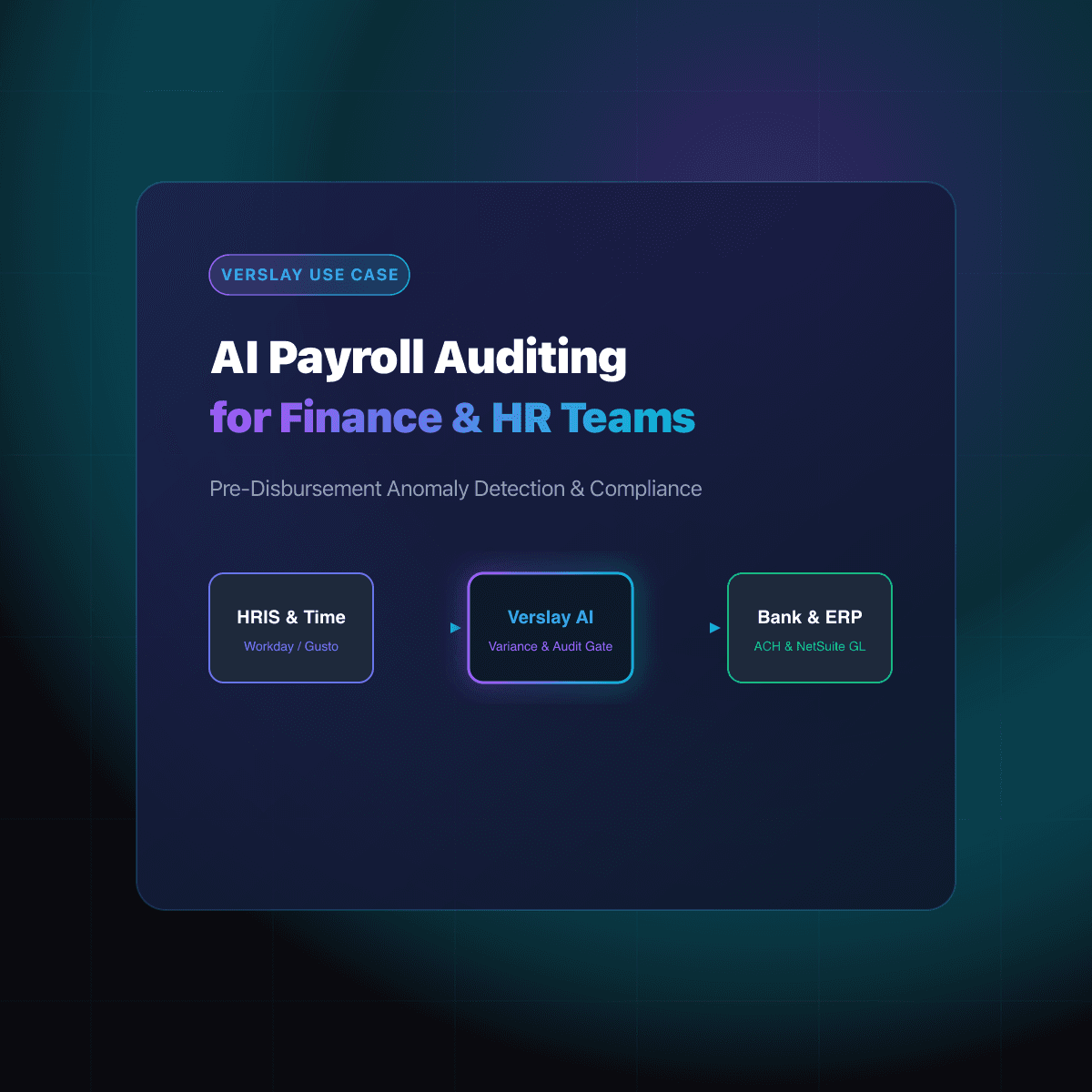
AI payroll auditing for finance and HR teams automates pre-disbursement verification, compensation anomaly detection, tax withholding validation, and general ledger reconciliation by deploying autonomous AI agents across human resources information systems (HRIS) and payroll processing platforms. By continuously cross-referencing timesheet records, approved salary adjustments, employee status updates, and tax jurisdictions against gross-to-net payroll registers before funds clear, AI agents eliminate manual spreadsheet spot-checks, prevent costly overpayments, and ensure 100% audit readiness across every pay cycle.
Payroll represents the single largest operational expenditure for most enterprise organizations. When finance and people operations teams must manually verify thousands of employee line items within tight 24- to 48-hour pre-funding settlement windows, manual review processes inevitably miss subtle anomalies—resulting in payroll leakage, retroactive tax adjustments, and employee frustration.
The Operational Friction in Manual Payroll Auditing
Payroll auditing serves as the critical line of defense between internal HR record changes and corporate cash disbursements. In modern distributed workplaces, maintaining payroll accuracy manually presents severe structural bottlenecks:
- Fragmented Data Silos: People data is distributed across disparate platforms—salaries in the HRIS (Workday, BambooHR), hours in specialized time-tracking tools (Deputy, Kronos), commission totals in sales platforms (Salesforce, CaptivateIQ), and deductions in benefits portals. Reconciling these feeds into a single gross-to-net payroll register requires tedious spreadsheet export-merge routines.
- Compressed Review Windows: Payroll managers typically face a razor-thin 24-to-48 hour window between receiving preliminary payroll registers from processors (such as ADP, Gusto, or Paychex) and authorizing the final direct deposit ACH transmission. Spot-checking under intense time pressure leaves minor calculation errors unnoticed.
- Retroactive Adjustments and Proration: Mid-cycle promotions, effective-dated salary increases, unrecorded unpaid leave, and prorated new-hire or termination payouts introduce complex edge cases where manual calculations frequently drift from company policies.
- Multi-State Tax and Remote Work Nexus: As employees relocate or work remotely across municipal and state borders, local withholding requirements, state unemployment insurance (SUI) rates, and reciprocity rules create compliance pitfalls that trigger costly tax agency penalties.
- Risk of Overpayment Leakage and Ghost Employees: Terminated contractors or former employees who remain active in payroll due to delayed offboarding tickets generate unrecovered payouts that drain operating capital.
To explore how intelligent automation addresses related accounting and people workflows, read about AI expense auditing for finance teams and AI employee onboarding for HR teams.
How Autonomous AI Agents Automate Payroll Auditing
Autonomous AI agents transform payroll auditing from a frantic, manual spot-check into a continuous, deterministic pre-disbursement audit pipeline. Connected securely via standardized Model Context Protocol (MCP) integrations, AI agents operate before every pay run:
1. Multi-Source Ingestion and Registry Synchronization
The AI agent ingests preliminary payroll registers alongside upstream source records:
- HRIS & Compensation Master: Pulls base salary, pay rate history, approved bonus schedules, and department cost-center allocations.
- Time and Attendance Logs: Normalizes timesheet hours, overtime classifications, meal penalty rules, and approved paid time off (PTO) records.
- Benefits & Deduction Feeds: Verifies pre-tax (401k, HSA, FSA) and post-tax voluntary benefit deduction schedules against active enrollment records.
2. Deep Variance & Anomaly Detection Engine
Rather than relying on basic threshold filters, AI agents run multi-dimensional cross-verification:
- Historical Baseline Comparison: Flags any employee whose current net or gross compensation deviates by more than expected variance thresholds compared to trailing 3-month averages, accounting for known bonuses or commission payouts.
- Rate and Title Consistency: Verifies that pay rate changes in the register correspond to timestamped, manager-approved compensation change tickets in the HRIS.
- Overtime and Hours Sanity Checks: Detects anomalies such as duplicate shift entries, excessive consecutive overtime hours, or hourly pay registered for exempt salaried staff.
3. Multi-Jurisdiction Tax and Compliance Validation
- Statutory Withholding Verification: Validates federal, state, and local payroll tax withholding calculations against updated municipal tax tables and employee W-4 elections.
- Remote Work Nexus Audit: Cross-checks employee home address coordinates against tax jurisdiction codes in the payroll register to prevent out-of-state misallocations.
4. Automated Exception Dossiers and Approval Routing
- Prioritized Discrepancy Queue: Sorts anomalies by financial materiality and compliance risk, presenting payroll administrators with clear side-by-side evidence dossiers.
- One-Click Remediation: Suggests exact register adjustments or updates upstream HRIS entries to resolve discrepancies prior to ACH finalization.
5. Post-Disbursement General Ledger Reconciliation
Once payroll is executed, the AI agent maps gross wages, employer taxes, benefit liabilities, and net disbursements directly to corresponding general ledger (GL) accounts, generating balanced journal entries in ERPs like NetSuite or QuickBooks.
Explore how deploying AI agents for business operations allows organizations to streamline critical financial and operational workflows.
Architecture of an AI-Driven Payroll Auditing Engine
The diagram below demonstrates how an autonomous AI agent verifies payroll data across distributed HR and financial systems prior to disbursement:
[HRIS & Compensation]      [Time & Attendance]      [Benefits & Deductions]
(Workday, BambooHR)        (Kronos, Deputy)         (Fidelity, Guideline)
         │                         │                          │
         └─────────────────────────┼──────────────────────────┘
                                   │
                                   ▼
                   [Preliminary Payroll Register Ingest]
                            (ADP, Gusto, Paychex)
                                   │
                                   ▼
                      [AI Payroll Auditing Agent]
                     ┌─────────────┴─────────────┐
                     ▼                           ▼
          [Deterministic Rules]       [Contextual Anomaly Engine]
         - Tax Table Validation       - Historical Variance Scans
         - Approval Ticket Check      - Ghost Employee Detection
         - Zero-Net / Negative Pay    - Unapproved Rate Spikes
                     │                           │
                     └─────────────┬─────────────┘
                                   │
                                   ▼
                      [Pre-Disbursement Audit Gate]
                       /                         \
             [Clean Register]               [Exceptions Flagged]
                    │                                 │
                    ▼                                 ▼
         [Authorize ACH Funding]            [Generate Audit Dossier]
         [Post Balanced GL Entry]          [Notify Payroll Controller]
- Pre-Run Synchronization: The agent connects to HRIS and time-tracking systems as soon as the preliminary payroll draft is compiled by the payroll engine.
- Deterministic & Contextual Passes: Routine calculations pass through instant compliance rules, while statistical models detect subtle behavioral anomalies.
- Audit Gate Enforced: Clean pay runs proceed directly to funding approval, while discrepancies freeze affected line items for rapid supervisor resolution.
- Automated GL Posting: Settled payroll records produce balanced, multi-department general ledger journal entries without manual data entry.
Pre-Disbursement Audit Matrix: Common Anomaly Categories & AI Resolution Logic
Enterprise payroll registers contain hundreds of variables. The table below outlines how AI agents isolate and resolve frequent payroll discrepancies:
| Audit Category | Typical Root Cause | Manual Audit Vulnerability | AI Agent Automated Resolution | | :--- | :--- | :--- | :--- | | Severance & Termination Lag | Offboarding ticket delayed; employee remains active on auto-pay | High risk of unrecoverable direct deposit overpayments | Correlates IT deprovisioning and HR termination dates; flags and halts auto-pay for inactive profiles instantly. | | Unapproved Rate Adjustments | Data entry error during annual merit cycle or title update | Easily overlooked in multi-thousand-row spreadsheets | Matches updated hourly or salary rates against signed compensation change letters; blocks unverified increases. | | Overtime and Double-Time Spikes | Timeclock glitch or overlapping shift submissions | Discovered weeks after payroll when budget variance reports run | Analyzes clock-in/out timestamps and schedule logs; isolates overlapping shifts and recalculates compliant overtime pay. | | Tax Nexus & Relocation Drift | Employee worked remotely in a new jurisdiction without updating W-4 | Discovered at tax year-end, triggering state audit penalties and W-2c filings | Cross-references IP logins and HR address updates with payroll tax withholdings; alerts payroll team to adjust state withholding codes. | | Duplicate Bonus Payments | Manager submits one-off bonus via both spreadsheet upload and HRIS portal | Duplicate line items slip through if review is split across team members | Evaluates recipient identity, dollar amounts, and bonus descriptions across all submission channels, flagging identical duplicates. |
To understand how automated settlement safeguards corporate cash positions, read about AI bank reconciliation for finance teams.
Resolving High-Complexity Payroll Edge Cases Autonomously
Standard rules engines and legacy payroll software struggle with complex human variables, creating false alarms or missing genuine discrepancies. Autonomous AI agents resolve these nuances using contextual intelligence:
- Prorated Mid-Period Compensation Adjustments: When an employee receives a promotion effective mid-pay period, the AI agent calculates split-rate earnings based on exact business days worked before and after the effective date, verifying that gross wages match mathematical expectations down to the cent.
- FLSA Exemption and Overtime Misclassification: If an employee classified as exempt salaried logs billable hours or non-exempt employees work unapproved overtime across multiple cost centers, the agent highlights potential Fair Labor Standards Act (FLSA) compliance risks for HR review.
- Benefit Deduction Catch-Ups and Limits: For employees nearing statutory annual contribution caps (such as IRS 401(k) limits or Social Security wage caps), the agent verifies that payroll engines automatically cap deductions, preventing improper withholdings.
- Multi-Entity Intercompany Allocations: For shared service teams whose time is billed across multiple subsidiaries, the agent splits payroll expense lines and fringe benefit allocations to correct intercompany accounts automatically.
Business and Compliance Impact for Finance and People Operations
Deploying autonomous AI payroll auditing delivers immediate operational, financial, and regulatory advantages:
- 100% Pre-Disbursement Audit Coverage: Replaces randomized sample audits with full line-item inspection across every single employee before direct deposits are initiated.
- Zero Payroll Leakage: Prevents accidental overpayments, ghost employee payouts, and duplicate disbursements before funds leave corporate bank accounts, eliminating awkward employee clawback conversations.
- Regulatory Penalty Prevention: Eliminates late deposit fees, tax withholding discrepancies, and multi-state compliance violations that attract federal and state penalties.
- Accelerated Financial Close: Direct integration with enterprise ERPs allows payroll journals to balance and close within minutes of pay run settlement, eliminating week-long payroll clearing account reconciliations.
Frequently Asked Questions
What is AI payroll auditing for finance and HR teams?
AI payroll auditing is the automated process of inspecting payroll registers, timecards, compensation changes, and tax withholdings prior to disbursement using autonomous AI agents to prevent overpayments, fraud, and compliance violations.
How do AI agents detect payroll anomalies and errors?
AI agents continuously cross-reference HRIS data, time-tracking logs, approved compensation adjustments, and banking details against gross-to-net calculations, instantly flagging outlier hours, duplicate payouts, or unauthorized rate changes.
How does AI payroll auditing integrate with ERP and HR systems?
AI payroll agents connect to HRIS platforms like Workday and BambooHR, payroll processors like ADP and Gusto, and ERPs like NetSuite via Model Context Protocol (MCP) integrations to automate variance analysis and general ledger journal reconciliation.