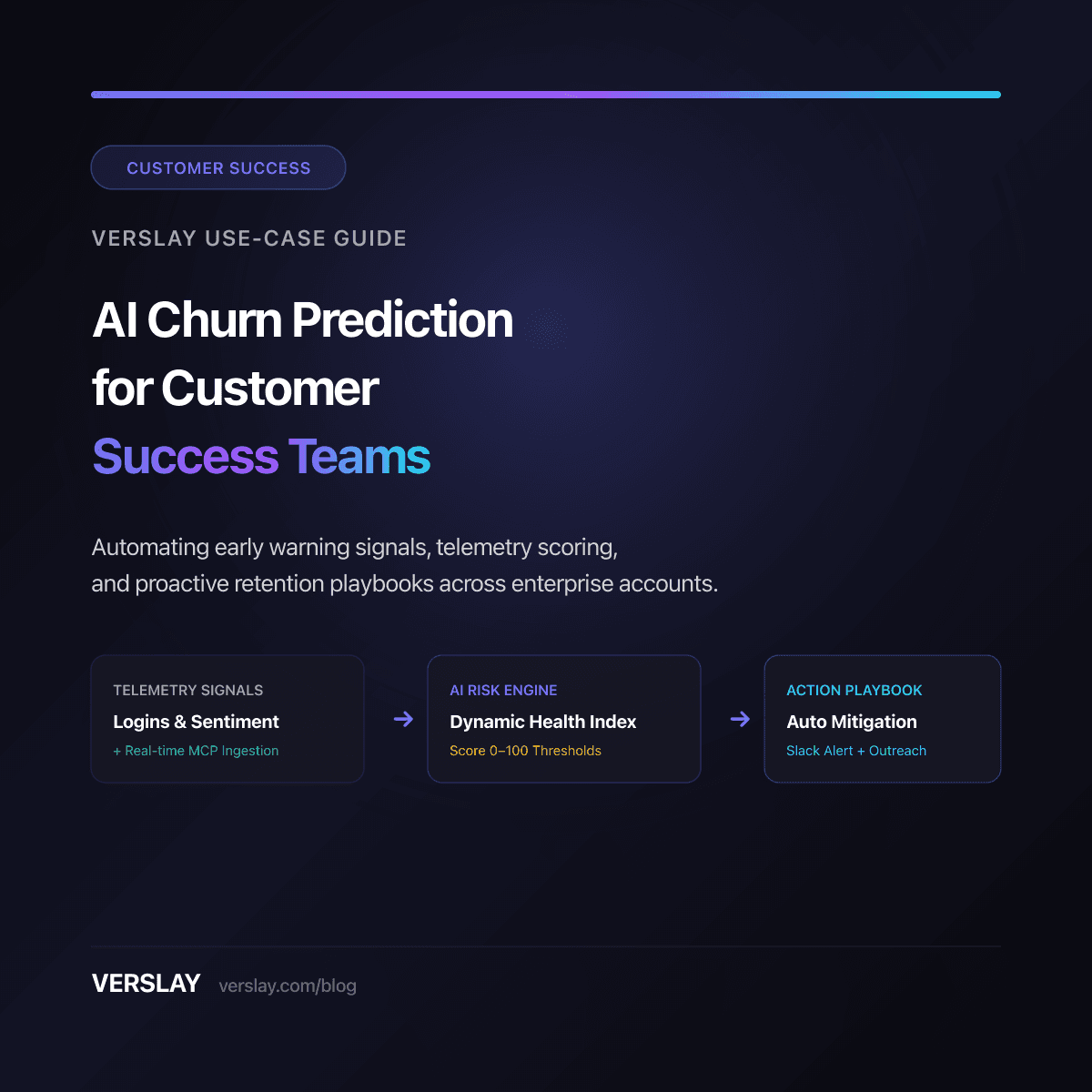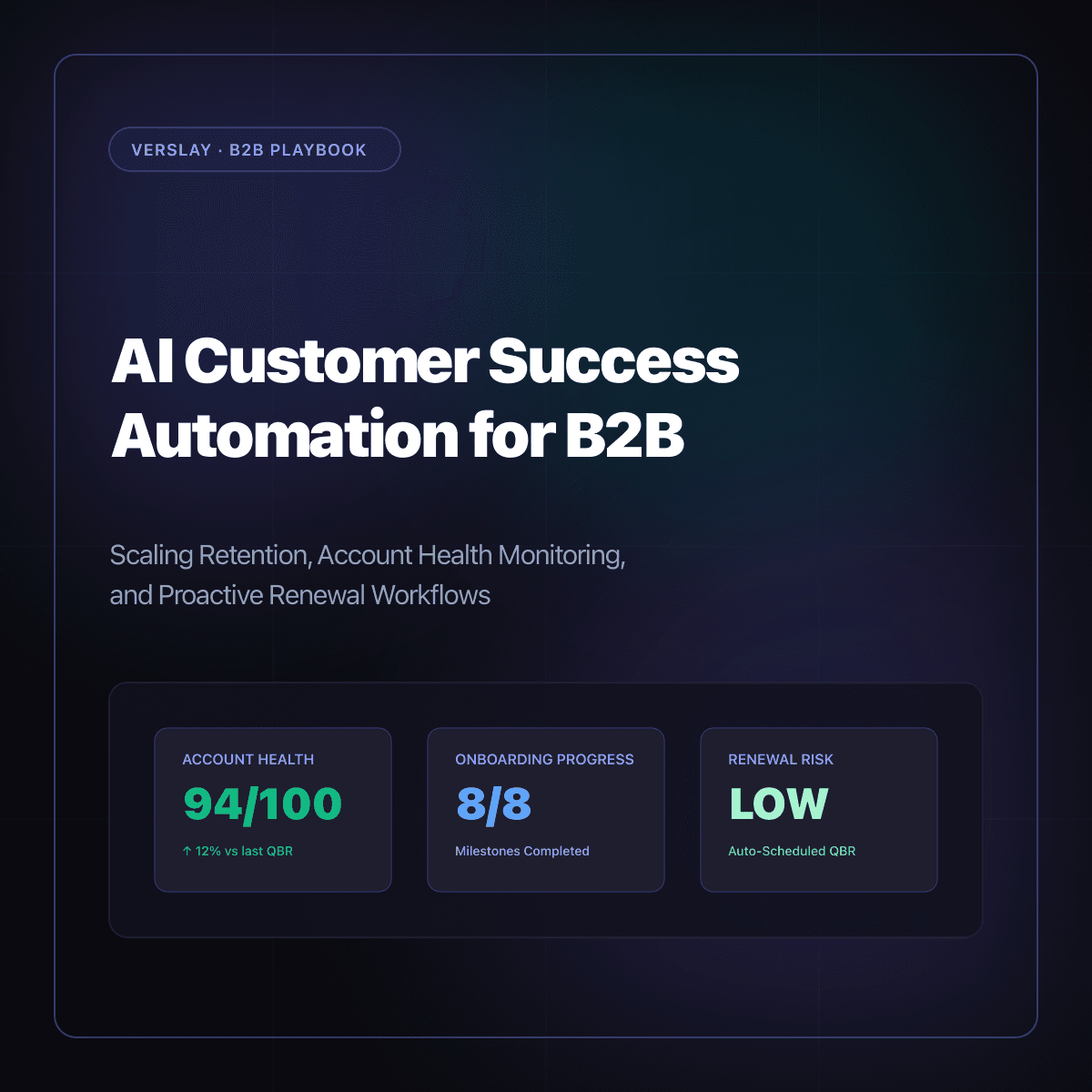
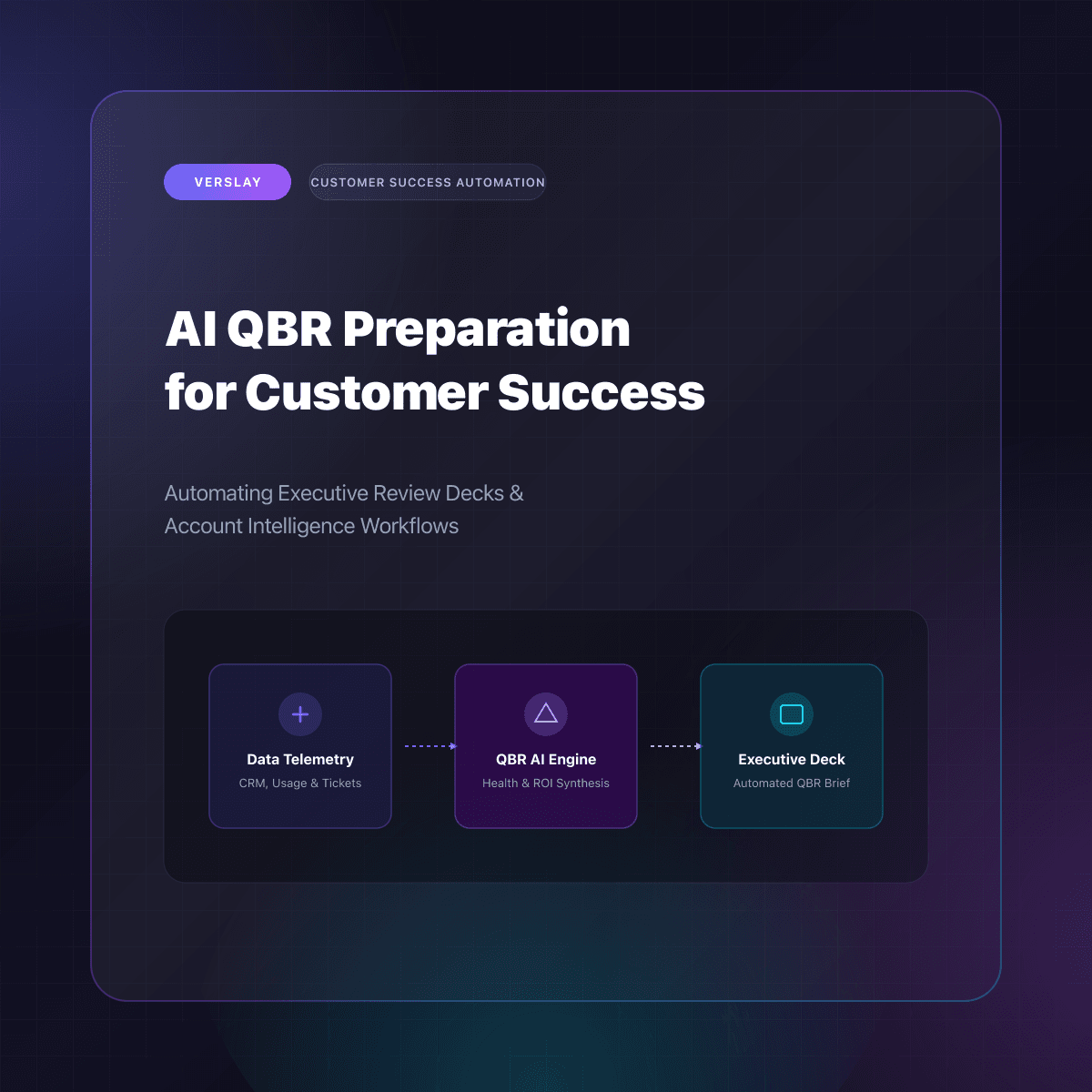
AI QBR preparation for customer success teams uses autonomous AI agents to collect usage telemetry, aggregate support history, and draft executive presentation decks automatically prior to quarterly review meetings. By connecting product analytics databases, CRM platforms, and ticketing systems through standardized Model Context Protocol (MCP) integrations, AI agents condense up to 10 hours of manual spreadsheet data compilation into seconds. This enables Customer Success Managers (CSMs) to walk into executive business reviews with verified ROI data, expansion opportunities, and mitigation playbooks ready for executive alignment.
Quarterly Business Reviews (QBRs) are the cornerstone of B2B SaaS and service retention. Yet in most organizations, QBR preparation remains a chaotic manual sprint. Customer Success Managers spend hours exporting CSV files from product analytics tools, pulling ticket summaries from help desks, copying contract details from CRMs, and pasting static charts into slide templates.
By deploying specialized AI Agents, customer success teams convert fragmented operational signals into polished, executive-ready presentations and account briefings automatically.
Structural Friction in Traditional QBR Workflows
Despite the strategic importance of executive business reviews, traditional QBR preparation suffers from three major operational bottlenecks:
- Fragmented Signal Sources: Product adoption data sits in data warehouses (Snowflake, BigQuery), customer sentiment lives in ticketing systems (Zendesk, Intercom), and commercial terms reside in CRMs (Salesforce, HubSpot). Reconciling these sources requires manual cross-referencing for every account.
- Lagging ROI Metrics: Manual preparation often relies on static snapshots generated days or weeks before the meeting. As a result, unexpected drop-offs in active seats or emerging support tickets are missed during executive discussions.
- Capacity Constraints: Preparing a comprehensive QBR deck takes between 6 and 10 hours per account. For a CSM managing 20 to 30 accounts, QBR prep alone can swallow over half of their operational bandwidth, limiting time available for proactive relationship management.
How AI QBR Preparation Works Across the Account Stack
Modern AI-driven QBR automation replaces manual data assembly with continuous background intelligence. Connected via secure protocol layers, AI agents pull real-time data across product, support, and commercial platforms to assemble a complete narrative of account health.
+-------------------+     +---------------------+     +----------------------+
| Product Telemetry |     | Support & Feedback  |     | CRM & Contract Data  |
| (MAU/DAU, Features)|    | (Tickets, CSAT)     |     | (ARR, Licenses, Reps)|
+---------+---------+     +----------+----------+     +----------+-----------+
          |                          |                           |
          +--------------------------+---------------------------+
                                     |
                                     v
                        +-------------------------+
                        | Verslay MCP Integration |
                        +------------+------------+
                                     |
                                     v
                        +-------------------------+
                        | AI QBR Synthesis Engine |
                        | (ROI & Benchmark Logic) |
                        +------------+------------+
                                     |
                                     v
             +-----------------------+-----------------------+
             |                                               |
             v                                               v
   +-------------------+                           +-------------------+
   | Executive Summary |                           | Slidedeck Draft   |
   | & Account Health  |                           | (Custom PowerPoint|
   | Brief (PDF/Doc)   |                           |  or Google Slides)|
   +-------------------+                           +-------------------+
1. Multi-Platform Telemetry Aggregation
Rather than logging into multiple administrative dashboards, the AI QBR preparation agent queries all connected systems simultaneously:
- License & Seat Utilization: Calculating assigned seats versus active monthly users across key feature modules.
- Support Health & Resolution Velocity: Analyzing median resolution times, open high-priority tickets, and recurring issue categories.
- Milestone & Value Achievement: Tracking custom onboarding milestones, project deliverables, and contract SLA compliance.
- Executive Champion Tracking: Verifying ongoing engagement from economic buyers and project sponsors.
2. ROI and Benchmark Narrative Synthesis
Data alone does not make a compelling QBR. The AI synthesis engine transforms raw numbers into executive-level insights by comparing account performance against cohort benchmarks:
- Identifies top 10% power-user workflows within the client organization.
- Highlights underutilized modules where adoption guidance will unlock additional ROI.
- Quantifies business impact (e.g., hours saved, tickets resolved, workflow completions).
Explore pre-built workflows designed for growing businesses in our Verslay Use Cases directory.
3 Core Workflows Powered by AI QBR Preparation
Workflow 1: 14-Day Automated Account Snapshot ---> Multi-System Data Harvest & Health Indexing
Workflow 2: Executive Presentation Drafting   ---> Auto-Generated Slide Deck & Speaker Notes
Workflow 3: Opportunity & Risk Identification  ---> Upsell Expansion & Mitigation Playbook
Workflow 1: Pre-Meeting Account Snapshot and Health Indexing
14 days prior to a scheduled QBR date, the AI agent automatically runs a comprehensive health audit. It compiles account history into a concise 2-page briefing document for the CSM, summarizing:
QBR Pre-Flight Briefing: CloudScale Inc.
- Commercial Status: $140,000 ARR · Renewal in 75 Days.
- Product Adoption: 92% seat allocation · Core workflow adoption up 28% Q-o-Q.
- Support Health: 14 tickets resolved · Zero open P1 incidents · CSAT 4.9/5.
- Key Value Win: Platform automated 4,200 task executions, saving an estimated 310 operational hours.
- Discussion Focus: Expansion into European business units; onboarding security module.
Workflow 2: Automated Executive Presentation Drafting
The AI agent uses the account snapshot to generate a complete slide presentation formatted according to corporate brand guidelines. The output includes:
- Executive Summary Slide: Key achievements and contract health metrics.
- Value Realization Slide: Graphs illustrating usage growth, operational hours saved, and goal completion.
- Support & Operational Review Slide: Transparent resolution metrics and infrastructure uptime.
- Strategic Roadmap Slide: Tailored recommendations for upcoming quarters based on the client's current feature usage.
Workflow 3: Expansion and Risk Mitigation Playbook
Beyond historical review, executive business reviews are key moments for account growth. The AI agent evaluates usage patterns to highlight strategic opportunities:
- Expansion Triggers: Identifies departments approaching seat caps or requesting advanced features, drafting expansion proposal slides automatically.
- Risk Mitigations: If usage has dipped in a specific division, the agent drafts a turnaround action plan to include in the presentation agenda.
Learn how specialized AI agents streamline team workflows across various sectors in Industry Solutions.
Technical Foundation: MCP Server Integration for Customer Success
Connecting product telemetry, customer feedback, and commercial data requires reliable, secure architecture. Verslay uses the open Model Context Protocol (MCP) standard to integrate AI agents safely with business software stacks.
Using standardized MCP servers, customer success teams connect AI agents to:
- CRMs & Revenue Management: Salesforce, HubSpot, Stripe, Chargebee
- Product Analytics & Warehouses: Snowflake, BigQuery, Mixpanel, Amplitude
- Help Desk & Ticketing: Zendesk, Intercom, Freshdesk, ServiceNow
- Presentation & Docs: Google Slides, Microsoft PowerPoint, Notion, Google Docs
This protocol-level integration ensures strong security, full audit logging, and data privacy while empowering AI agents to execute complex data aggregation tasks autonomously.
Frequently Asked Questions
What is customer QBR preparation?
Customer QBR (Quarterly Business Review) preparation involves gathering product usage metrics, support ticket history, license utilization, and ROI milestones to present account health and strategic value to executive stakeholders.
How do AI agents automate QBR preparation?
AI agents automatically query CRM records, usage databases, and support platforms to aggregate account health signals, generate benchmark insights, and draft executive review presentations without manual spreadsheet work.