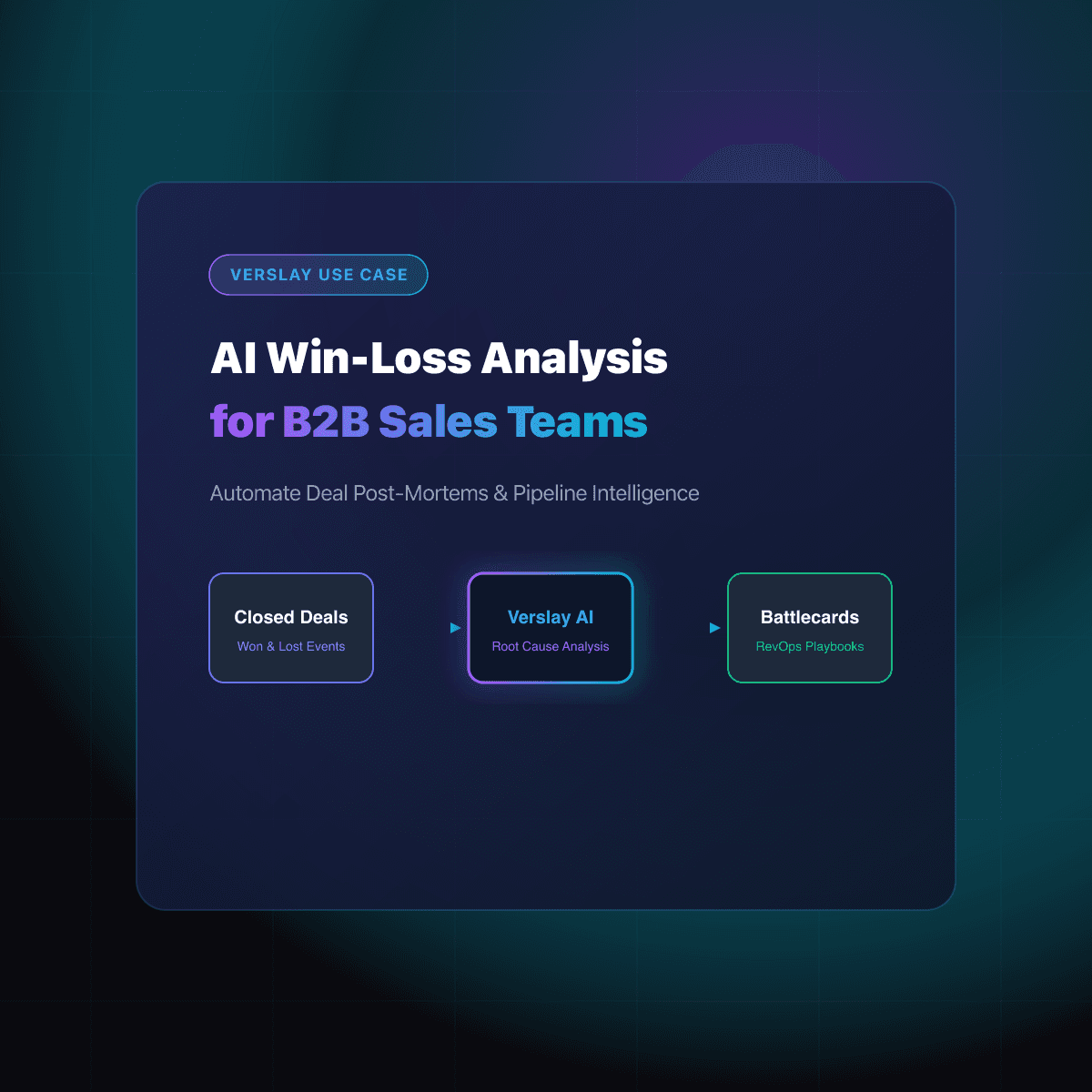
AI Win-Loss Analysis for B2B Sales Teams
AI win-loss analysis for B2B sales teams connects CRM platforms, sales conversation intelligence, and buyer feedback loops to automatically analyze why deals are won or lost. By replacing subjective sales rep post-mortems with data-driven AI pattern extraction, revenue operations teams uncover pricing friction, product feature gaps, and competitive dynamics in real time—boosting overall pipeline win rates by 15% to 25%.
In high-growth sales organizations, understanding the true drivers of closed deals is essential for sustainable revenue expansion. However, traditional post-deal feedback relies heavily on busy sales reps filling out mandatory CRM fields, leading to superficial loss reasons like "lost on price" or unverified customer sentiment. Deploying autonomous AI agents turns unstructured sales interactions into structured pipeline intelligence.
The Flaws of Traditional Win-Loss Reviews
Standard B2B win-loss analysis processes suffer from systemic operational friction that skews sales strategy:
- Sales Rep Bias & Fatigue: Reps often select default CRM picklist items (e.g., "Price" or "Feature Gap") to complete deal updates quickly, masking true underlying buying decisions.
- Fragmented Context: Key win/loss signals are scattered across call recordings, email threads, pricing calculators, and legal redlines rather than unified in central reports.
- Delayed Feedback Loops: Quarter-end reviews analyze deals months after they close, allowing negative patterns and competitor displacement to persist unchecked.
- Low Buyer Response Rates: Manual post-sale outreach by third-party research agencies receives low completion rates from busy decision-makers.
By embedding AI intelligence directly into your CRM, revenue leaders build continuous learning systems into their revenue stack. Explore our AI Agents for Sales and HubSpot AI Agents to learn how agentic workflows transform raw pipeline data into actionable sales playbooks.
How AI Win-Loss Analysis Workflows Function
Autonomous AI agents execute a multi-stage analysis pipeline whenever a deal moves to Closed Won or Closed Lost:
[CRM Stage: Closed-Won / Closed-Lost]
                 │
                 ▼
    1. AI Ingests Deal Artifacts
    (CRM Stage History, Transcripts, Emails)
                 │
                 ▼
    2. Sentiment & Root Cause Extraction
    (Identify Objections, Competitors, Pricing)
                 │
                 ▼
    3. Automated Buyer Feedback Survey
    (Contextual Micro-Survey Email Dispatch)
                 │
                 ▼
    4. Aggregate Intelligence & Alerts
    (Update Battlecards, Product & RevOps Dashboards)
1. Multi-Channel Data Aggregation
Upon deal stage transition, the AI agent aggregates all digital touchpoints recorded during the deal lifecycle. It parses demo call transcripts, security questionnaire exchanges, email negotiation chains, and quote revisions.
2. Deep Root-Cause Synthesis
Using natural language understanding, the agent isolates core decision drivers. It distinguishes between genuine budget constraints and unaddressed technical requirements, identifying specific competitors mentioned and evaluation criteria emphasized by buyers.
3. Contextual Buyer Micro-Outreach
If additional buyer perspective is needed, the AI dispatches personalized micro-surveys tailored to the specific deal context. These short 2-question prompts yield significantly higher response rates than generic 20-minute interviews.
4. Continuous Playbook & Battlecard Optimization
Synthesized findings populate real-time dashboards for Product Marketing and Sales Enablement. When multiple deals are lost to a specific competitor feature, the agent automatically updates internal battlecards and notifies product managers. See how our RFP Response Automation and Lead Scoring Automation leverage shared intelligence across the sales lifecycle.
Manual vs. AI-Driven Win-Loss Analysis
Comparing traditional manual reviews with automated AI agent analysis demonstrates clear efficiency gains:
| Dimension | Manual Post-Mortems | AI Win-Loss Intelligence | | :--- | :--- | :--- | | Data Collection Time | 3–5 hours per deal | Instant (< 3 seconds post-close) | | Insight Depth | Single rep opinion / picklist | Multi-channel transcript & email synthesis | | Analysis Coverage | < 10% of deals (high-value only) | 100% of pipeline (all deal sizes) | | Actionability | Quarterly PDF reports | Real-time alerts & battlecard updates |
Deploying AI Win-Loss Automation with Verslay
Implementing AI win-loss analysis with Verslay requires no custom script maintenance. Verslay MCP tools allow revenue operations teams to connect CRM records, email logs, and conversation tools securely while maintaining full data privacy and governance.
Start unlocking true pipeline intelligence today by powering your revenue team with Verslay's AI agent platform.