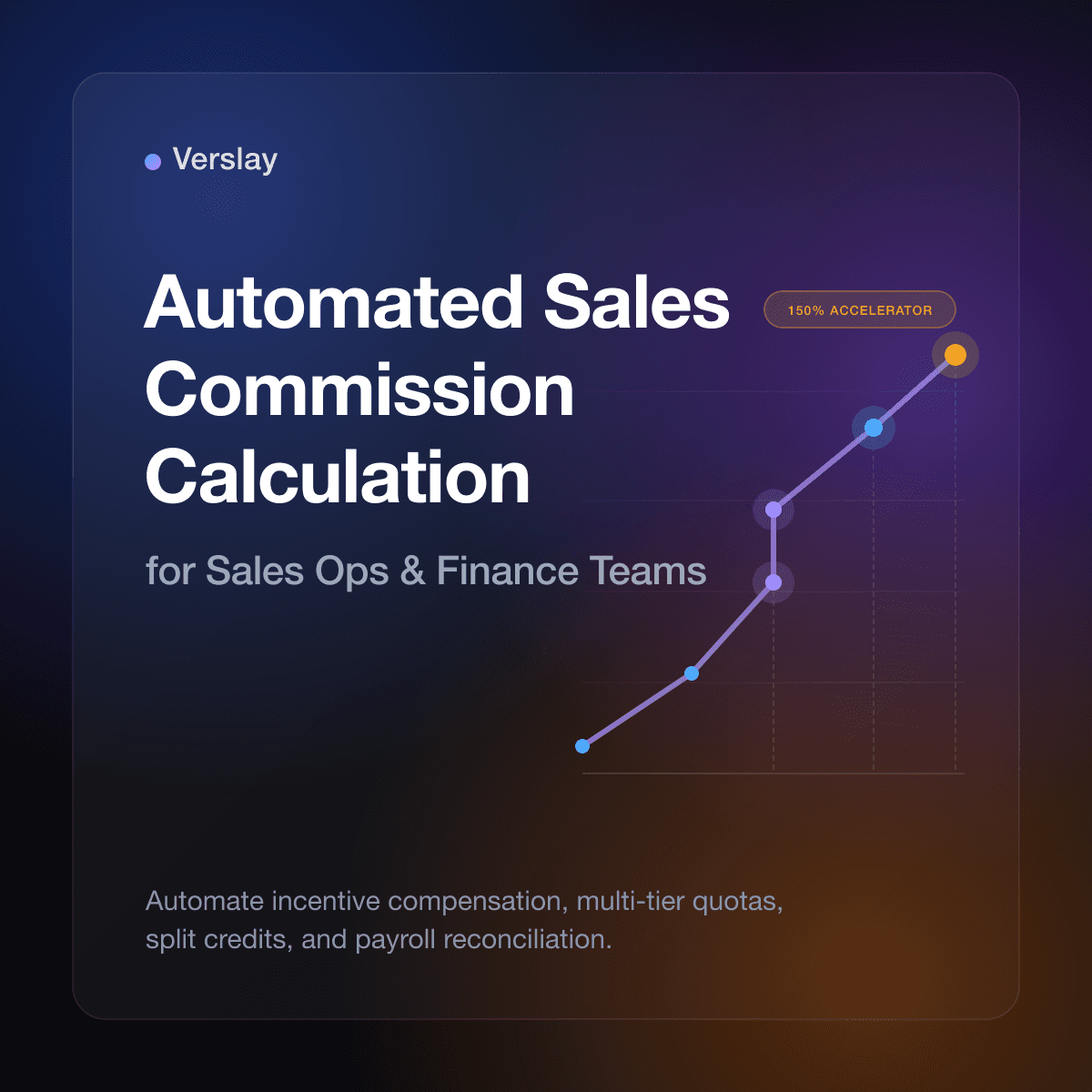
Automated sales commission calculation is the technology-driven process of capturing closed-won deal data from CRM systems, evaluating transactions against multi-tiered compensation plans, applying quota accelerators and split credits, and synchronizing verified commission payouts into payroll and general ledger systems. By replacing fragile spreadsheet workbooks with autonomous logic engines, automated sales commission calculation eliminates payout discrepancies, accelerates month-end commission settlement from weeks to hours, and provides revenue teams with real-time earnings visibility.
In fast-growing enterprise sales organizations, incentive compensation is the primary lever for driving commercial velocity. Yet the operational mechanics of calculating and disbursing commissions remain notoriously error-prone. As companies expand, compensation plans become increasingly sophisticated—incorporating tiered attainment thresholds, non-linear accelerators, multi-product weighting, team-based splits, non-standard payment terms, and dynamic clawback rules.
When sales operations and finance teams attempt to manage these variables in manual spreadsheets, the results are predictable: delayed payroll cutoffs, calculation disputes, and rampant "shadow accounting," where account executives spend hours building personal spreadsheets to verify their commission checks. By integrating AI agents for sales operations and finance, organizations can automate the entire commission lifecycle, bridging the gap between closed deals in the CRM and accurate disbursements in payroll.
The Operational Friction of Spreadsheet-Based Commission Tracking
Managing incentive compensation in spreadsheets creates severe administrative drag and governance risk for both sales operations and finance departments:
- Complex Plan Proliferation: Modern sales teams rarely operate under a single, flat commission rate. Inbound SDRs, outbound BDRs, enterprise Account Executives (AEs), Customer Success Managers (CSMs), and sales engineers each possess unique compensation structures with varying base salaries, on-target earnings (OTE), and variable splits.
- Dynamic Quota Accelerators & Step-Ups: Top-performing reps often unlock higher marginal payout rates after crossing 100% or 120% of their quarterly quota. Manually tracking the exact transaction that triggers a tier transition—and splitting that transaction value across both standard and accelerated rates—is a frequent source of manual calculation errors.
- Multi-Party Deal Splits & Overlay Credits: Strategic enterprise accounts frequently involve multiple contributors, such as geographic account owners, vertical industry specialists, technical architects, and channel partner managers. Manually calculating fractional credit allocations across disparate CRM opportunities introduces confusion and duplicate commission payouts.
- Contract Modifications, Cancellations & Clawbacks: When a customer downgrades, cancels early, or fails to pay their invoice within agreed terms, finance must initiate a commission clawback. Tracking deferred commission obligations and netting negative adjustments against future payouts across different quarters requires complex historical reconciliation.
- Booking vs. Billing Disconnect: Sales compensation is often booked when an opportunity closes in the CRM, but payroll disbursement may be contingent upon customer payment or invoicing verification in the ERP. Manual reconciliation between systems often leads to premature payouts or unrecorded liabilities.
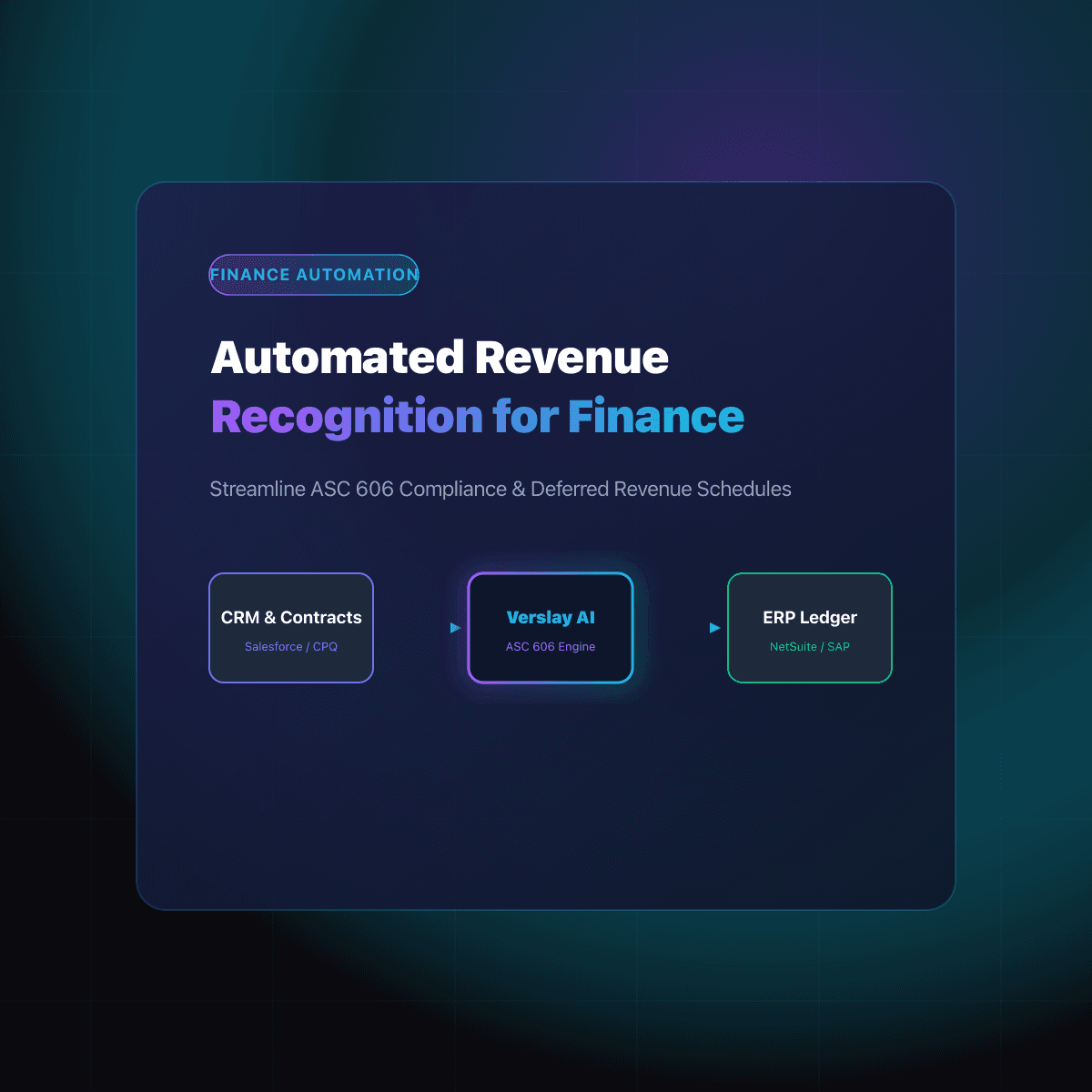
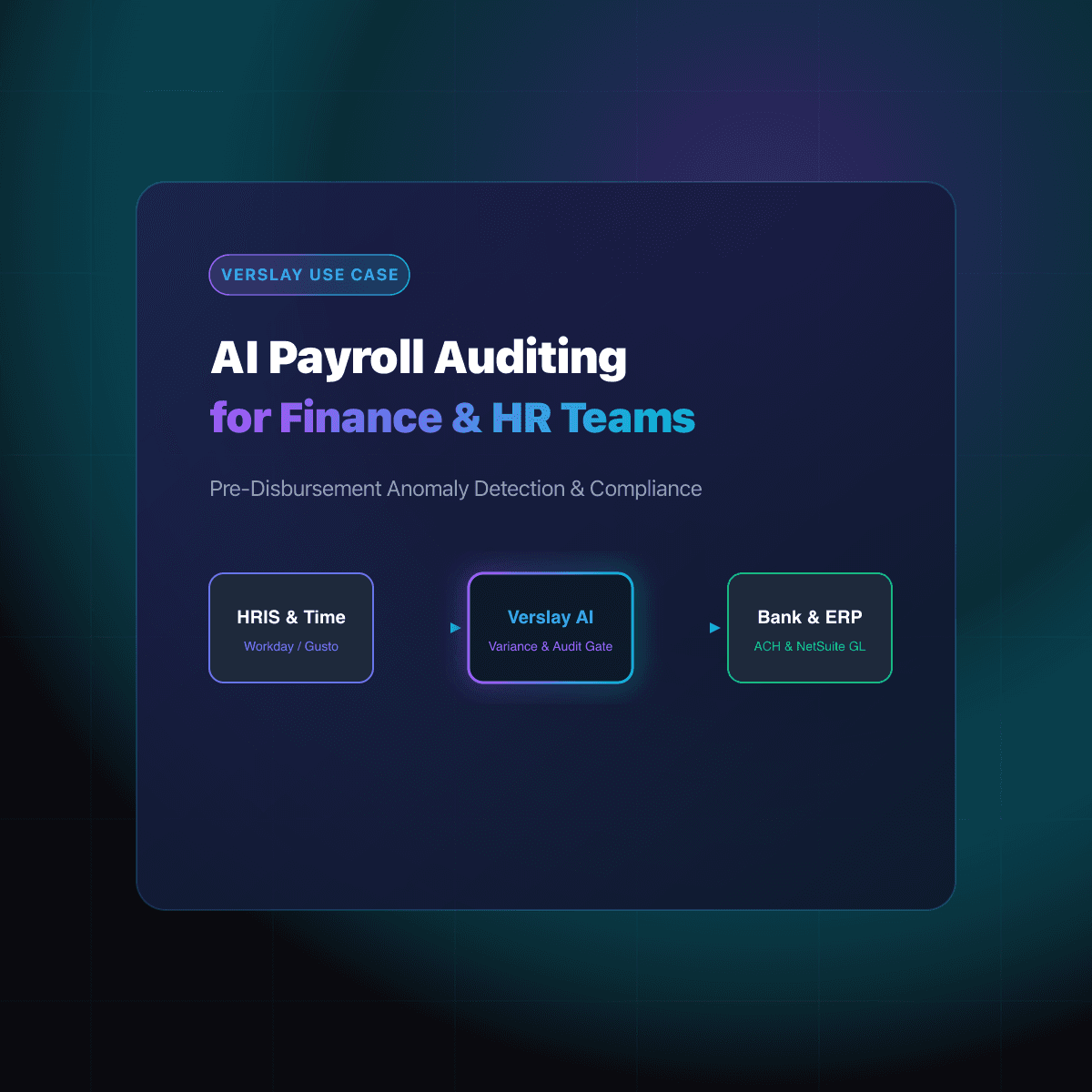
To explore how automated workflows solve adjacent billing and compensation challenges, read our analyses of automated revenue recognition for finance teams and AI payroll auditing for finance and HR teams.
How Autonomous AI Agents Automate Sales Commission Calculations
Autonomous software agents transform commission management from an arduous month-end scramble into a continuous, event-driven calculation stream. Sitting between your CRM, billing platform, ERP, and HRIS, autonomous agents execute five critical stages of the compensation cycle:
1. Real-Time Opportunity Ingestion & Deal Desk Validation
When an opportunity reaches "Closed-Won" status in Salesforce or HubSpot, an autonomous agent captures the deal payload:
- Contract Parameter Verification: Ingests total contract value (TCV), annual recurring revenue (ARR), payment schedules, discount percentages, and multi-year commitments directly from approved deal desk quotes.
- Governance Filtering: Checks against predefined policy gates (such as credit approval, signature validation, or minimum gross margin thresholds) before queuing the transaction for commission crediting.
2. Attainment Tracking & Tiered Quota Evaluation
- Rep Profile Matching: Maps the opportunity to the rep’s active compensation plan, effective date range, and current quota attainment tier.
- Marginal Step-Up Splitting: If a deal crosses an accelerator threshold (e.g., transitioning from 10% commission below 100% quota to 15% commission above 100%), the calculation engine automatically bisects the deal value, applying the base rate to the pre-quota portion and the accelerated rate to the surplus.
3. Split Credit & Overlay Allocation
- Automated Credit Matrix: Reads team participation metadata directly from the CRM opportunity team table, allocating predefined percentage splits to the primary owner, co-sellers, and technical specialists without manual data re-entry.
- Manager Rollup Calculations: Automatically rolls eligible deal credits up the reporting hierarchy, updating sales managers' and regional directors' override pools based on aggregated team attainment.
4. Continuous Clawback & Adjustment Handling
- Invoice Aging & Collections Monitoring: Continuously cross-references billing feeds from Stripe, NetSuite, or QuickBooks. If an invoice remains uncollected beyond contractual grace periods, the agent flags the commission for hold or initiates an automated clawback schedule.
- Audit-Logged Adjustments: Automatically recalculates balances and logs adjustments in the rep’s upcoming compensation statement, complete with transparent explanations and source invoice links.
5. Statement Publishing & Payroll General Ledger Sync
- Self-Service Rep Transparency: Publishes interactive commission statements where sales reps can inspect line-by-line earnings, current attainment, projected accelerators, and historical payouts in real time.
- Journalized Payout Files: At the close of each compensation cycle, compiles approved payout batches and syncs formatted files directly to payroll platforms (such as ADP, Workday, or Rippling) and ERP general ledgers.
Learn more about orchestrating multi-system enterprise workflows with AI agents for business automation.
Architecture of an Automated Sales Commission Pipeline
The diagram below shows how an autonomous commission engine orchestrates data across CRM deals, plan calculation logic, and payroll settlement:
[CRM & Deal Desk]                 [Billing & ERP Systems]
(Salesforce, HubSpot, DealHub)     (Stripe, NetSuite, QuickBooks)
          │                                   │
          ▼                                   ▼
 [Closed-Won Opportunity]             [Cash Collection Feed]
 (ARR, TCV, Rep, Products)           (Invoice Status & Aging)
          │                                   │
          └─────────────────┬─────────────────┘
                            │
                            ▼
           [Commission Rules & Plan Engine]
           ┌────────────────┴────────────────┐
           ▼                                 ▼
 [Quota & Tier Evaluation]        [Split & Overlay Logic]
 (Base, Accelerator, Caps)        (Rep, SE, Manager Pools)
           │                                 │
           └────────────────┬────────────────┘
                            │
                            ▼
              [Exception & Hold Verification]
              (Discounts, Collections, Clawbacks)
                            │
                            ▼
              [Interactive Rep Statement]
              (Real-Time Attainment & Disputes)
                            │
                            ▼
             [Payroll & General Ledger Sync]
             (ADP, Workday, Rippling, NetSuite)
- Event Capture: Webhook listeners trigger calculations instantaneously upon CRM deal closure or ERP invoice payment.
- Deterministic Computation: Business rules and math equations run within a hardened execution sandbox, guaranteeing 100% mathematical accuracy without manual formula overrides.
- Continuous Re-evaluation: If a contract is amended or cancelled, the compensation engine dynamically re-evaluates historical attainment without corrupting prior closed periods.
- Immutable Audit Trails: Every calculation parameter, quota tier transition, and adjustment reason is preserved for external financial audits.
Commission Calculation Logic Matrix: Scenario vs. Automated Handling
Sales compensation plans incorporate diverse operational nuances. The matrix below outlines how an autonomous commission engine evaluates and executes complex commercial scenarios:
| Compensation Scenario | Commercial Condition | Commission Calculation Treatment | Automated Agent Execution | | :--- | :--- | :--- | :--- | | Standard New Business | Rep at 80% quota closes a $50k ARR deal with standard 10% commission rate | Linear rate applied to full contract ARR | Identifies eligible ARR, validates rep compensation plan, and queues a $5,000 commission for the next payroll cycle. | | Tiered Quota Accelerator | Rep needs $20k to hit 100% quota; closes a $60k deal with an accelerator from 10% to 15% | Marginal split calculation across quota threshold | Allocates $20k at the standard 10% rate ($2,000) and the remaining $40k at the accelerated 15% rate ($6,000), totaling $8,000. | | Co-Selling Team Split | Enterprise AE and Industry Solutions Specialist co-sell a $120k deal with a 70/30 credit split | Proportional allocation based on opportunity team roles | Credits $84k deal volume to the AE and $36k to the Specialist, evaluating each rep’s respective commission rate and attainment tier independently. | | Payment-Contingent Payout | Deal terms require 50% commission upon booking and 50% upon invoice cash collection | Phased milestone disbursement linked to ERP status | Disburses 50% upon CRM Closed-Won stage; monitors ERP receivables and automatically releases the remaining 50% once cash settles. | | Customer Early Cancellation | Customer cancels annual agreement in Month 3 with a standard 180-day clawback policy | Recapture of unearned commission against future earnings | Automatically detects subscription cancellation in billing system, calculates unearned commission balance, and applies clawback deduction to next payout cycle. | | Sales Management Override | Regional VP receives a 1.5% override on all closed deals across five AE territories | Hierarchical aggregation and management pool crediting | Aggregates all closed-won volume across assigned direct reports and automatically credits the regional override pool without duplicate bookings. |
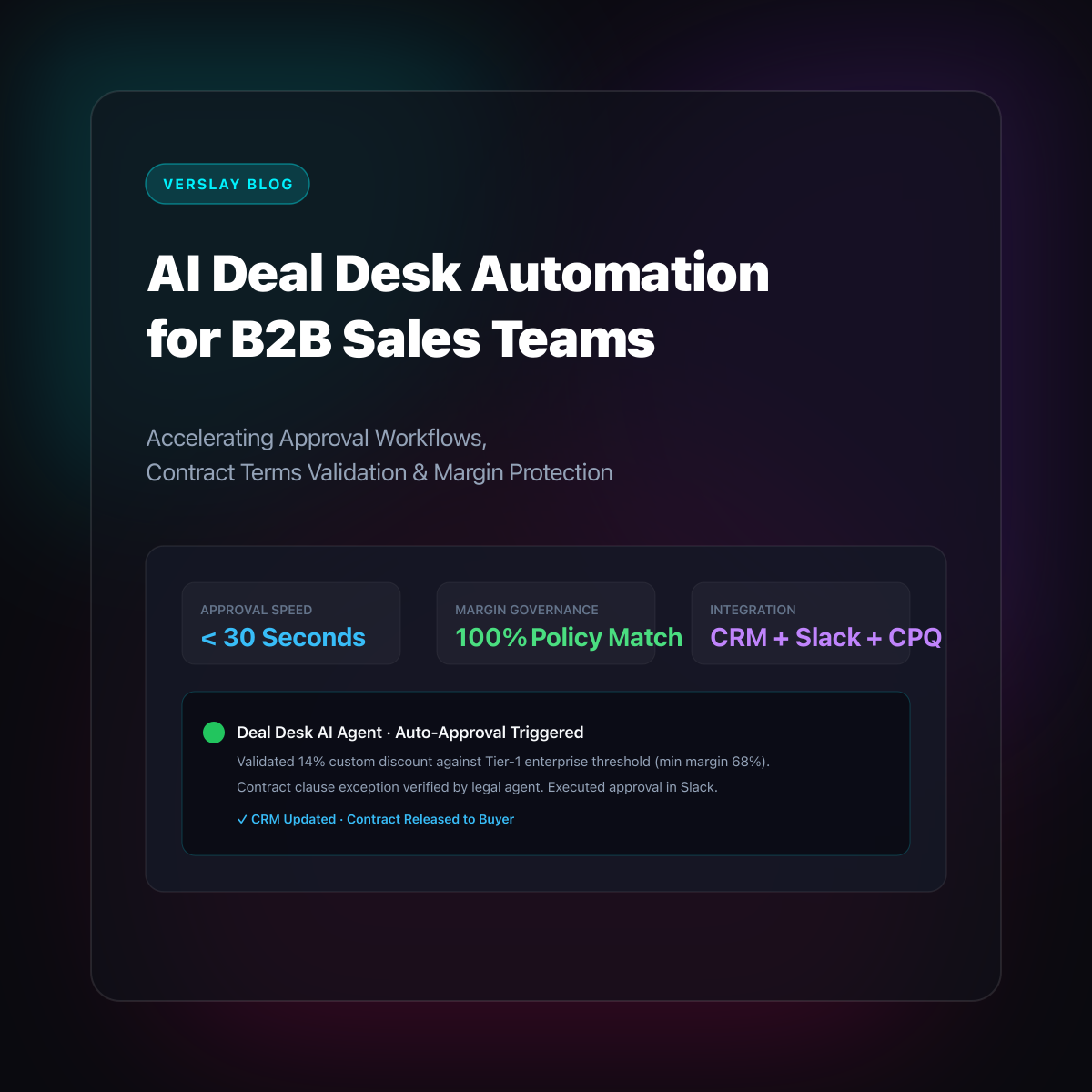
For organizations evaluating broader sales automation strategies, explore our guide on AI deal desk automation for B2B sales teams.
Accounting Governance & ASC 340-40 Compliance
Beyond operational efficiency, automated sales commission software plays a vital role in corporate financial compliance under ASC 340-40 (Contracts with Customers: Cost of Contracts).
Under GAAP standards, incremental costs incurred to obtain a contract—primarily sales commissions—must be capitalized on the balance sheet as contract assets and amortized systematically over the estimated period of benefit (often 3 to 5 years), rather than expensed immediately:
- Automated Cost Capitalization: An automated commission platform automatically categorizes commission payments into capitalized contract acquisition assets versus immediately expensable bonuses.
- Systematic Amortization Schedules: The system builds monthly amortization waterfall schedules that mirror customer contract life and portfolio retention models, pushing balanced journal entries to the ERP.
- Audit-Ready Substantiation: During annual audits, finance teams can furnish comprehensive, transaction-level reports tying balance sheet asset balances directly to underlying sales contracts, eliminating hours of spreadsheet reconstruction.
Strategic Benefits for Revenue Operations and Finance
Implementing automated sales commission calculations delivers quantifiable strategic improvements across the enterprise:
- Elimination of Shadow Accounting: When sales reps have real-time, transparent visibility into deal earnings and pipeline attainment, they stop wasting productive selling hours building and disputing personal spreadsheets.
- Accelerated Payroll Close: Compresses the commission reconciliation cycle from multiple days of manual spreadsheet verification to a rapid, 30-minute approval workflow.
- Increased Sales Motivation: Real-time commission calculators allow reps to model potential earnings on in-flight pipeline deals, driving higher deal sizes and faster close rates.
- Zero Calculation Overpayments: Eliminates formula errors, double-counting on split deals, and missed clawbacks, typically saving growing organizations between 2% and 5% of their total annual commission expenditure.
Frequently Asked Questions
How is sales commission calculated automatically?
Automated sales commission calculation systems pull verified closed-won deal data from CRMs, match transactions against rep-specific compensation plans and tiered quota rules, calculate commissions with splits and accelerators, and push approved payouts directly into payroll software.
What are the main challenges in manual sales commission calculation?
Manual commission calculations in spreadsheets suffer from high human error rates, delayed payout schedules, lack of visibility for sales reps, complex split and clawback disputes, and difficult reconciliation between CRM booking records and ERP billing ledgers.
How does automated sales commission software integrate with CRM and payroll systems?
Autonomous integration agents listen for closed-won events in CRMs like Salesforce or HubSpot, apply custom compensation logic, flag commission exceptions for sales ops review, and export journalized payout files directly into HRIS and payroll tools like Workday, ADP, and Rippling.