Competitor Price Monitoring for Online Stores: A Guide
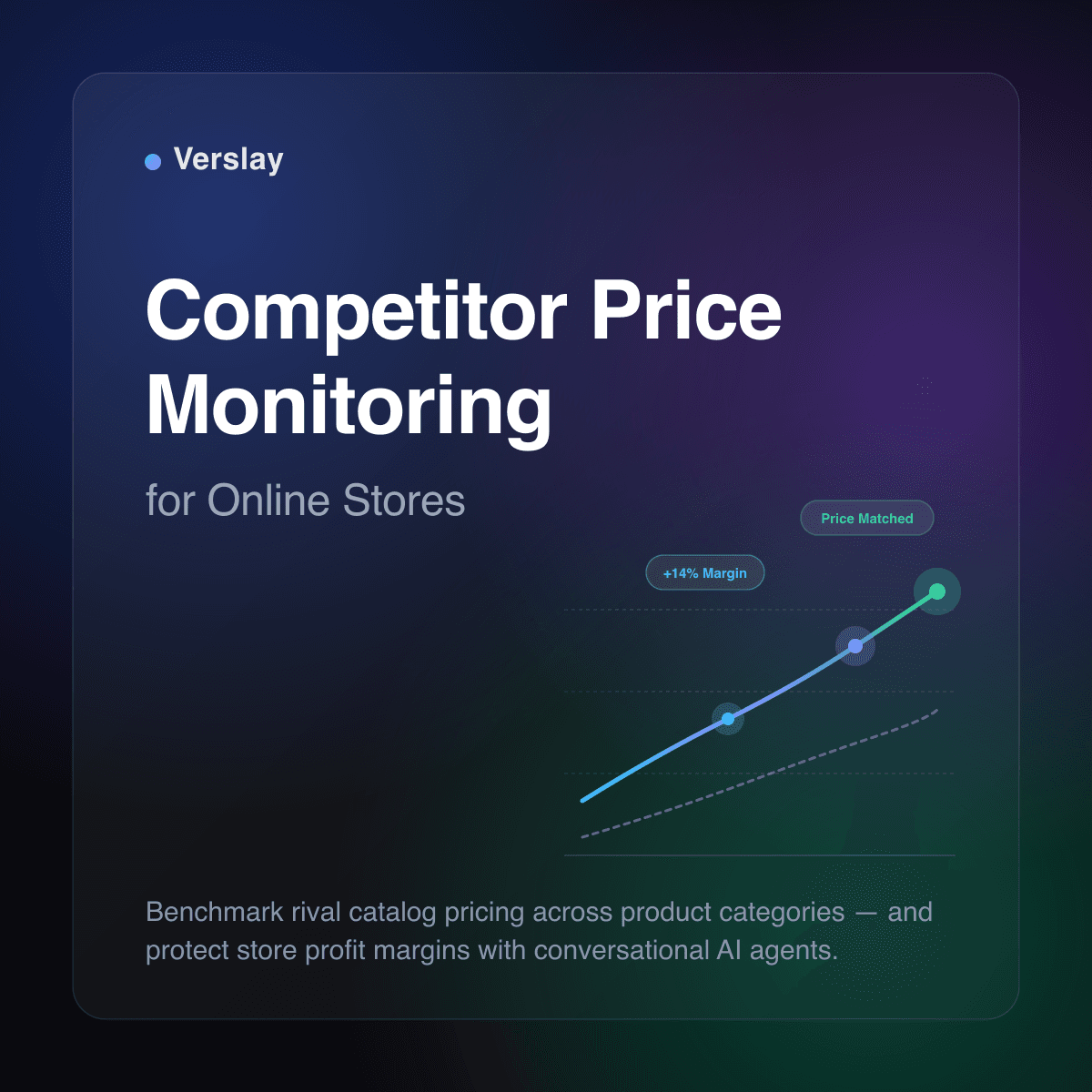
Competitor price monitoring for online stores tracks rival catalog pricing, discount campaigns, and product availability to help ecommerce merchants safeguard profit margins and make informed adjustments. Rather than manually copying numbers from competing websites or blindly engaging in price wars, store teams use AI agents in Claude to benchmark catalog pricing against market rates and draft margin-safe updates. This operational workflow preserves gross margin while ensuring your storefront remains compelling to price-conscious shoppers.
At a glance
- Core function: Scans competitor product prices and stock availability to identify pricing gaps and margin opportunities.
- How it runs: Connects directly to Claude through the Verslay Model Context Protocol (MCP) server without custom code.
- Key advantage: Replaces manual spreadsheets with automated margin calculations and floor-price protections.
- Ideal for: Growing Shopify brands, multi-brand retailers, and DTC merchants with 50 to 5,000 active SKUs.
Why is manual competitor price tracking unsustainable for online retailers?
Pricing decisions directly dictate ecommerce conversion rates and cash flow. When rival merchants launch flash discounts, bundle deals, or seasonal promotional events, online store operators must decide quickly whether to match prices or maintain their positions. Doing this manually across dozens of competing storefronts creates severe operational bottlenecks:
- Spreadsheet Fatigue and Human Error: Operations staff spend hours every week searching competitor websites, copying SKUs, and pasting prices into spreadsheets. Manual data entry frequently introduces typos, mismatches variant sizes, and consumes valuable time that could be dedicated to merchandising.
- Lagging Market Information: By the time an operations associate discovers a rival promotion in a weekly manual audit, the competitor may have already dominated sales for five days. Delayed pricing intelligence leaves your store vulnerable to lost search traffic and abandoned carts.
- Hidden Discount Blindspots: Competitors often hide real discounts behind promotional discount codes, threshold shipping rules, or bundle pricing. A basic manual glance at a product listing often fails to capture the effective checkout price a customer actually pays.
- The Race-to-the-Bottom Hazard: Without strict gross margin floor calculations, store owners who impulsively lower prices to beat rivals risk erasing their profitability. Slashing prices without evaluating cost of goods sold (COGS) turns high sales volume into net losses.
- Multi-Channel Catalog Inconsistencies: Modern merchants sell across direct storefronts, digital marketplaces, and social channels. Reconciling competitor positioning across fragmented retail touchpoints manually is nearly impossible once a catalog expands beyond 50 active items.
According to official Shopify pricing documentation, setting strategic product prices requires balancing market demand with clear profit margins. Relying solely on manual website checks leaves merchants blind to rapid pricing shifts across competing stores.
Explore our AI Agents catalog to see how dedicated assistants support price auditing, inventory monitoring, and daily operations across modern online storefronts.
How do AI agents monitor competitor catalog prices in Claude?
The foundation of modern pricing analysis is the Model Context Protocol (MCP). Verslay connects your online storefront directly to your team workspace in Claude. Rather than requiring external monitoring subscriptions or complex web-scraping code, Claude acts as an interactive pricing analyst that benchmarks catalog items on demand.
An AI competitor price monitoring workflow operates in four disciplined stages:
- Catalog and Benchmark Mapping: Claude accesses your active product catalog via the Verslay MCP server. The agent pairs each internal SKU with verified competitor product URLs, establishing an accurate benchmark mapping for identical or equivalent items.
- Price and Promotion Extraction: When an audit prompt is triggered, Claude inspects the designated competitor pages. The agent retrieves public listing prices, variant-level surcharges, bundle terms, and active promotional banners.
- Margin Calculation and Guardrail Enforcement: Claude cross-references competitor pricing against your internal unit costs and target gross margin thresholds. If a competitor discounts an item below your breakeven floor, the agent highlights the discrepancy but advises against matching the price.
- Actionable Repricing Briefs: Rather than blindly editing catalog database entries, Claude compiles an audit report. The brief outlines competitor price movements, identifies opportunities to raise prices where competitors have increased theirs, and presents drafted adjustments for management confirmation.
Review our MCP integrations directory to understand how Claude connects directly with ecommerce stores, logistics tools, and data sources.
How does manual price tracking compare to conversational AI price monitoring?
To understand how conversational agents transform retail operations, consider the functional differences between conventional manual spreadsheets and AI-assisted price monitoring:
| Operational Dimension | Manual Spreadsheet Tracking | Conversational AI Price Monitoring | | :--- | :--- | :--- | | Audit Frequency | Periodic weekly or monthly sampling | Daily or on-demand automated catalog scans | | Data Accuracy | Susceptible to manual transcription errors | Direct page parsing and standardized SKU matching | | Margin Integration | Requires complex disconnected formulas | Live synthesis with unit costs and floor margin rules | | Competitor Stock Awareness | Rarely monitors whether rival stock is available | Identifies rival stockouts to capture margin premiums | | Execution Workflow | Manual price adjustments one item at a time | Drafted repricing tables ready for manager sign-off | | Human Interface | Cumbersome spreadsheet files and tabs | Interactive conversational questions and reports in Claude |
For more ecommerce automation playbooks, visit our ecommerce use cases library.
How can store managers implement competitor price audits with Claude?
Deploying competitor price monitoring with Claude requires no programming knowledge or server maintenance. Store managers can run comprehensive pricing audits using four straightforward steps:
Step 1: Connect your store catalog via Verslay MCP
Configure your Shopify store in the Verslay management hub. This authorizes Claude to read product titles, active SKUs, current retail prices, and inventory balances securely during your sessions.
Step 2: Establish competitor URLs and margin guardrails
Provide Claude with a basic reference list of your key competitors, their corresponding product URLs, and your minimum target margin percentages (for example, never dropping below 40% gross margin on apparel or 30% on hardware).
Step 3: Run your pricing audit prompt in Claude
When conducting your daily or weekly pricing review, submit an operational prompt to Claude. Here is a practical prompt template designed for ecommerce operators:
Please perform a competitor price audit for our store catalog:

1. Query current retail prices and inventory balances for our top 20 revenue-generating SKUs.
2. Check the corresponding competitor product URLs provided in our benchmark list.
3. Extract rival prices, active discounts, and stock availability for each equivalent product.
4. Compare our pricing against competitor pricing:
   - Identify items where our price is more than 5% above the market average.
   - Identify items where competitors are out of stock and we can capture full margin.
   - Flag any competitor price that sits below our 35% minimum gross margin floor.
5. Provide a summary table including:
   - SKU and Product Name
   - Our Current Price
   - Competitor Benchmark Price
   - Price Variance Percentage
   - Recommended Action (Match, Hold, or Increase)
6. Draft a recommended price update table that I can review and confirm.
Step 4: Review and approve drafted adjustments
Claude generates an organized comparison table highlighting where your prices sit relative to the market. If a rival has raised prices or sold out of inventory, you can capture extra margin by adjusting your rate upward. Once you review and confirm the proposed changes, you can apply them with full confidence in your unit economics.
How does Verslay protect store data and prevent unwanted price changes?
Protecting store security and maintaining pricing governance is vital when managing retail catalogs. Verslay maintains rigorous operational protections:
- Customer-Owned AI Interface: All data analysis occurs within your team workspace in Claude. Verslay does not retain private sales records or commercial customer data.
- Zero Local Infrastructure: Your company does not need to deploy private cloud servers, host web scraper scripts, or maintain custom code.
- Strict Human Approval Gates: AI agents draft pricing suggestions and margin calculations; they never modify live store prices without explicit merchant confirmation.
- Auditable Tool Actions: Store operators view every catalog query and benchmarking check that Claude executes, ensuring complete operational transparency.
To explore plans and capabilities tailored for growing online merchants, visit our pricing page.
Frequently asked questions
What is competitor price monitoring for online stores?
Competitor price monitoring for online stores is the systematic tracking of rival merchant pricing, promotions, and shipping fees to help retailers safeguard margins and remain competitive.
How does AI track competitor prices without manual scraping?
AI agents in Claude use the Verslay MCP server to query live product URLs and public competitor catalogs on demand, extracting exact price points and variant matches without brittle scraping scripts.
Can AI automatically adjust my Shopify store prices?
While AI agents calculate suggested price adjustments and margin impacts, they draft recommendations for merchant approval rather than altering store prices without human authorization.
How does competitor price monitoring protect gross profit margins?
By pairing competitor benchmark data with cost of goods sold (COGS) guardrails, price monitoring prevents destructive race-to-the-bottom discounting and flags when rival price increases allow healthy margin expansion.
Take the next step with Verslay
Automating competitor price monitoring helps ecommerce brands protect gross margins while maintaining market competitiveness. Schedule a consultation at https://calendly.com/verslay/30mins to see how our AI agents support your store operations.