Ecommerce Review Analysis with AI: Practical Store Guide
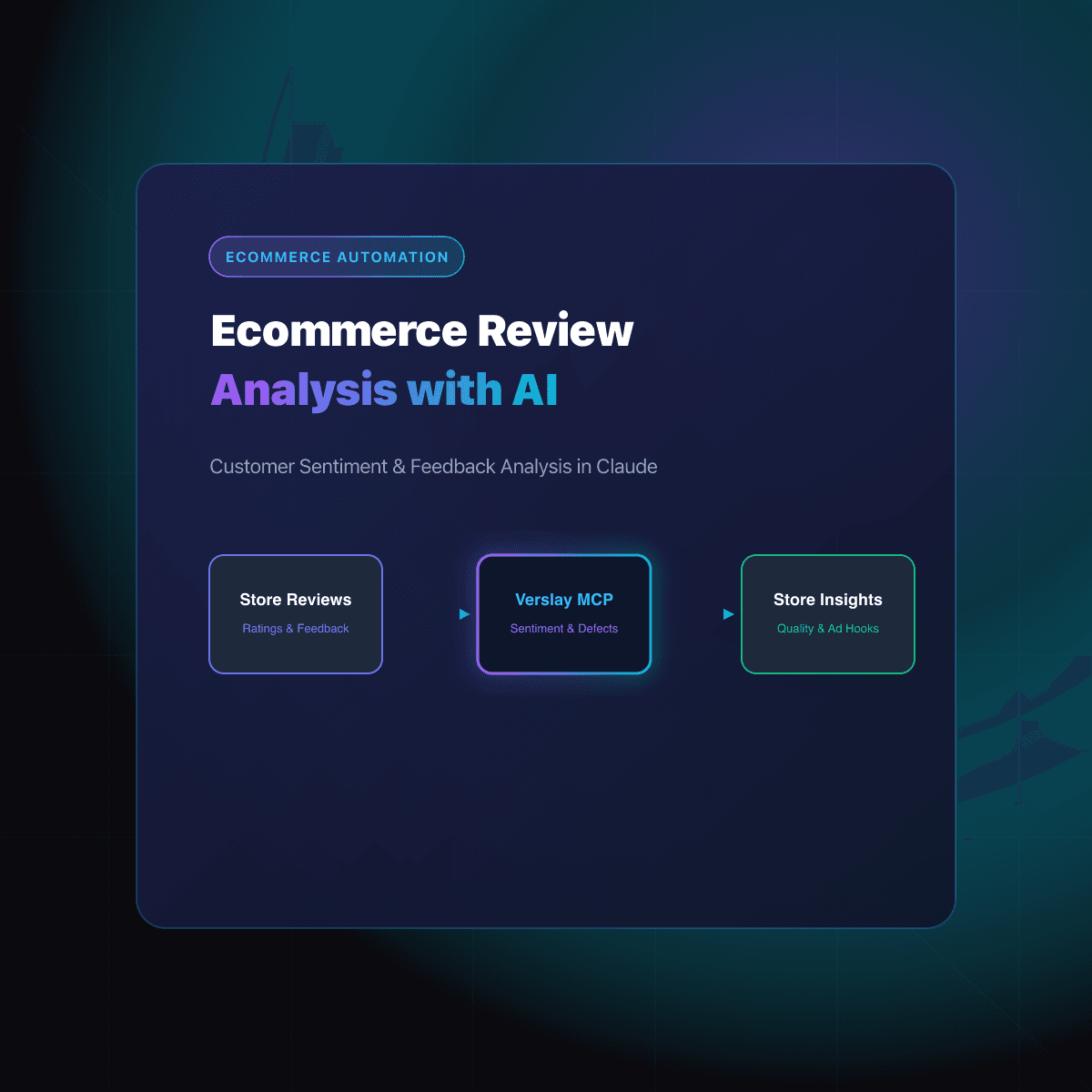
Analyzing ecommerce customer reviews with AI enables online store owners to extract actionable product feedback, spot emerging defect patterns, and gauge shopper sentiment across hundreds of feedback submissions using conversational Claude workflows. Rather than manually sorting through customer ratings across scattered marketplace channels and review widgets, merchants use the Verslay MCP server to summarize recurring complaints and highlight high-converting feature requests. This structured feedback loop gives growing ecommerce teams rapid operational visibility while maintaining strict merchant oversight over store catalog adjustments.
At a glance
- Core function: Synthesizes customer review sentiment, clusters recurring product feedback, and identifies catalog improvement priorities using Claude.
- How it runs: Operates within your Claude workspace connected to your Shopify store and review data via the Verslay Model Context Protocol (MCP) server.
- Operational benefit: Eliminates hours of manual feedback sorting, surfaces critical product defects early, and guides merchandising decisions.
- Target merchant: Growing direct-to-consumer brands and multichannel ecommerce stores managing 50 to 5,000 monthly customer reviews.
What is ecommerce review analysis with AI?
Ecommerce review analysis with AI is the automated process of gathering, categorizing, and interpreting customer ratings and written feedback using large language models. Rather than relying on simple keyword filters or average star ratings that conceal subtle customer frustrations, merchants deploy Claude as an analytical assistant capable of understanding context, tone, and specific product nuance.
When a customer writes a three-star review stating that a jacket looks wonderful but the zipper sticks after two weeks of use, traditional numerical averages treat the rating as mildly positive. An AI workflow, however, immediately isolates the zipper durability issue, links it to the specific production run, and records the complaint under quality control metrics.
By connecting your store data to conversational AI, online retailers can ask direct questions about their catalog performance:
- Which product variants receive the most complaints regarding sizing and fit?
- What specific features do customers praise most frequently in five-star reviews?
- Are recent negative shipping reviews tied to a specific regional fulfillment center?
- What recurring phrases appear when shoppers compare our products against alternative brands?
Store operators can explore our AI Agents catalog to see how conversational assistants manage specialized workflows across ecommerce operations, customer communication, and catalog maintenance.
Why does manual review monitoring hold online stores back?
Monitoring customer feedback manually works well when a boutique store receives five reviews a week. Once an online business scales to dozens of daily orders across multiple collections, reading every submission becomes a persistent operational bottleneck.
Manual review monitoring creates several distinct operational liabilities:
- Delayed Defect Discovery: Merchants often notice manufacturing flaws or packaging weaknesses only after return rates spike and dozens of unhappy customers leave negative ratings.
- Superficial Star Metrics: Relying on overall star ratings masks critical product defects. A four-star average can easily hide a 20 percent failure rate on a specific component or closure.
- Channel Fragmentation: Customer feedback scatters across on-site review widgets, third-party marketplaces, social media comments, and support tickets, preventing a consolidated overview.
- Wasted Merchandising Insights: Enthusiastic customer testimonials contain exact phrases and use cases that could improve product page descriptions, yet these phrases remain buried in archived spreadsheets.
- Team Burnout: Customer service and marketing teams spend countless hours exporting CSV files and manually tagging feedback categories instead of resolving customer issues.
Online businesses that transition to automated analysis eliminate these administrative delays, allowing product teams to address design issues and marketing teams to refine ad copy quickly.
What operational insights can AI extract from customer reviews?
Modern AI agents do far more than count positive and negative adjectives. They perform multi-dimensional analysis that connects customer language directly to store inventory records and operational processes.
The table below contrasts standard manual review sorting with automated Claude analysis across key store functions:
| Feedback Analysis Area | Manual Review Sorting | Automated Claude Analysis | | :--- | :--- | :--- | | Sentiment Tracking | Subjective skimming of 1-star and 5-star ratings | Systematic sentiment classification across all star tiers | | Defect Detection | Delayed discovery until return rates spike | Flags recurring sizing or manufacturing defects in real time | | Feature Requests | Lost in customer support inboxes or spreadsheet rows | Clusters buyer enhancement ideas into prioritized product lists | | Competitor Benchmarking | Hours spent manually copying public feedback notes | Rapid comparative analysis of common merchant strengths and gaps | | Marketing Copy Inputs | Guessing customer language for ad headlines | Extracts exact customer phrases praising high-performing benefits |
By translating unstructured text into structured operational priorities, store managers make data-backed inventory and marketing choices. You can review complementary operational workflows across our ecommerce use cases.
How do you analyze store reviews using Claude and Verslay?
Setting up Claude to analyze customer reviews takes only a few minutes. Because Verslay provides ready-to-use MCP connectors, store teams never need custom coding or complex server setups.
Step 1: Connect your store and review channels
Log in to your Verslay account and connect your Shopify store along with your review applications. The platform provisions a dedicated MCP endpoint configured specifically for your store workspace.
Step 2: Register the Verslay MCP server in Claude
Add the Verslay MCP configuration details into your Claude desktop application or team workspace. Once connected, Claude gains direct access to query product collections, order records, and customer feedback.
Step 3: Run your review audit prompt
Open a conversation in Claude and execute a structured analytical prompt. Here is a practical prompt template designed for weekly review analysis:
Please audit all customer reviews submitted for our catalog over the past 30 days:

1. Query all recent reviews across our active product collections via the Verslay MCP server.
2. For each review, extract:
   - Product SKU and variant title
   - Star rating and review submission date
   - Primary customer sentiment (Positive, Neutral, Negative)
   - Core topics mentioned (Fit, Quality, Shipping, Price, Usability)
3. Identify top defect signals:
   - Flag any specific component failures or sizing discrepancies mentioned more than three times.
   - Correlate flagged SKUs with recent customer return reasons.
4. Extract marketing conversion hooks:
   - List the five most common phrases happy customers use to describe their favorite benefits.
5. Provide a summary breakdown with:
   - SKU and Variant Name
   - Total Review Volume and Average Sentiment Score
   - Primary Recurring Complaint (if any)
   - Actionable Merchandising Recommendation
6. Draft a brief executive summary for our production team highlighting any items requiring immediate quality inspection.
Step 4: Review findings and coordinate catalog updates
Claude returns an organized breakdown detailing customer sentiment, recurring complaints, and standout product praises. Store operators can review the findings, share the executive summary with suppliers, and update product description sizing charts to reduce future return inquiries.
To explore how these capabilities integrate with your existing commerce software stack, browse our integrations directory.
How does human oversight keep product and marketing decisions grounded?
While AI provides exceptional speed in parsing thousands of sentences, human merchant judgment remains essential when altering store operations or product design. Autonomous systems should inform choices rather than execute unilateral changes to your store catalog or supplier agreements.
Verslay ensures merchant control through several structural principles:
- Customer-Owned Interface: All data queries, prompt runs, and report generation take place within your team authenticated Claude account.
- Zero Local Infrastructure: Store owners never manage private virtual servers, database migrations, or custom API listeners.
- Merchant Approval Gates: Claude acts as an analytical research partner that flags trends and drafts recommendations. The assistant never modifies live store prices, alters product listings, or emails suppliers without explicit operator confirmation.
- Transparent Reasoning: Every analytical conclusion drawn by Claude cites the specific customer reviews and timestamps that informed the deduction, allowing operators to verify claims instantly.
Maintaining this balance between automated data synthesis and disciplined human review protects brand integrity while accelerating growth. To inspect flexible pricing packages suited for scaling DTC stores, visit our pricing page.
Frequently asked questions
How does an AI agent analyze customer sentiment across ecommerce reviews?
The agent evaluates review text for emotional tone, specific product mentions, and recurring complaint themes through the Verslay MCP server to deliver categorized sentiment breakdowns.
Can Claude connect directly to Shopify review apps and external channels?
Yes, Claude accesses review data from Shopify apps, customer support tickets, and external marketplaces through pre-built connectors without requiring custom integrations.
How does automated review analysis identify product defect trends?
By clustering recurring phrases regarding sizing, material durability, or packaging damage, Claude alerts merchants to manufacturing defects before return rates spike.
Does analyzing ecommerce reviews with AI require custom code or private hosting?
No custom programming or dedicated servers are required. The entire analysis workflow operates directly within your Claude workspace connected to your store via Verslay.
Take the next step with Verslay
Automating customer review analysis allows your team to spot product defect trends early, refine marketing messaging, and improve shopper retention without manual data sorting. Schedule a consultation at https://calendly.com/verslay/30mins to see how our AI agents support your store operations.