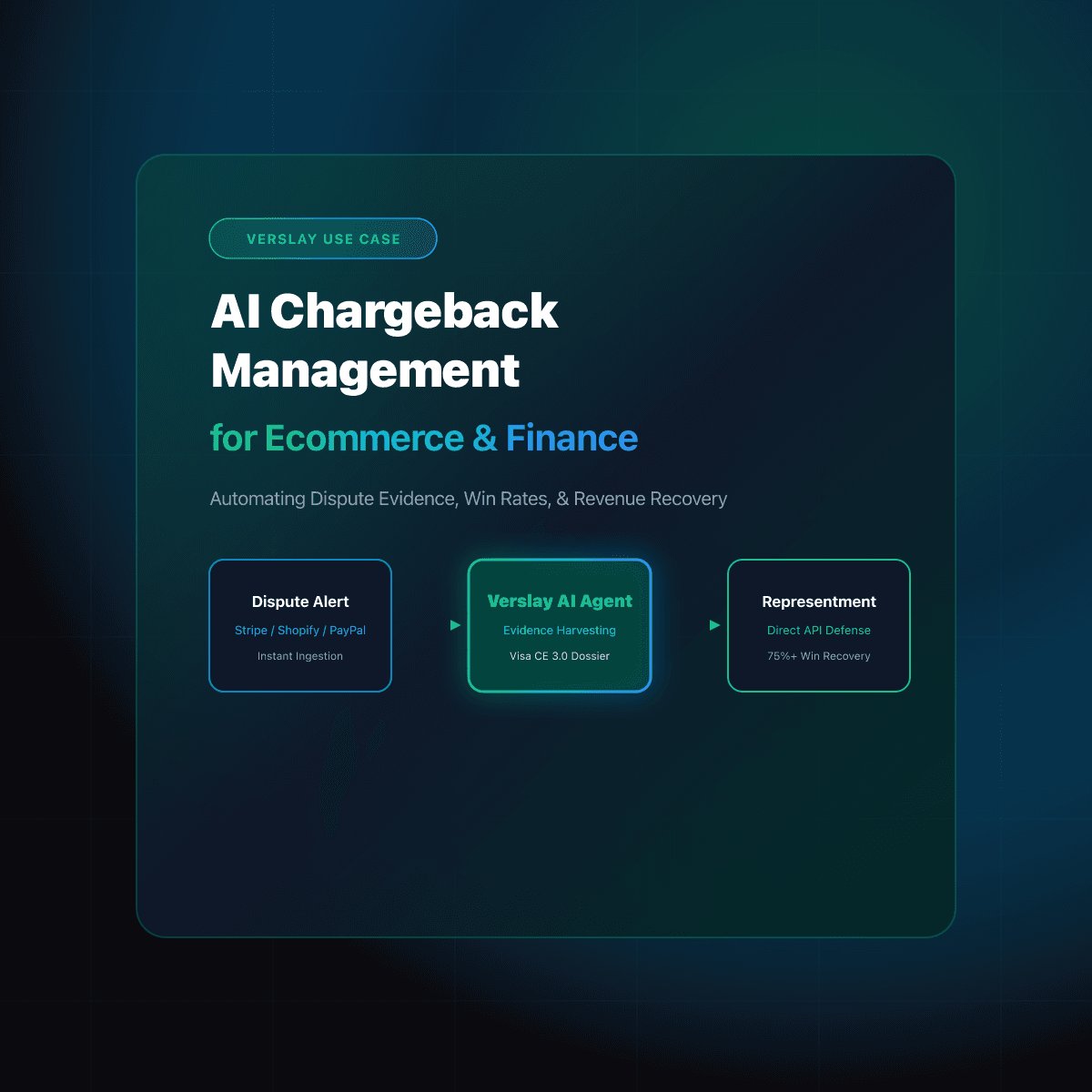
AI chargeback management automates dispute evidence compilation, representment packet generation, and revenue recovery for ecommerce brands and finance teams using autonomous AI agents. By connecting directly to payment processors like Stripe, Shopify Payments, and PayPal alongside order management systems and customer communication logs, AI agents detect chargebacks the instant they are filed, extract compelling transaction evidence, and submit winning representments without manual merchant intervention. This autonomous workflow elevates dispute win rates above 75% while protecting merchant processing accounts from punitive card network chargeback ratios.
Closest Verslay page: Stripe Payment Reconciler. Matches every Stripe payment, fee, and refund against your orders. It is the nearest live match for this topic, not a one-to-one fit.
For direct-to-consumer (DTC) brands, digital marketplaces, and high-volume ecommerce operations, customer chargebacks have evolved from an occasional cost of doing business into an existential threat to bottom-line profitability. Between mounting transaction dispute fees, forfeited inventory, and the growing surge of first-party fraud ("friendly fraud"), merchants lose billions of dollars annually to payment reversals that should have been successfully defended.
By deploying autonomous AI Agents capable of cross-referencing payment records, shipping logs, and customer service transcripts across fragmented SaaS architectures, finance teams can transform an exhausting manual firefighting routine into an automated revenue recovery engine.
The Hidden Cost of Chargebacks: Why Manual Representment Fails Growing Merchants
Fighting chargebacks manually has long been one of the most tedious operational drains in modern ecommerce. As order volumes scale, payment dispute workflows invariably break down under the weight of fragmented data and strict bank timelines:
- Strict Card Network Windows & Missed Deadlines: Issuing banks enforce unforgiving deadlines—often just 7 to 21 days—to submit dispute representment packages. When finance teams are already stretched across accounts receivable reconciliation, billing inquiries, and month-end closes, dispute alerts sit unnoticed in email inboxes until the claim automatically defaults to a total loss.
- The Explosion of "Friendly Fraud": Industry data indicates that over 70% of modern credit card disputes stem from first-party misuse rather than criminal identity theft. Customers claim "item not received" or "unrecognized charge" despite legitimate parcel delivery and repeated email correspondence. Disproving friendly fraud requires cross-referencing multi-system proof that rule-based filters cannot assemble.
- Disjointed Data Silos Across the Stack: Compiling compelling evidence demands pulling customer order histories from Shopify or BigCommerce, fulfillment tracking confirmations and carrier signatures from FedEx or ShipStation, fraud telemetry logs (AVS/CVV verification, IP geolocations) from Stripe, and ticket transcripts from Zendesk or Gorgias. Manually stitching these screenshots into a cohesive PDF takes 30 to 45 minutes per dispute.
- Disproportionate Labor Cost vs. Claim Value: When an average dispute represents $80 to $200 in merchandise value, spending an hour of an analyst's time compiling evidence yields negative operational return. Consequently, merchants routinely abandon representment on transactions below $100, handing millions of dollars in unrecovered margin back to bad actors.
- Account Disqualification & Processing Surcharges: When a merchant's chargeback-to-transaction ratio climbs above card network thresholds (typically 0.9% for Visa and Mastercard), acquiring banks impose severe penalty fees, mandatory monitoring programs, and frozen reserve accounts, threatening the merchant's ability to process card transactions altogether.
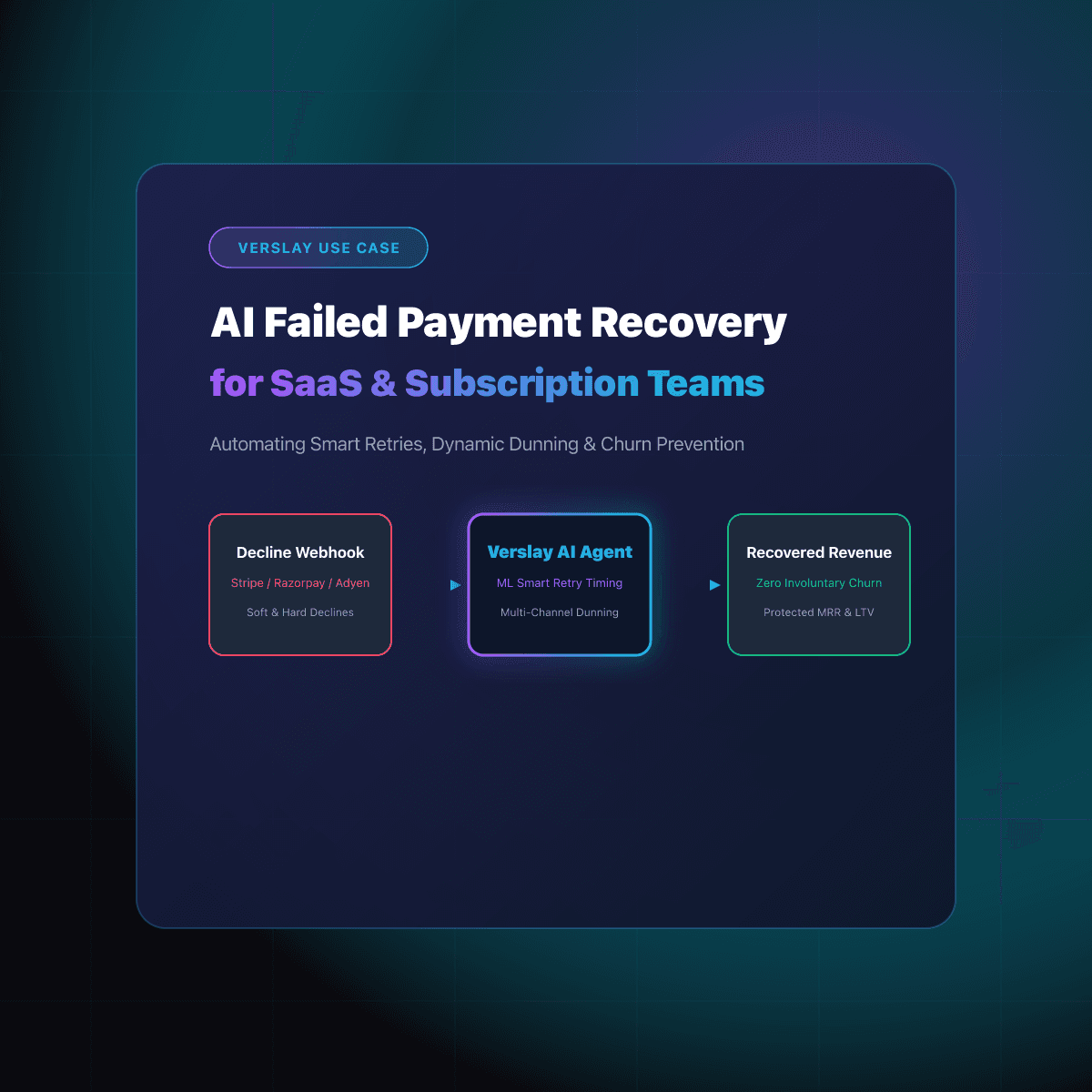
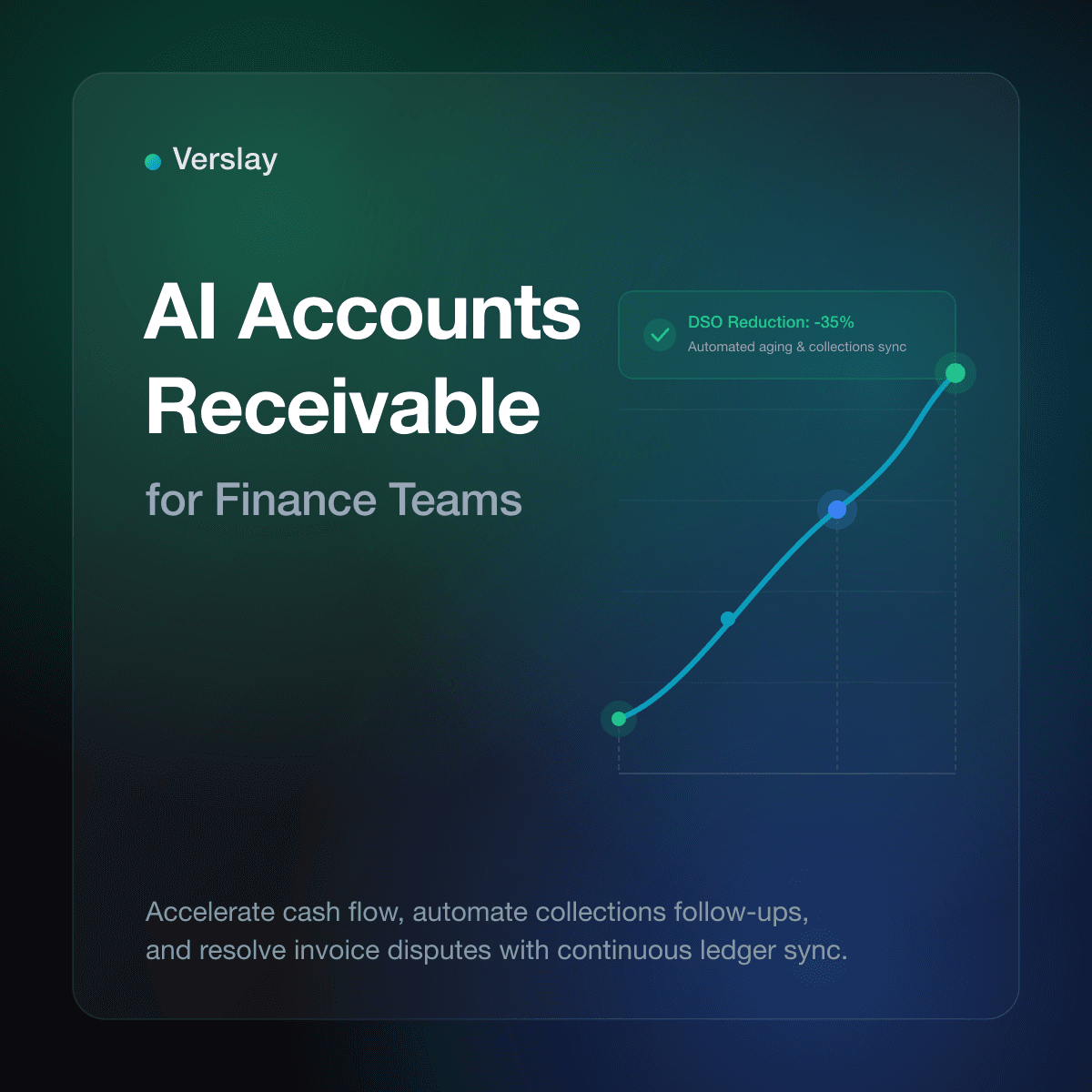
To explore how AI automates adjacent financial workflows, read our guides on AI failed payment recovery for SaaS teams and AI accounts receivable automation for finance teams.
Core Capabilities of Autonomous AI Chargeback Management
Modern AI chargeback management software replaces rigid templates with adaptive cognitive agents that understand card network reason codes, ingest multi-source data streams, and build legally compelling representment packets on demand:
1. Instant Dispute Webhook Ingestion & Alert Triage
The moment an issuing bank files an inquiry, pre-arbitration notice, or chargeback notification:
- Unified Gateway Synchronization: Ingests real-time dispute webhooks from Stripe, Shopify Payments, PayPal, Braintree, Adyen, and Razorpay into a centralized queue.
- Dispute Reason Code Translation: Automatically parses proprietary card network reason codes (e.g., Visa Reason Code 10.4 "Other Fraud", Mastercard 4837 "No Cardholder Authorization", Visa 13.1 "Merchandise Not Received") and maps them to required evidentiary proof standards.
- Financial Risk & Recoverability Scoring: Evaluates the transaction value, evidence availability, card network jurisdiction, and historical win probability to prioritize high-yield disputes.
2. Multi-System Transaction Evidence Harvesting
Rather than requiring human clerks to manually copy and paste receipts and screenshots:
- Order & Fulfillment Verification: Queries order management systems to extract order confirmation timestamps, billing addresses, line-item itemizations, and delivery confirmations.
- Carrier Telemetry & Proof of Delivery: Connects to carrier tracking APIs (FedEx, UPS, DHL, USPS) to pull real-time GPS coordinates, carrier delivery timestamps, and recipient signature images.
- Identity & Fraud Telemetry: Gathers payment gateway risk logs, including Address Verification Service (AVS) full-match codes, Card Verification Value (CVV) checks, 3D Secure (3DS) authentication tokens, and customer checkout IP geolocations.
- Customer Interaction Records: Searches customer support tools (Zendesk, Gorgias, Intercom) to retrieve chat transcripts, ticket exchanges, and shipping updates showing the customer acknowledged the order.
3. Reason-Code Tailored Representment Letter Generation
Winning a dispute requires presenting clear, compliant arguments formatted specifically to the issuer's adjudication rubric:
- Dynamic Argument Formulation: Generates a concise, professional cover letter tailored to the specific reason code, citing relevant terms of service, return policies, and card network compliance guidelines (such as Visa Compelling Evidence 3.0 standards).
- Legible PDF Packet Assembly: Combines the cover letter, order invoice, proof of delivery, and fraud check logs into a single, standardized representment file formatted to the payment processor's exact size and layout specifications.
4. Direct Gateway Submission & Ledger Reconciliation
Closing the loop without manual file uploads:
- Autonomous API Submission: Submits the completed representment package directly through the payment processor's dispute API well ahead of network deadlines.
- Accounting & ERP Sync: Updates general ledger records in NetSuite, QuickBooks, or Xero, accounting for provisional credit, disputed balances, and recovered funds once the dispute is won.
5. Root-Cause Pattern Detection & Prevention Feedback
Preventing future disputes before they occur:
- Friendly Fraudster Blacklisting: Flags abusive repeat disputers across customer accounts to block future unauthorized orders automatically.
- Product & Fulfillment Defect Insights: Correlates recurring dispute codes with specific SKUs, marketing campaigns, or regional carriers, alerting operations to damaged inventory batches or deceptive product copy.
Architecture: How an AI Chargeback Defense Engine Orchestrates Representment
The diagram below demonstrates how an autonomous AI dispute agent ingests payment gateway alerts, queries distributed ecommerce systems, compiles evidence, and executes touchless representment:
[Payment Processor Dispute Webhook] (Stripe, Shopify Payments, PayPal)
                              │
                              ▼
            [Dispute Ingestion & Triage Agent]
         (Reason Code Translation, Risk Scoring)
                              │
                              ▼
              [Multi-Source Evidence Harvester]
    ┌─────────────────────────┼─────────────────────────┐
    ▼                         ▼                         ▼
[Ecommerce OMS]       [Carrier Delivery]       [Support & CRM]
(Shopify/Magento)     (FedEx / UPS / DHL)      (Gorgias/Zendesk)
• Invoices & SKUs     • GPS Delivery Proof     • Chat Transcripts
• AVS / CVV Checks    • Signature Images       • Email Confirmations
    └─────────────────────────┬─────────────────────────┘
                              │
                              ▼
           [AI Representment Generator & Validator]
        (Visa CE 3.0 Alignment, PDF Dossier Assembly)
                              │
                              ▼
               [Autonomous Submission Engine]
            (Direct Gateway API Representment)
                              │
                              ▼
                [Closed-Loop Outcome Ledger]
           (Win/Loss Analytics & General Ledger Sync)
- Ingest: The dispute webhook triggers the agent within seconds of the issuing bank's notice.
- Harvest: The agent queries OMS, carrier APIs, and support transcripts in parallel to gather all corroborating transaction artifacts.
- Synthesize: The agent compiles a compliant representment dossier adhering to card network evidentiary requirements.
- Submit & Learn: The evidence is submitted programmatically, with win/loss verdicts feeding the agent's evidentiary weighting model.
Traditional Manual Dispute Handling vs. Autonomous AI Chargeback Management
| Evaluation Criteria | Manual Merchant Handling | Legacy Rule-Based Tools | Autonomous AI Chargeback Agents | | :--- | :--- | :--- | :--- | | Response Latency | 5 to 14 days (frequent deadline defaults) | 2 to 4 days (batched exports) | Instant (under 15 minutes from dispute alert) | | Evidence Assembly | Manual screenshots copied into text documents | Basic template merging from single databases | Multimodal extraction across OMS, carriers, CRM, and fraud logs | | Reason Code Adaptation | Static form letters often rejected by issuers | Basic keyword matching | Dynamic arguments customized to specific card brand reason codes | | Friendly Fraud Defense | Difficult to disprove without extensive research | Struggles with unstructured support transcripts | Unifies AVS/CVV, 3DS logs, GPS parcel delivery, and customer chats | | Average Win Rate | 20% to 35% | 40% to 50% | 72% to 85%+ | | Labor Cost per Dispute | $15 to $35 in staff time per claim | Requires ongoing template maintenance | $0 manual effort; pure straight-through automation | | Small-Claim Defense (<$100) | Almost always abandoned as economically unviable | Inconsistent coverage | 100% defended automatically, maximizing net margin |
Measurable Financial and Operational Impact for Finance Teams
Adopting autonomous AI chargeback management delivers immediate, compounding returns across both balance sheet health and merchant operational overhead:
- Up to 3x Increase in Dispute Win Rates: Transitioning from generic merchant rebuttals to structured, carrier-verified evidence packets routinely raises win rates from industry averages of ~25% to over 75%.
- 100% Recovery of Small-Dollar Claims: Because automated representment costs virtually nothing in incremental labor, brands capture thousands of dollars per month in previously abandoned $40–$100 disputes.
- Zero Missed Deadlines: Autonomous ingestion ensures representment packages are delivered within hours of dispute initiation, eliminating forfeitures caused by administrative backlog.
- Protection from Processing Penalties: Maintaining a low dispute ratio shields merchants from punitive processor fines, rolling reserve holdbacks, and processor account terminations.
- Liberated Financial Resources: Finance and operations analysts can pivot away from dispute spreadsheets and refocus on core financial modeling, vendor negotiations, and revenue growth.
See it in Verslay
Verslay agents work through the tools you already connect and prepare drafts and staged actions for a person to approve. The Stripe Payment Reconciler page shows the real workflow. You can also browse all use cases or book a 30-minute walkthrough.
Frequently Asked Questions
What is AI chargeback management?
AI chargeback management uses autonomous software agents to monitor payment processor disputes in real time, extract compelling transaction proof from order management and fulfillment systems, and compile customized representment packages to recover lost revenue.
How do autonomous AI agents improve dispute win rates over manual representment?
AI agents tailor compelling evidence packages to specific card network reason codes (Visa, Mastercard, Amex, Discover), instantly attaching verified delivery tracking, AVS/CVV matching logs, and customer communication histories before tight bank deadlines expire.
Can AI chargeback management integrate with modern payment gateways and ecommerce platforms?
Yes, AI chargeback management connects natively to payment gateways including Stripe, Shopify Payments, PayPal, and Razorpay, automatically pulling dispute details and submitting digital evidence packages directly through gateway APIs.
Protect Your Revenue and Win More Disputes with Verslay
Stop losing hard-earned ecommerce revenue to friendly fraud and administrative delays. Verslay's autonomous AI agents connect directly to your payment gateways, order management systems, and customer support channels to compile winning dispute representments on autopilot.
Explore Verslay's AI Agents to automate your dispute operations today.