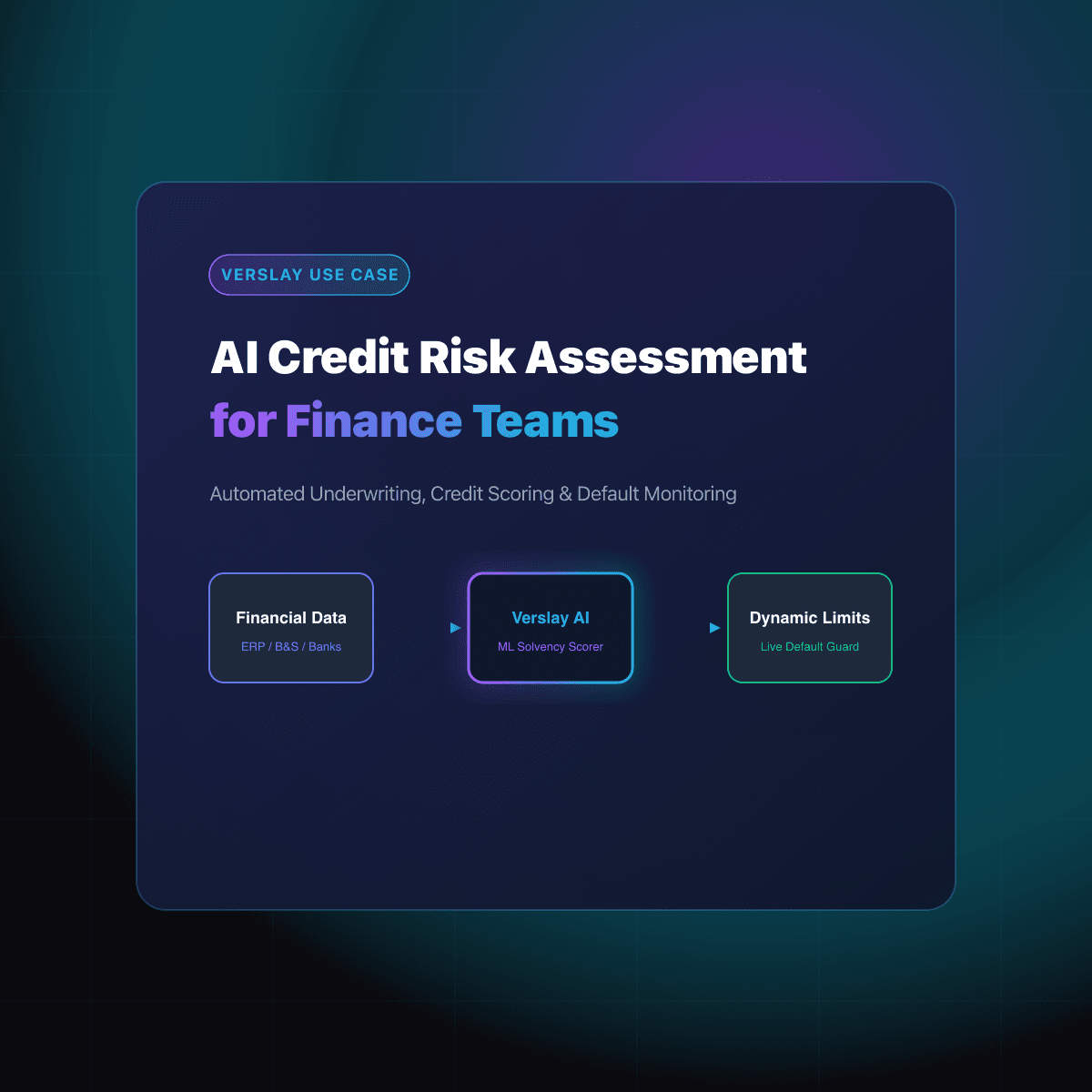
AI Credit Risk Assessment for Finance Teams: Automating B2B Credit Scoring, Financial Underwriting, and Real-Time Default Monitoring
AI credit risk assessment automates B2B credit scoring, financial statement underwriting, and counterparty default monitoring by deploying autonomous AI agents across finance, treasury, and accounts receivable operations. By replacing static credit agency reports, manual spreadsheet modeling, and periodic portfolio audits with real-time financial telemetry, enterprise finance teams compress commercial credit approvals from days to seconds while eliminating bad-debt write-offs. Connecting directly to enterprise resource planning (ERP) platforms, open banking APIs, and regulatory registries via Model Context Protocol (MCP), AI agents transform trade credit from an operational bottleneck into a dynamic competitive advantage.
In business-to-business commerce, trade credit represents the lifeblood of customer acquisition and revenue expansion. Over 80% of B2B transactions occur on deferred net payment terms (e.g., Net 30, Net 60, or Net 90), effectively turning suppliers into short-term lending institutions for their corporate buyers. However, evaluating the creditworthiness of corporate counterparties remains one of the most operationally fragile processes in modern finance. Finance leaders are caught in a permanent structural tension: sales teams demand instant credit line approvals to close enterprise deals, while risk and treasury teams must guard against insolvency, liquidity shocks, and cascading defaults.
Traditional credit risk evaluation is plagued by structural lag. Credit managers still rely on third-party bureau reports (such as Dun & Bradstreet, Experian, or CreditSafe) that reflect payment behaviors that occurred months in the past. When market conditions tighten, interest rates fluctuate, or supply chains bottleneck, lagging indicators fail to warn finance teams until invoices are already past due and capital is impaired.
By deploying autonomous AI Agents connected through open integration standards, enterprise finance operations eliminate manual underwriting friction. AI agents ingest unstructured balance sheets, calculate real-time debt service coverage, monitor ongoing invoice aging across ERP ledgers, and adjust dynamic credit limits before counterparty stress translates into write-offs.
The Operational Reality: Why Traditional B2B Credit Underwriting Fractures
Traditional commercial credit underwriting relies on a manual, periodic review architecture designed in the pre-cloud era. In fast-paced enterprise environments processing millions in monthly accounts receivable, this manual methodology collapses across five critical failure points:
[Inbound Credit Application] ──► [Manual PDF Ingestion] ──► [Static Bureau Pull]
                                                                  │
                                                                  ▼
[Annual Re-Review Backlog] ◄── [Spreadsheet Solvency Model] ◄── [Stale D&B Scorecard]
          │
          ▼
[Late Default Alert] (Invoices Already 90+ Days Delinquent)
1. Stale Bureau Data & Lagging Commercial Indicators
Conventional commercial credit ratings reflect historical public filings and trade payment reports submitted on 30- to 90-day delays. A buyer experiencing acute liquidity distress—such as the loss of a major customer or unexpected debt covenant breach—can easily maintain an "acceptable" bureau score while actively delaying vendor payments. By the time a traditional bureau downgrades an account, the supplier has often accumulated hundreds of thousands of dollars in uncollectible receivables.
2. Unstructured Financial Statement Processing Bottlenecks
Enterprise customers seeking seven-figure credit facilities submit diverse financial packages: audited GAAP balance sheets, quarterly cash flow statements, tax filings, and bank statements in varied PDF formats. Credit analysts spend hours manually transcribing line items into internal Excel templates to calculate debt-to-equity ratios, current ratios, and EBITDA margins. This creates an underwriting backlog that slows deal closing and frustrates sales teams.
3. Static Credit Limits in a Dynamic Economy
Under legacy operating models, a customer's credit limit is evaluated once during onboarding and rarely revisited unless the account requests a limit increase or incurs an acute non-payment event. However, counterparty risk is fluid: a buyer's working capital position changes every month based on seasonality, cash burn, and macro factors. Static credit limits either expose the business to unchecked downside risk or restrict sales to rapidly growing, creditworthy customers.
4. Fragmented ERP, Banking, and CRM Data Silos
Critical credit signals are distributed across disconnected enterprise systems:
- Payment performance and dispute records live in the ERP general ledger (NetSuite, SAP, Workday).
- Customer pipeline, renewal forecasts, and contract commitments reside in the CRM (Salesforce, HubSpot).
- Actual cash receipts and clearing delays sit inside commercial banking portals. Because these systems rarely synchronize in real time, credit analysts make decisions in an informational vacuum without visibility into cross-departmental customer behavior.
5. Absence of Real-Time Early Warning Systems
When a corporate counterparty begins to deteriorate, operational symptoms appear weeks before formal bankruptcy filings: payment delays on smaller invoices, sudden changes in billing contacts, disputed charges, state UCC lien filings, or adverse legal proceedings. Without automated telemetry continuously crawling internal ledgers and public registries, finance teams discover defaults only after invoices reach collections.
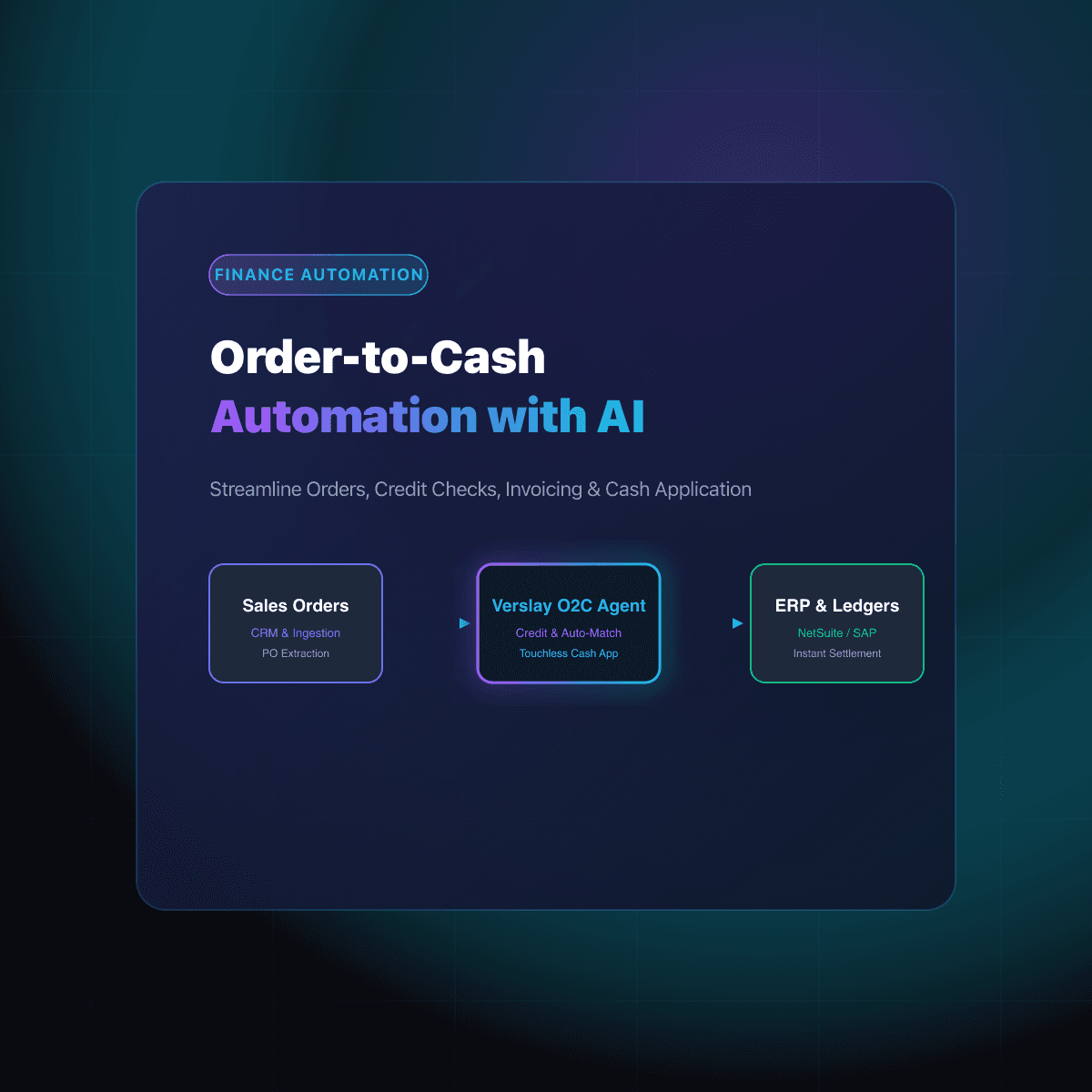
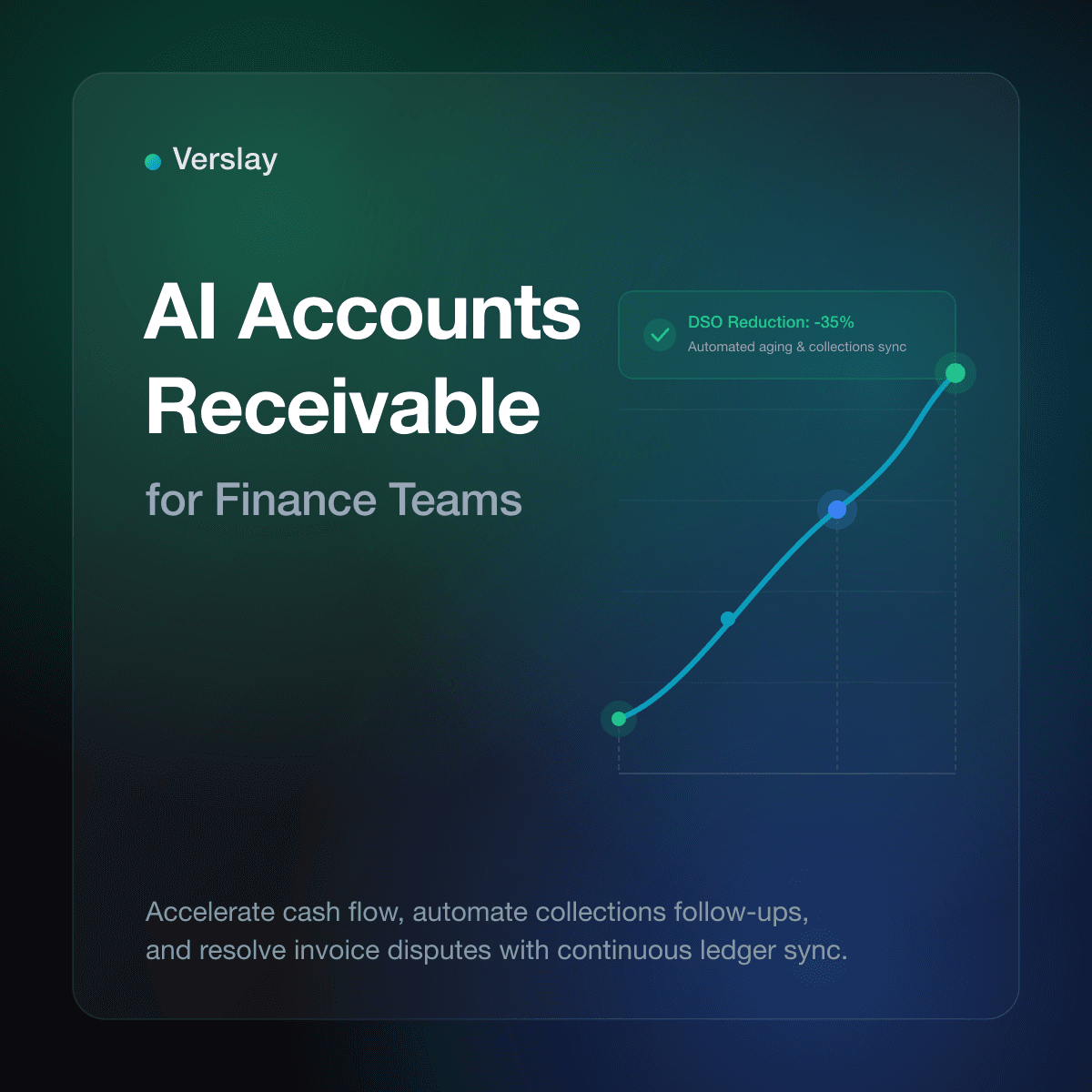
To explore how upstream and downstream revenue operations connect with credit workflows, read our detailed guides on AI order-to-cash automation for finance teams and AI accounts receivable automation for finance teams.
Architectural Blueprint: Autonomous AI Credit Risk Assessment Engine
Autonomous AI credit risk assessment operates as an intelligent orchestration layer connecting external credit data, banking rails, and internal ERP systems. Utilizing the Model Context Protocol (MCP), AI agents execute multi-source financial extraction, predictive risk modeling, and credit policy enforcement without manual data re-entry:
┌────────────────────────────────────────────────────────────────────────────────────────┐
│                   VERSLAY AI CREDIT RISK ASSESSMENT ENGINE                             │
└────────────────────────────────────────────────────────────────────────────────────────┘
          ▲                                    ▲                                    ▲
          │ (1) Ingest & Extract               │ (2) Model & Underwrite             │ (3) Enforce & Sync
          ▼                                    ▼                                    ▼
┌───────────────────┐               ┌───────────────────────┐            ┌───────────────────────┐
│ External Inputs   │               │ Autonomous AI Agents  │            │ Core Enterprise Stack │
├───────────────────┤               ├───────────────────────┤            ├───────────────────────┤
│ • Audited PDF B/S │               │ • Statement Extractor │            │ • NetSuite / SAP ERP  │
│ • Open Banking API│ ────────────► │ • ML Solvency Scorer  │ ─────────► │ • Salesforce / CRM    │
│ • Bureau Telemetry│               │ • Exposure Monitor    │            │ • HighRadius / AR Tool│
│ • UCC & Court Feeds│               │ • Early Warning Guard │            │ • Slack / Teams Alerts│
└───────────────────┘               └───────────────────────┘            └───────────────────────┘
                                               │
                                               ▼
                                    ┌───────────────────────┐
                                    │ Audit Trail & Human   │
                                    │ Approval Gate         │
                                    └───────────────────────┘
Rather than relying on brittle rule-based scripts, modern AI agents utilize vision-native multimodal parsers and explainable machine learning architectures. When an enterprise prospect submits a 40-page financial audit, the AI agent extracts structured line items, reconciles footnotes regarding contingent liabilities, validates cash positions against open banking APIs, and runs predictive insolvency models in under 60 seconds.
The 5 Core Pillars of AI Credit Risk Assessment
An enterprise-grade AI credit underwriting framework unifies new account onboarding, continuous portfolio risk monitoring, and proactive collections governance across five structural pillars:
Pillar 1: Multi-Source Financial Ingestion ──► Automated parsing of audited balance sheets, P&L, and open banking feeds
Pillar 2: Explainable ML Solvency Modeling ──► Hybrid predictive scoring pairing Altman Z-scores with gradient-boosted trees
Pillar 3: Dynamic Credit Limit Orchestration ──► Real-time limit calibration adjusting to revenue velocity and payment history
Pillar 4: Real-Time Early Warning Telemetry ──► Continuous monitoring of ERP aging, UCC filings, court dockets, and adverse news
Pillar 5: Audit-Ready Governance & Controls  ──► Deterministic risk policy enforcement with human-in-the-loop escalation gates
Pillar 1: Zero-Template Financial Ingestion & Multi-Source Extraction
Inbound commercial credit applications arrive in diverse, non-standardized formats across enterprise accounts:
- Multimodal Statement Extraction: AI agents ingest complex balance sheets, income statements, and cash flow reports regardless of layout, currency, or accounting standard (GAAP vs. IFRS).
- Direct Banking Telemetry: Integrating with open banking protocols and Plaid/Yodlee feeds, agents verify real-time average daily balances, cash burn velocity, and recurring revenue stability.
- Footnote & Covenant Analysis: Beyond top-line numbers, agents parse footnotes to identify off-balance-sheet financing, pending litigation, debt maturity schedules, and restrictive bank covenants.
Pillar 2: Explainable Machine Learning & Predictive Solvency Modeling
Black-box AI algorithms create regulatory and governance risks for corporate finance. Leading finance teams utilize explainable machine learning architectures that combine classical financial theory with modern predictive modeling:
- Structural Solvency Scoring: The system calculates foundational indicators, including the Altman Z-Score for bankruptcy prediction, the Merton structural default probability, and Beneish M-Score for earnings manipulation detection.
- Gradient-Boosted Decision Trees: Evaluates thousands of micro-features—such as seasonal order patterns, average payment latency, invoice dispute frequency, and industry distress indices.
- SHAP (SHapley Additive exPlanations) Attribution: Every credit score output includes deterministic explainability vectors showing exactly why a score was assigned (e.g., "+15 pts for 24 months flawless payment history, -8 pts for increased short-term leverage").
Pillar 3: Dynamic Credit Limit Orchestration & Exposure Management
Trade credit lines should never remain static documents filed away in archives:
- Algorithmic Limit Recommendation: Based on counterparty solvency scores, expected order frequency, and risk appetite parameters, AI agents recommend initial credit limits and payment terms (e.g., Net 30 with a $250,000 ceiling).
- Real-Time Exposure Tracking: The agent continuously monitors total open exposure—combining unbilled sales orders, invoices in transit, and aged receivables—preventing order fulfillment when an account exceeds its approved threshold.
- Automated Step-Up Workflows: When a reliable customer consistently pays on time and expands order volume, the agent automatically models and proposes credit line expansions to account executives, accelerating account growth.
Pillar 4: Real-Time Early Warning Telemetry & Adverse Event Detection
Catching customer deterioration before formal default saves enterprises millions in bad-debt write-offs:
- ERP Micro-Behavioral Shifts: Tracks subtle changes in payment habits, such as a customer gradually shifting from paying within 28 days to 42 days, or partial payments on previously routine invoice runs.
- Public Registry & Legal Feeds: Continuously monitors Secretary of State filings, county clerk records, and federal dockets for new Uniform Commercial Code (UCC) financing statements, tax liens, or breach of contract lawsuits.
- Adverse Market & Executive Signals: Monitors news feeds, earnings call transcripts, and corporate leadership changes to flag sudden CFO resignations, layoffs, or credit rating agency downgrades.
Pillar 5: Audit-Ready Governance, Compliance & Human-in-the-Loop Gates
Enterprise risk management requires absolute policy adherence and institutional control:
- Policy Tiering & Guardrails: Standard low-risk applications under defined thresholds (e.g., $50,000) can execute touchless straight-through approvals, while high-value or elevated-risk facilities automatically route to Senior Credit Officers.
- Comprehensive Decision Memos: For every evaluated account, the AI agent generates a standardized, cited Credit Underwriting Memo summarizing financials, risk factors, benchmarking, and recommended actions.
- Cryptographic Auditability: Every data ingestion step, score calculation, policy check, and human approval is logged into an append-only audit trail, satisfying internal SOX compliance and external financial auditors.
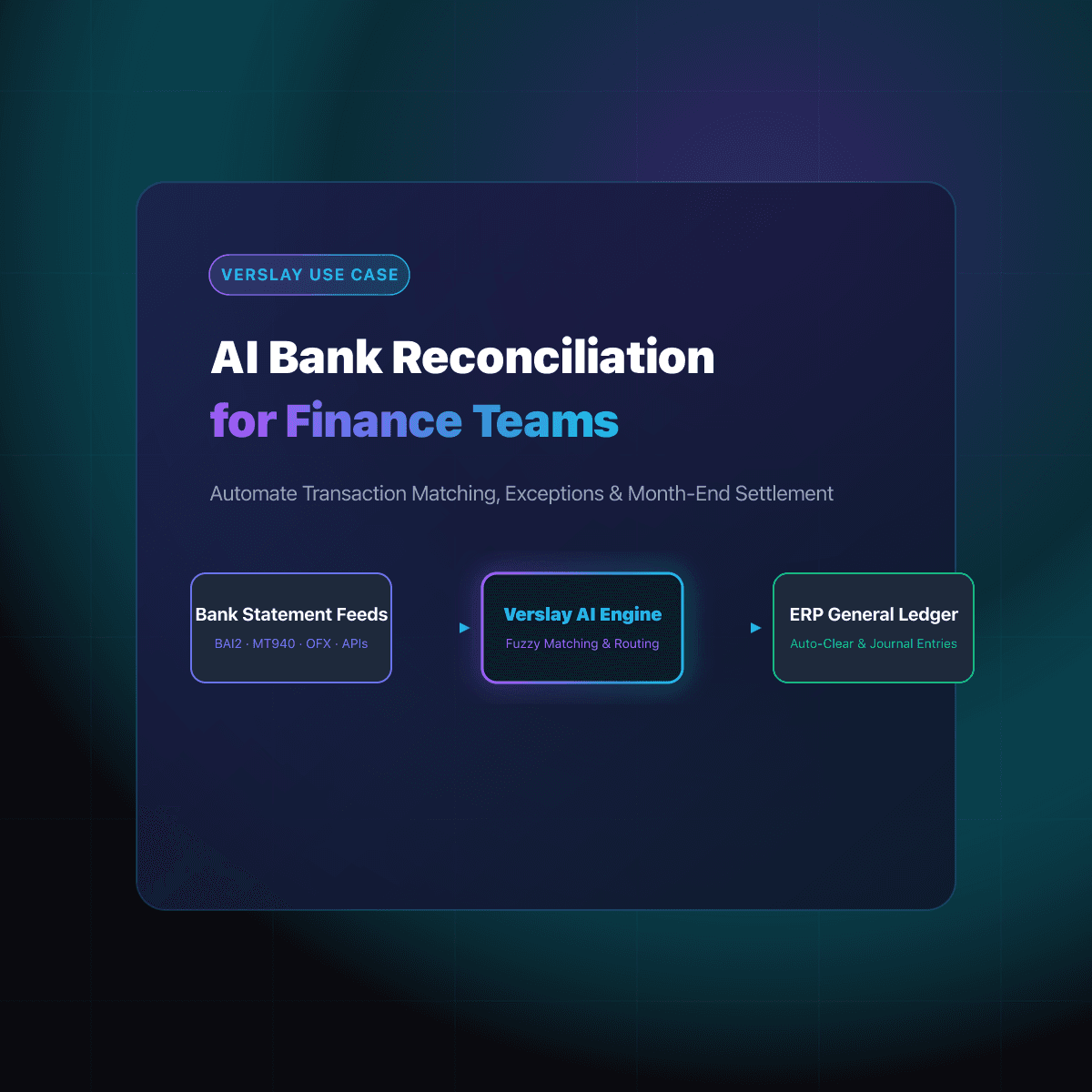
Learn how automated reconciliation eliminates discrepancies between customer payments and enterprise ledgers in our guide on AI bank reconciliation for finance teams.
Comparison Matrix: Manual Underwriting vs. Legacy Bureaus vs. Autonomous AI Credit Assessment
| Dimension | Manual Credit Analysis | Legacy Credit Bureaus (D&B/Experian) | Autonomous AI Agents (Verslay) | | :--- | :--- | :--- | :--- | | Time to Decision | 3 to 7 business days | Instant (if pre-indexed report exists) | < 30 seconds end-to-end | | Data Freshness | Stale point-in-time PDFs | 30 to 90-day reporting lag | Real-time (bank feeds + live ERP aging) | | Financial Statement Analysis | Manual Excel keying & modeling | None or generic summary data | Automated multimodal line-item extraction | | Model Explainability | Subjective analyst judgment | Proprietary black-box scores | Transparent SHAP factor attribution | | Portfolio Monitoring | Annual review or reactive on default | Generic batch email alerts | Continuous 24/7 multi-signal telemetry | | Credit Limit Adaptation | Static until customer complains | Static credit suggestions | Dynamic limit calibration based on velocity | | Audit Compliance | Inconsistent notes in shared folders | Third-party PDF report downloads | Immutable, structured audit trail & memos |
Step-by-Step Implementation Blueprint for Enterprise Finance Teams
Transitioning from manual credit underwriting to an agentic AI framework follows a structured, four-phase rollout designed to ensure complete accuracy and risk governance:
Phase 1: System Integration & Telemetry Unification (Weeks 1–2)
Phase 2: Credit Policy Modeling & Weight Calibration (Weeks 3–4)
Phase 3: Shadow Underwriting & Retrospective Backtesting (Weeks 5–6)
Phase 4: Production Automation & Real-Time Portfolio Governance (Week 7+)
Phase 1: System Integration & Telemetry Unification
- Connect Verslay MCP servers to core enterprise systems: NetSuite or SAP for historical receivables data, Salesforce or HubSpot for CRM opportunity pipelines, and commercial banking APIs.
- Configure webhook integrations for real-time order intake and new customer onboarding workflows.
- Establish external data connectors for public legal registries, corporate registries, and credit bureau feeds.
Phase 2: Credit Policy Modeling & Weight Calibration
- Codify internal credit policy guidelines into deterministic scoring rules: establish minimum debt service coverage ratios, acceptable liquidity thresholds, and maximum exposure tiers.
- Configure risk score weightings balancing foundational financial statement metrics (40%), real-time ERP payment history (35%), and external credit intelligence (25%).
- Establish human-in-the-loop authorization gates: set approval thresholds by facility size, requiring dual-officer sign-off on facilities exceeding $500,000.
Phase 3: Shadow Underwriting & Retrospective Backtesting
- Run historical backtesting across the past 24–36 months of enterprise account data, verifying whether the AI underwriting engine successfully flagged past defaults and delinquencies before write-offs occurred.
- Operate the system in "Shadow Mode" alongside human credit analysts for four weeks, comparing automated recommendations against manual determinations to calibrate precision.
- Solicit feedback from credit managers to refine the structure and readability of the automated Credit Underwriting Memos.
Phase 4: Production Automation & Continuous Portfolio Governance
- Activate straight-through processing for standard, low-risk accounts, reducing customer onboarding friction and accelerating sales cycle velocity.
- Enable 24/7 early warning monitoring across the active customer portfolio, automatically alerting account managers and credit controllers when counterparty risk scores dip below target thresholds.
- Schedule periodic quarterly re-underwriting runs that refresh financial statements and dynamically tune credit ceilings across all enterprise accounts.
Frequently Asked Questions
What is AI credit risk assessment?
AI credit risk assessment uses autonomous machine learning agents and real-time financial telemetry to evaluate counterparty creditworthiness, automating underwriting, risk scoring, and credit limit determinations across B2B sales and finance operations.
How do AI agents improve B2B credit risk analysis over traditional credit bureaus?
Traditional credit bureaus rely on historical trade records that lag reality by 30 to 90 days. AI agents continuously ingest live accounting data, ERP invoice aging, real-time bank transaction feeds, and adverse market intelligence to detect counterparty distress weeks before conventional credit bureaus issue formal downgrades.
What credit risk models do AI systems use for enterprise underwriting?
Modern AI underwriting pairs foundational structural solvency models (such as Altman Z-scores and Merton default frameworks) with explainable machine learning models (such as gradient-boosted decision trees) that evaluate real-time transaction velocity, debt service ratios, and macroeconomic indicators with full factor explainability.
Can AI credit assessment integrate directly with existing ERP and CRM systems?
Yes. Using open integration protocols such as the Model Context Protocol (MCP), AI agents connect natively with ERP platforms (NetSuite, SAP, Workday), customer relationship management tools (Salesforce, HubSpot), and communication channels (Slack, Microsoft Teams) to ingest data and synchronize credit limits seamlessly.