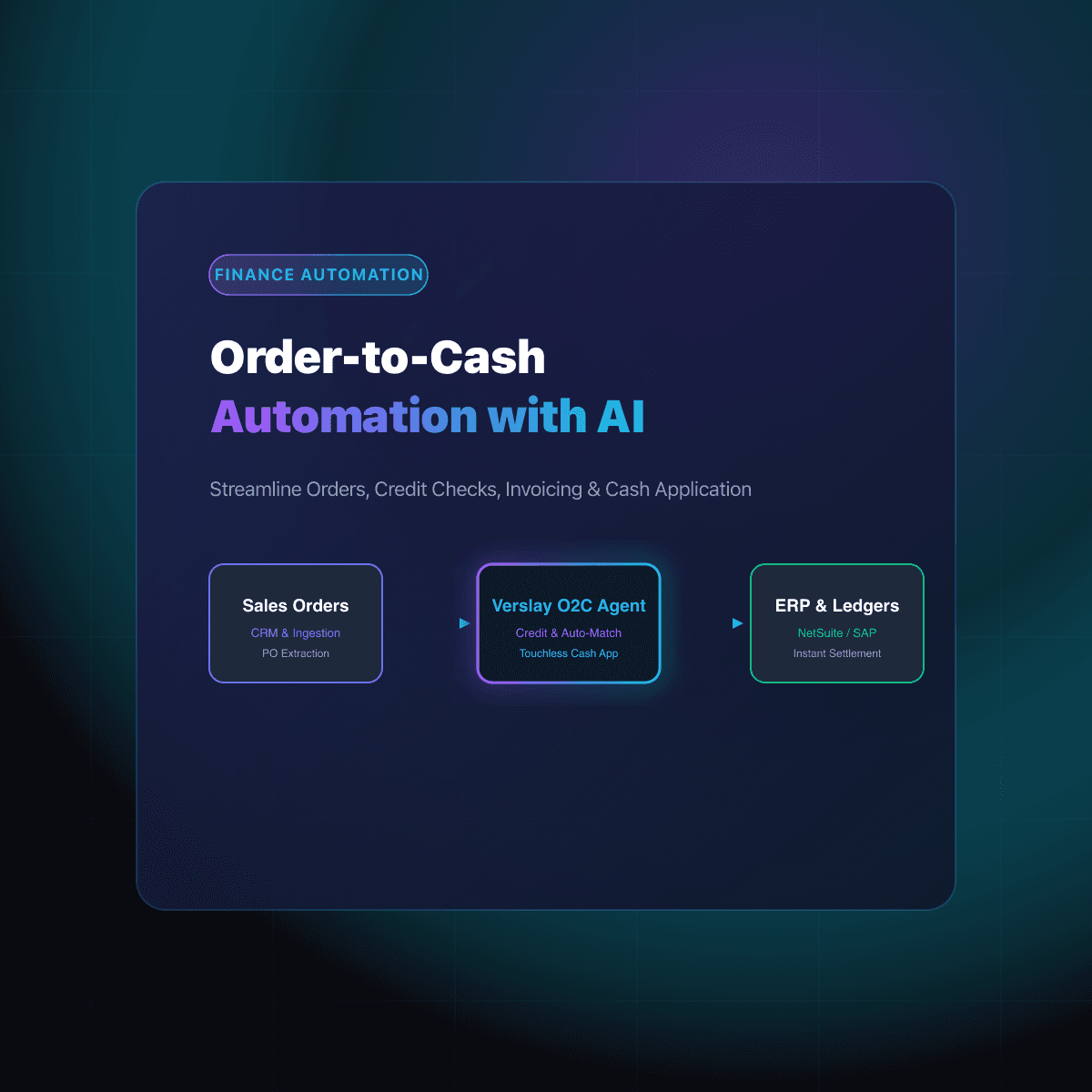
AI Order-to-Cash Automation for Finance Teams: Streamlining Sales Order Ingestion, Credit Checks, Invoicing, and Cash Application
AI order-to-cash automation unifies the entire revenue lifecycle—from sales order ingestion and automated credit underwriting to fulfillment validation, billing, collections, and touchless cash application—by deploying autonomous AI agents across CRM, billing, and ERP platforms. By replacing manual data entry, disconnected spreadsheets, and fragmented inter-departmental handoffs with deterministic agentic execution, corporate finance teams eliminate billing bottlenecks, lower dispute rates, and significantly reduce Days Sales Outstanding (DSO). Instead of relying on rigid, rule-based legacy tools that fracture whenever contract terms vary, modern finance operations leverage context-aware AI agents to achieve touchless order-to-cash processing at scale.
For mid-market and enterprise organizations, the Order-to-Cash (O2C) workflow represents the operational circulatory system of business performance. Every delay in converting a booked sales contract into deposited, reconciled cash directly impairs working capital, inflates short-term borrowing costs, and clouds executive visibility into cash flow predictability. Despite significant investments in modern cloud ERPs such as NetSuite, SAP S/4HANA, and Workday, the fundamental handoffs between commercial sales teams, credit desks, fulfillment coordinators, and revenue accountants remain overwhelmingly manual.
Finance teams frequently find themselves trapped in a reactive operational posture. Accounts receivable clerks spend up to 40% of their business day transcribing customer purchase orders into billing systems, chasing departmental managers for manual credit limit overrides, fielding customer billing inquiries triggered by invoice formatting discrepancies, and manually matching unstructured bank remittance advices against open invoices in general ledgers.
By deploying autonomous AI Agents connected through standardized Model Context Protocol (MCP) integrations, finance leaders can orchestrate the complete order-to-cash journey autonomously. AI agents execute end-to-end multi-system coordination, verifying customer creditworthiness, parsing inbound EDI and PDF purchase orders, generating compliant billing schedules, and applying lockbox payments directly to open receivables while preserving strict auditability and segregation of duties.
The Operational Reality: Why Legacy Order-to-Cash Pipelines Break Down
The order-to-cash continuum spans five distinct operational disciplines: customer order intake, credit evaluation, order fulfillment and billing, accounts receivable management, and payment reconciliation. In traditional corporate environments, each phase is handled by disparate tools and separated by functional organizational silos:
[Inbound Customer PO] ──► [Sales Rep Keying] ──► [Credit Review Queue] ──► [Fulfillment Tracking]
                                                                                   │
                                                                                   ▼
[Bank Lockbox Deposit] ◄── [AR Collections]  ◄── [Dispute Triage]     ◄── [Invoice Generation]
        │
        ▼
[Manual GL Remittance Match] (Days to Post)
This fragmentation produces acute operational friction across five key vulnerability points:
1. Inefficient Sales Order Intake and Format Complexity
Enterprise customers transmit purchase orders (POs) across diverse media, including email PDF attachments, electronic vendor portals, punchout catalogs, and Electronic Data Interchange (EDI) feeds (such as EDI 850). Sales operations and customer service teams must manually open each document, re-key line items into Salesforce or Microsoft Dynamics, and verify pricing tiers against signed master service agreements (MSAs). A single transcription error—such as a misplaced unit of measure or an omitted discounted rate—propagates through the entire O2C pipeline, guaranteeing billing rejections downstream.
2. Static, Disconnected Credit Risk Governance
Before fulfilling enterprise orders, finance teams must assess buyer credit risk. In legacy setups, this involves credit managers pulling manual credit bureau reports from Dun & Bradstreet, Experian, or CreditSafe, checking current exposure across unbilled orders, and emailing finance controllers for discretionary credit limit approvals. This introduces multi-day fulfillment hold delays for high-velocity deals or, conversely, leads to unmonitored credit exposure when reps bypass manual credit gates to hit end-of-quarter quotas.
3. Billing Delays and Invoicing Discrepancies
Invoicing is frequently decoupled from delivery verification. When services or goods are delivered, billing specialists must aggregate data from professional services automation (PSA) tools, warehouse management systems (WMS), and bespoke contracts to generate customer-facing invoices. Discrepancies between purchase order line items and final invoices trigger customer payment holds, leading to formal billing disputes that stall cash inflows for weeks.
4. Fragmented Accounts Receivable and Collections Friction
When invoices become past due, collections specialists often rely on static aging reports generated once a week. Every customer receives generic, cadence-based dunning emails regardless of relationship tier, historical payment behavior, or ongoing dispute investigations. Critical account disputes remain buried in regional email threads until an invoice is 60 or 90 days delinquent, severely eroding net recovery rates.
5. The Cash Application Bottleneck (Unapplied Cash)
When buyers submit electronic funds transfers (ACH, Fedwire, SEPA) or physical lockbox checks, remittance data rarely travels cleanly alongside the payment. Customers frequently bundle payments for dozens of invoices into a single lump sum, deduct unspecified short-payments for shipping adjustments or vendor penalties, and email unstandardized PDF remittance slips to a shared inbox. Finance accountants spend days manually matching incoming payments against open invoice line items, creating an "unapplied cash" backlog that distorts real-time liquidity reporting.
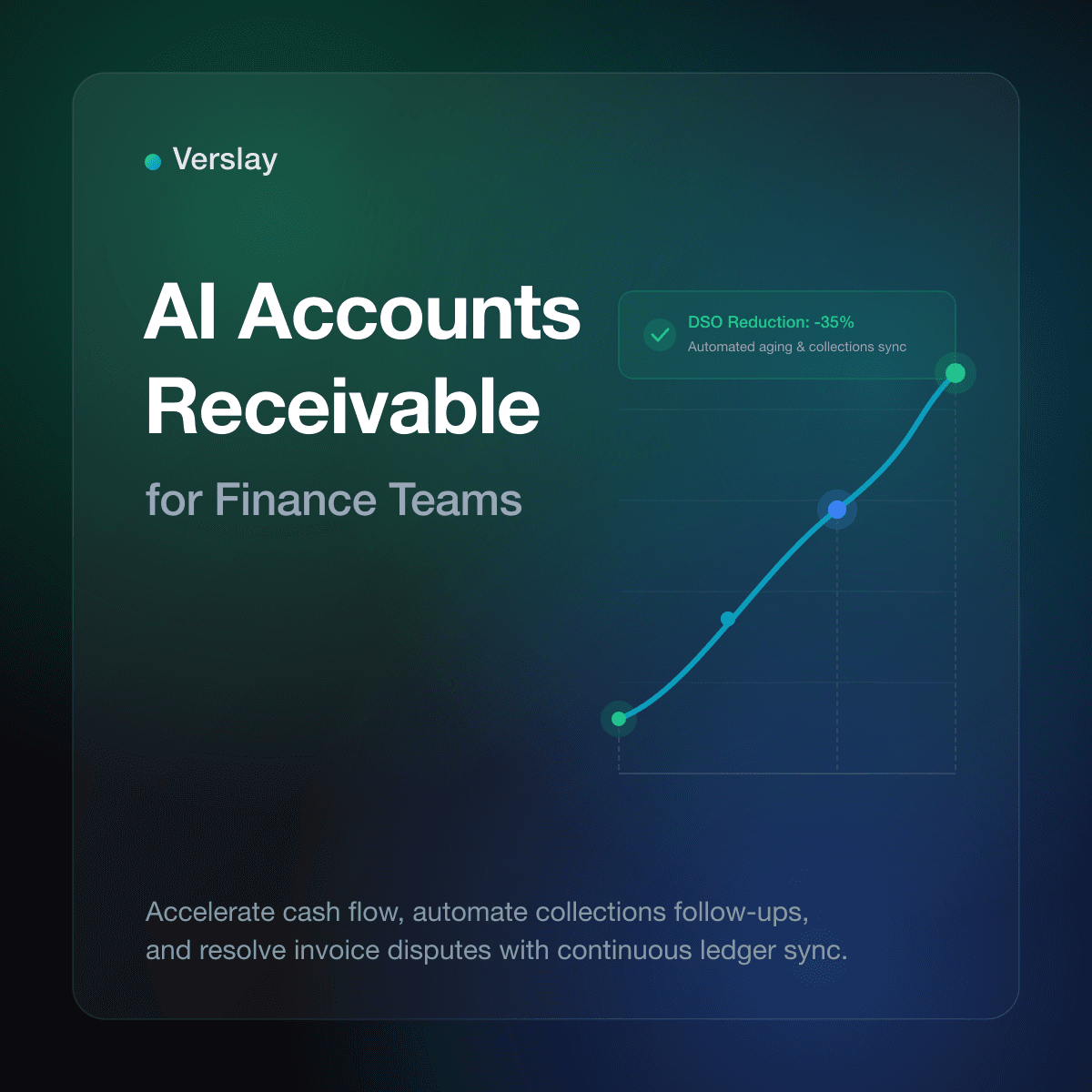
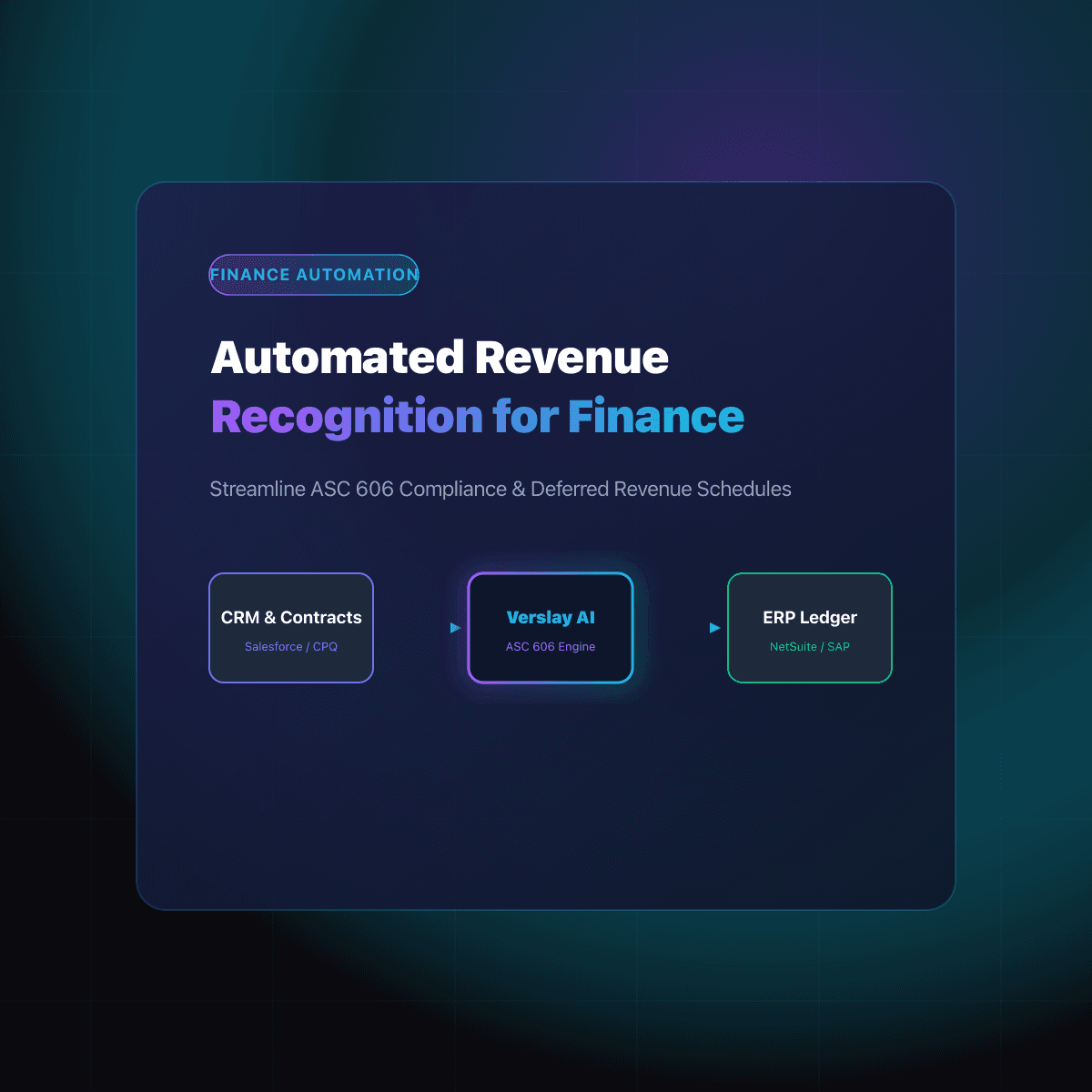
To understand how automated processing mitigates upstream billing discrepancies, explore our guides on AI accounts receivable automation for finance teams and automated revenue recognition for finance teams.
Architectural Blueprint: Autonomous AI Order-to-Cash Orchestration
Autonomous AI order-to-cash automation bridges the gap between commercial front-office applications and transactional back-office ERP ledgers without requiring costly core system migrations. Operating as an intelligent orchestration layer via Model Context Protocol (MCP), AI agents continuously listen to operational webhooks, monitor inbound communication streams, and execute multi-step deterministic business logic:
┌────────────────────────────────────────────────────────────────────────────────────────┐
│                        VERSLAY AI ORDER-TO-CASH ENGINE                                 │
└────────────────────────────────────────────────────────────────────────────────────────┘
          ▲                                    ▲                                    ▲
          │ (1) Ingest & Extract               │ (2) Credit & Underwrite            │ (3) Sync & Reconcile
          ▼                                    ▼                                    ▼
┌───────────────────┐               ┌───────────────────────┐            ┌───────────────────────┐
│ Commercial & CRM  │               │ Autonomous AI Agents  │            │ Financial Core / ERP  │
├───────────────────┤               ├───────────────────────┤            ├───────────────────────┤
│ • Salesforce CPQ  │               │ • Vision PO Parser    │            │ • NetSuite / SAP /    │
│ • HubSpot Deals   │ ────────────► │ • Credit Risk Engine  │ ─────────► │   Workday General GL  │
│ • EDI 850 Feeds   │               │ • Billing Orchestrator│            │ • Stripe / Bank BAI2  │
│ • PDF Inbound POs │               │ • Touchless Cash App  │            │ • Lockbox Remittance  │
└───────────────────┘               └───────────────────────┘            └───────────────────────┘
                                               │
                                               ▼
                                    ┌───────────────────────┐
                                    │ Audit, Compliance &   │
                                    │ Human-in-the-Loop     │
                                    └───────────────────────┘
Rather than treating documents as dumb image pixels, multimodal vision and reasoning models inspect inbound documents with semantic understanding. The agent cross-references customer purchase order numbers, line-item item codes, pricing discounts, shipping terms (Incoterms), and tax jurisdictions against active enterprise database records before committing records to the general ledger.
The 5 Core Pillars of AI Order-to-Cash Automation
An enterprise-ready AI order-to-cash solution replaces manual touchpoints with coordinated, deterministic workflows spanning five critical stages:
Pillar 1: Omnichannel Order Capture & Zero-Template Ingestion
The order intake stage represents the first line of defense against downstream billing errors. AI agents automate order capture across all incoming channels:
- Multimodal Document Understanding: Vision-native AI models parse purchase orders formatted as PDFs, TIFF scans, Excel spreadsheets, or emails, extracting critical fields such as PO numbers, bill-to/ship-to addresses, payment terms (e.g., Net 30, 2/10 Net 60), and line-item schedules.
- Semantic Line-Item Validation: The agent compares inbound PO items against internal ERP product master catalogs, automatically mapping customer-specific SKU aliases to standardized company item IDs.
- Contract and Pricing Harmonization: Validates that pricing on the customer PO strictly mirrors negotiated rates in Salesforce CPQ or signed legal contracts, flagging price mismatches for instant rep review before order booking.
- ERP Sales Order Creation: Transcribes verified order details into NetSuite or SAP as an official Sales Order record in seconds, triggering immediate fulfillment workflows.
Pillar 2: Dynamic B2B Credit Underwriting & Real-Time Risk Monitoring
Rather than evaluating customer credit once during initial onboarding, AI agents maintain continuous credit governance:
- Automated Credit Bureau Aggregation: Upon receiving an enterprise order exceeding pre-set thresholds, the agent queries credit bureaus (D&B, CreditSafe) via API to pull up-to-date credit scores, financial risk ratings, and public lien filings.
- Dynamic Exposure Calculation: Computes real-time exposure by calculating the customer's total outstanding AR balance, unbilled work-in-progress (WIP), and pending sales orders across all corporate subsidiaries.
- Deterministic Approval Escalations: If the transaction sits safely within established credit tolerances, the order is auto-approved without manual review. For edge-case credit risks, the agent drafts a comprehensive Credit Diligence Brief and routes it to the VP of Finance or Controller via Slack or Microsoft Teams for single-click authorization.
Pillar 3: Automated Invoicing, Tax Jurisdiction Routing & E-Delivery
Billing accuracy is paramount for maintaining healthy cash collection velocity:
- Milestone & Delivery Verification: AI agents monitor fulfillment milestones across warehouse systems (3PL feeds) or service milestones across PSA systems (Asana, Jira, Mavenlink). Invoices are triggered strictly upon confirmed delivery or verified contract dates.
- Automated Sales Tax & VAT Determination: Integrates with automated tax engines (such as Avalara or Vertex) to verify accurate jurisdiction-level tax calculations, exemption certificate validity, and cross-border digital service tax compliance.
- Customer-Specific Portal Dispatch: Beyond emailing standard PDF invoices, the agent automates delivery into proprietary customer Accounts Payable portals (such as Coupa, Ariba, or Tungsten Network), completing complex portal-specific web forms and attaching verified supporting documentation autonomously.
Pillar 4: Intelligent Receivables Management & Dispute Resolution
AI agents shift AR collections from generic badgering to strategic, high-leverage customer engagement:
- Predictive Payment Timing: Analyzes historical customer payment patterns (e.g., specific payment run days, bi-weekly check cycles) to schedule payment reminders precisely when accounts payable departments prepare disbursements.
- Personalized, Contextual Communications: Drafts personalized payment reminder emails that reference specific project deliverables, invoice line items, and previous email correspondence, maintaining executive brand reputation.
- Automated Short-Payment & Deduction Triage: When a customer short-pays an invoice, the agent ingests the customer's deduction code, retrieves shipping bill-of-lading (BOL) proofs or pricing agreements, validates whether the deduction is legitimate, and prepares offsetting credit memos or dispute letters automatically.
Pillar 5: Touchless Cash Application & Remittance Reconciliation
The final phase of the O2C cycle matches deposited customer funds to open general ledger balances:
- Multi-Source Remittance Scraping: The agent continuously monitors bank lockbox files, BAI2 feeds, CAMT.053 XML statements, and dedicated remittance email inboxes, extracting payment reference details from unstructured remittances.
- Multi-Factor Invoice Matching Engine: Matches lump-sum deposits to open AR invoices using complex algorithmic pairing: combining customer bank account numbers, invoice references, PO numbers, and fuzzy total amounts across multiple open balances.
- ERP Journal Entry & AR Subledger Clearing: Automatically creates customer payment records in the ERP, clears open balances in the accounts receivable subledger, and books bank fee deductions or exchange rate gain/loss entries without human intervention.
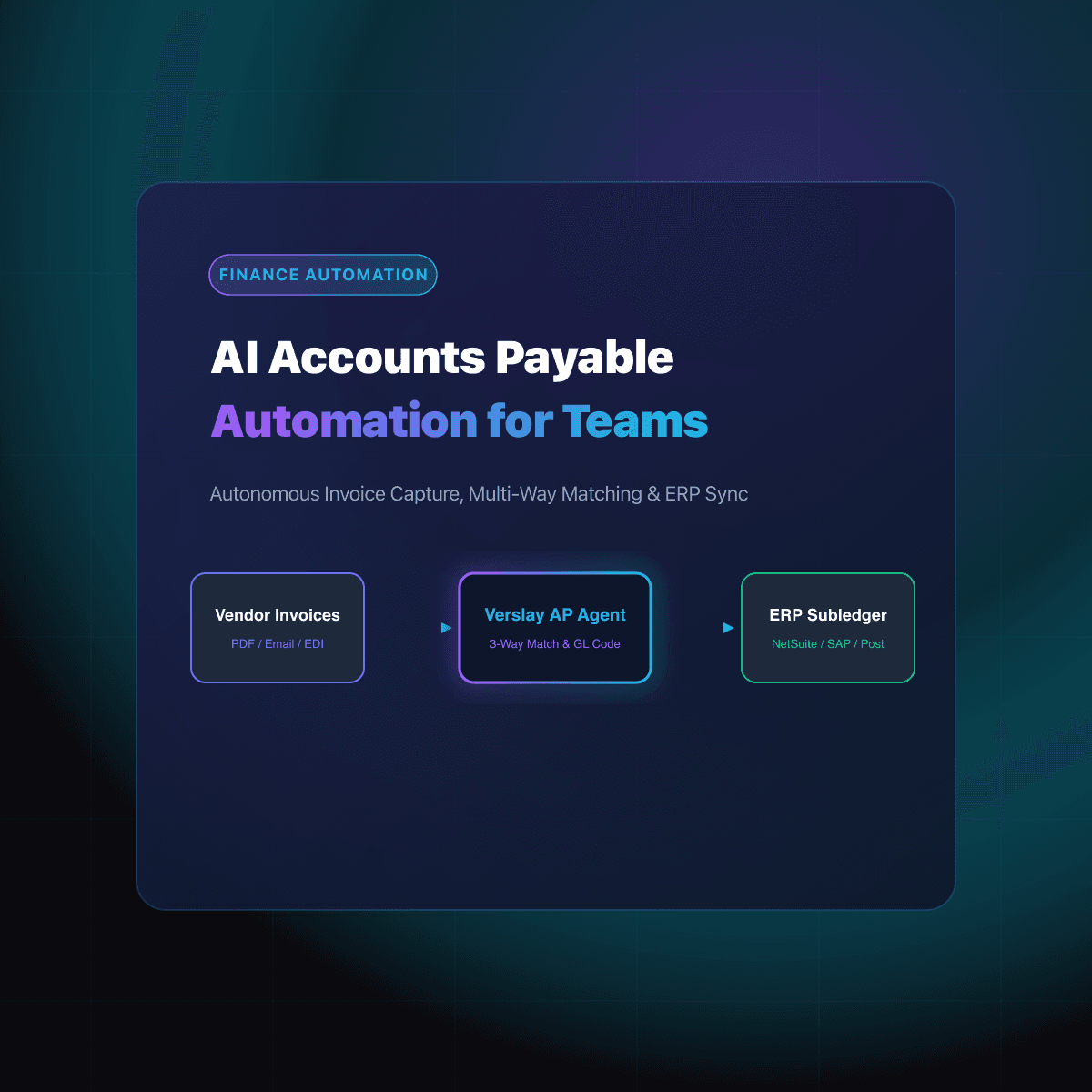
To see how similar autonomous principles apply across enterprise expense and purchasing lifecycles, review our operational analysis on AI 3-way matching for accounts payable teams.
Comparison Matrix: Manual Operations vs. Legacy RPA vs. Autonomous AI O2C
| Capability | Manual Order-to-Cash | Legacy RPA Scripting | Autonomous AI Agents (Verslay) | | :--- | :--- | :--- | :--- | | Sales Order Intake | Manual typing from PDFs & emails; high error rate | Brittle screen scraping; breaks when PDF layout shifts | Vision-native semantic extraction; layout-agnostic | | SKU & Catalog Mapping | Clerks manually look up customer aliases | Requires hardcoded lookup tables; fails on new SKUs | Contextual fuzzy matching & automated alias learning | | Credit Governance | Periodic manual bureau pulls; static credit limits | Basic rule triggers; cannot evaluate qualitative data | Real-time exposure aggregation & dynamic risk scoring | | Dispute Management | Scattered across individual rep email inboxes | Cannot parse unstructured dispute text or emails | Autonomous deduction triage, POD retrieval & drafting | | Cash Application | Manual spreadsheet reconciliation (hours/days) | Matches only exact invoice number & dollar amounts | Multi-factor reconciliation, partial payment & lockbox parsing | | Exception Handling | Human solves 100% of pipeline exceptions | Throws uncaught exceptions to IT engineering | Autonomous self-correction with structured human gates | | Time to Reconcile | 3 to 10 business days post-deposit | 1 to 2 business days (rigid cases only) | Near real-time (< 5 minutes post-statement) |
Technical Integration: Connecting Salesforce, NetSuite, and Banking Feeds
Modern enterprise architectures demand seamless interoperability across commercial CRMs, operational ERPs, and financial institutions. Implementing AI order-to-cash automation does not require tearing out existing enterprise infrastructure; rather, it uses Model Context Protocol (MCP) servers to expose existing database APIs as callable capabilities for AI agents.
Example: Order Verification & Credit Gate Workflow
// Pseudocode: Autonomous AI Order Ingestion & Credit Validation Hook
interface PurchaseOrderPayload {
  customer_id: string;
  po_number: string;
  line_items: Array<{
    customer_sku: string;
    quantity: number;
    unit_price: number;
  }>;
  billing_address: string;
  payment_terms: string;
}

async function processInboundOrder(po: PurchaseOrderPayload) {
  // Step 1: Map SKUs and Harmonize Pricing with Salesforce CPQ
  const validatedOrder = await mcp.execute("salesforce_harmonize_order", {
    customer_id: po.customer_id,
    po_items: po.line_items,
  });

  if (!validatedOrder.pricing_valid) {
    return await mcp.execute("notify_sales_rep_discrepancy", {
      po_number: po.po_number,
      discrepancies: validatedOrder.pricing_discrepancies,
    });
  }

  // Step 2: Query Live Credit Exposure via NetSuite ERP
  const creditProfile = await mcp.execute("netsuite_get_credit_profile", {
    customer_id: po.customer_id,
  });

  const totalExposure =
    creditProfile.open_ar_balance +
    creditProfile.unbilled_orders_amount +
    validatedOrder.total_amount;

  // Step 3: Evaluate Dynamic Credit Gate
  if (totalExposure > creditProfile.approved_credit_limit) {
    // Generate AI Credit Diligence Brief for Finance Controller
    const creditBrief = await mcp.execute("generate_credit_risk_brief", {
      customer_id: po.customer_id,
      total_exposure: totalExposure,
      bureau_score: creditProfile.external_bureau_score,
      dso_history: creditProfile.historical_dso,
    });

    return await mcp.execute("request_controller_credit_approval", {
      brief: creditBrief,
      amount: validatedOrder.total_amount,
    });
  }

  // Step 4: Create Validated Sales Order in NetSuite ERP
  const salesOrder = await mcp.execute("netsuite_create_sales_order", {
    customer_id: po.customer_id,
    po_number: po.po_number,
    lines: validatedOrder.mapped_lines,
    status: "Pending_Fulfillment",
  });

  return { status: "ORDER_COMMITTED", sales_order_id: salesOrder.id };
}
By structuring these integrations as modular, deterministic tools, the AI agent can execute complex judgment calls while strictly enforcing company financial controls and data validation rules.
Governance, Segregation of Duties, and SOX Compliance
Automating order-to-cash workflows in public or heavily regulated enterprises introduces rigorous compliance and governance requirements. Under Sarbanes-Oxley (SOX) Section 404, organizations must demonstrate robust internal controls over financial reporting (ICFR), specifically around revenue cutoff, authorization of sales orders, credit limit modifications, and bad debt write-offs.
Autonomous AI agents reinforce enterprise internal controls through structured architectural safeguards:
- Strict Segregation of Duties (SoD): The agent that ingests sales orders and schedules billing cannot unilaterally modify customer master data or write off delinquent receivables. Permission boundaries are enforced at the API token and database access levels.
- Deterministic Confidence Thresholds: When parsing unstructured remittance documents or customer POs, the AI assigns an extraction confidence score (0 to 100) to each field. Any value falling below pre-defined organizational thresholds (e.g., 98% confidence) automatically halts touchless execution and prompts human verification.
- Immutable Audit Trails: Every decision, field extraction, data reconciliation, and approval routing event is recorded in a centralized, append-only audit ledger with cryptographic timestamps. Compliance teams can trace every ERP general ledger update back to its originating customer document.
- Human-in-the-Loop Thresholds: High-risk financial actions—such as approving credit limits exceeding $100,000, issuing credit memos over $5,000, or altering customer banking routing numbers—always require dual-custody human authorization before execution.
Measuring Business Impact: The Operational ROI of Automated O2C
Implementing AI order-to-cash automation delivers measurable working capital and operational efficiency gains across four core financial KPIs:
┌─────────────────────────────────┬──────────────────────┬──────────────────────┐
│ Operational Metric              │ Before Automation    │ After AI Automation  │
├─────────────────────────────────┼──────────────────────┼──────────────────────┤
│ Days Sales Outstanding (DSO)    │ 54.2 Days            │ 39.8 Days (-26%)     │
│ Sales Order Cycle Time          │ 28 Hours             │ < 15 Minutes (-99%)  │
│ Invoice Dispute Frequency       │ 12.4% of Invoices    │ 1.8% of Invoices     │
│ Touchless Cash Application Rate │ 22% Auto-Match       │ 94% Auto-Match       │
│ Unapplied Cash at Month-End     │ $2.4M Avg Balance    │ < $120K Avg Balance  │
└─────────────────────────────────┴──────────────────────┴──────────────────────┘
1. Compressing Days Sales Outstanding (DSO)
By eliminating order entry backlogs, delivering invoices instantly upon fulfillment via automated customer portals, and actively monitoring customer payment schedules, organizations consistently compress DSO by 10 to 18 days. For a mid-market enterprise generating $100M in annual revenue, a 14-day DSO reduction unlocks over $3.8M in immediate operating cash flow, dramatically reducing working capital borrowing costs.
2. Eliminating Unapplied Cash and Accelerated Close Times
Manual remittance posting creates an unapplied cash backlog that forces accounting teams to conduct emergency reconciliations during month-end close. Autonomous cash application matches 90%+ of bank deposits to open invoices within minutes of statement arrival. Cash is posted in real time, enabling the FP&A and treasury teams to close books up to three days faster.
3. Elevating Finance Staff from Data Entry to Strategic Advisory
Finance talent is scarce and expensive. Replacing manual PO re-keying and remittance transcription with autonomous AI execution allows credit analysts and AR specialists to shift their focus toward strategic customer relationships, high-value dispute resolutions, proactive risk underwriting, and capital allocation.
Explore our catalog of Enterprise Finance Use Cases to discover how top organizations deploy autonomous AI workflows across treasury, billing, and accounting operations.
Frequently Asked Questions (FAQ)
What is order to cash automation?
Order-to-cash automation uses autonomous AI agents to manage the end-to-end cycle from sales order ingestion and credit verification to fulfillment validation, invoicing, collections, and automated cash application against ERP ledgers. By integrating commercial CRM tools directly with core accounting software, AI O2C eliminates manual transcription, prevents billing errors, and accelerates the conversion of sales orders into reconciled cash.
How does order to cash process automation improve working capital?
By eliminating manual order-entry bottlenecks, shortening credit approval cycles, instantly generating error-free invoices, and auto-matching incoming customer payments, automated O2C reduces Days Sales Outstanding (DSO) and frees up operating cash flow. Faster invoice distribution combined with proactive, AI-driven payment follow-ups ensures customer payments arrive sooner and post immediately to general ledgers.
What is the difference between order to cash (O2C) and procure to pay (P2P)?
Order-to-cash (O2C) governs inbound revenue and customer fulfillment from sales order through cash collection, while procure-to-pay (P2P) governs outbound expenditures and supplier procurement from purchase requisition through vendor payment. In O2C, your organization acts as the vendor collecting receivables from buyers; in P2P, your organization acts as the buyer purchasing goods and disbursing payments to vendors.
How does AI handle unstructured remittance advices from lockboxes and emails?
AI order-to-cash agents use multimodal vision and document-parsing models to read unstructured PDF, TIFF, and Excel remittance advices sent by buyers or lockbox banking providers. The agent extracts check numbers, invoice line-item references, gross amounts, and discount deductions, running multi-factor fuzzy matching algorithms against open ERP receivables to clear invoices touchlessly even when buyers do not provide clean reference numbers.
Getting Started with Autonomous Order-to-Cash Automation
Transitioning to automated order-to-cash management does not require multi-year enterprise transformation initiatives. With Verslay's modular AI agent architecture, finance leaders can deploy targeted capabilities incrementally—beginning with autonomous cash application or sales order ingestion—before expanding across the complete O2C lifecycle.
Ready to compress your organization's DSO and modernize your financial operations? Explore our comprehensive suite of AI Agents, browse live customer workflows in the use-case library, and discover how Verslay powers the next generation of autonomous enterprise finance.