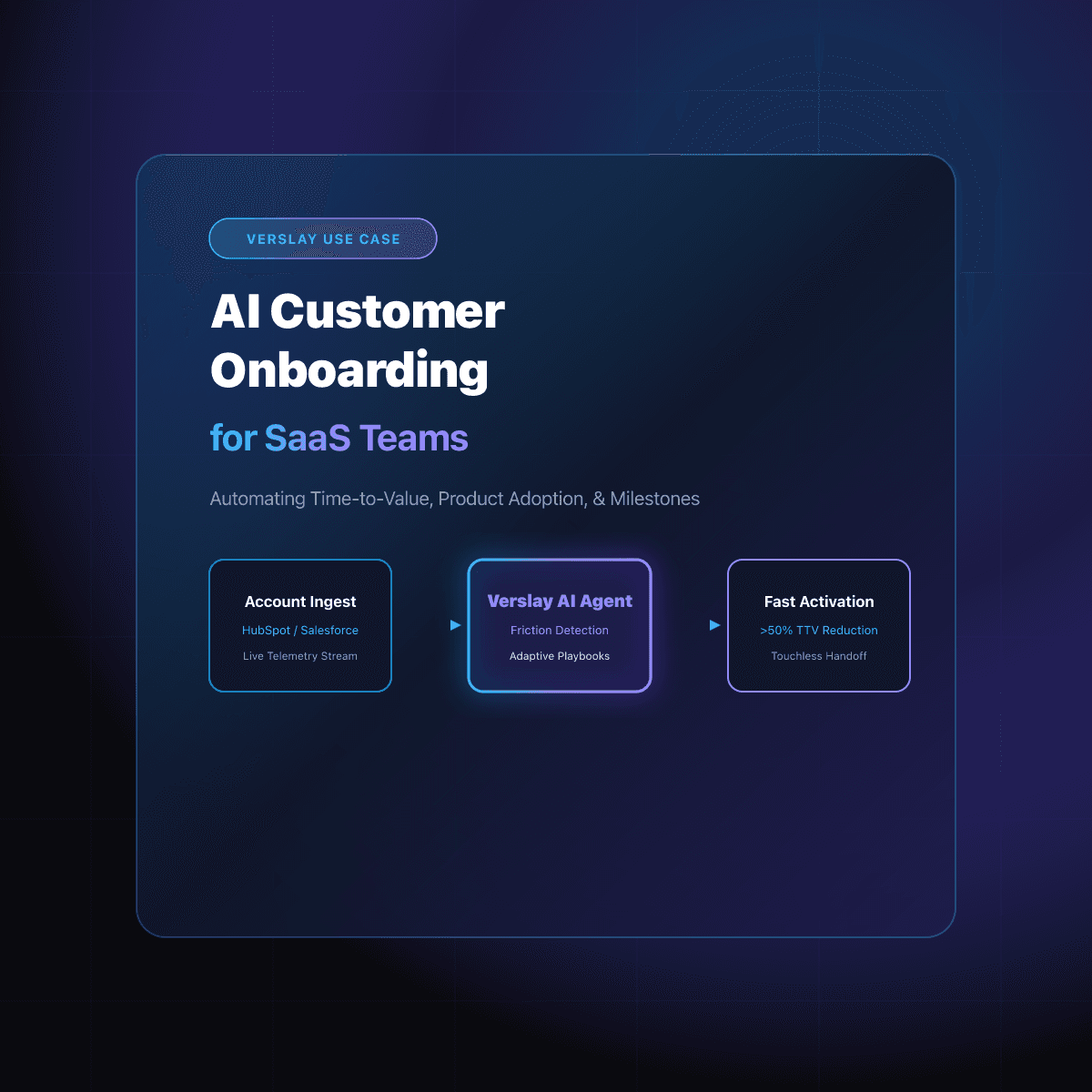
AI customer onboarding automates new account provisioning, milestone tracking, and product adoption for SaaS teams using proactive AI agents. By connecting directly to product analytics, CRMs, and customer communication channels, AI agents detect implementation friction in real time, deliver contextual guidance to end-users, and alert customer success managers before onboarding milestones slip. This touchless orchestration slashes time-to-value (TTV) by more than 50% while scaling customer success capacity across mid-market and larger accounts.
In modern B2B SaaS, the customer onboarding phase represents the highest-leverage window in the entire customer lifecycle. When new users achieve their core "aha moment" within days of signing an agreement, net revenue retention surges and renewal risk plummets. Conversely, when onboarding drags across weeks of disconnected email threads, delayed API setups, and inactive user seats, customers form negative first impressions that inevitably culminate in early contract cancellation.
By deploying autonomous AI Agents that continuously inspect product telemetry, coordinate stakeholders, and provide instant technical guidance, SaaS companies replace rigid linear checklists with intelligent, adaptive onboarding journeys.
The Onboarding Bottleneck: Why Manual SaaS Implementation Fails at Scale
Customer success and implementation teams are caught between surging customer expectations and constrained operational headcount. As SaaS products grow in capability and architectural complexity, onboarding workflows regularly break down across predictable operational failure points:
- Invisible Implementation Drop-Off: Customer success managers (CSMs) typically manage 20 to 40 onboarding accounts simultaneously. When a customer team encounters an authentication error, a failed CSV import, or internal team hesitation, they rarely submit a support ticket. Instead, product usage silently grinds to a halt. By the time a CSM notices at the next scheduled status check-in, two weeks of momentum have evaporated.
- Generic, Impersonal Setup Checklists: Traditional onboarding automation relies on static in-app walkthrough modals and canned email drips. These rigid cadences treat a multi-product deployment the same as a single-seat self-serve trial, ignoring account size, technical maturity, and specific contract use cases.
- Fragmented Data Across Systems: Evaluating whether a new account is genuinely progressing requires cross-referencing workspace creation timestamps in Stripe or Salesforce, event telemetry in PostHog or Mixpanel, single sign-on (SSO) configurations in Okta, and support queries in Zendesk. Gathering this data manually takes hours per customer review.
- CSM Burnout and Administrative Drag: High-touch onboarding specialists spend up to 60% of their working hours chasing customers for kickoff agendas, reminding IT administrators to verify domains, and scheduling walkthrough calls rather than delivering strategic consulting.
- The Churn Seed Planted in Days 1 to 30: Over 70% of downstream churn can be traced directly to incomplete onboarding. When customers fail to integrate their core data streams during the initial 30 days, team-wide habituation never takes root, leaving the renewal unprotected.
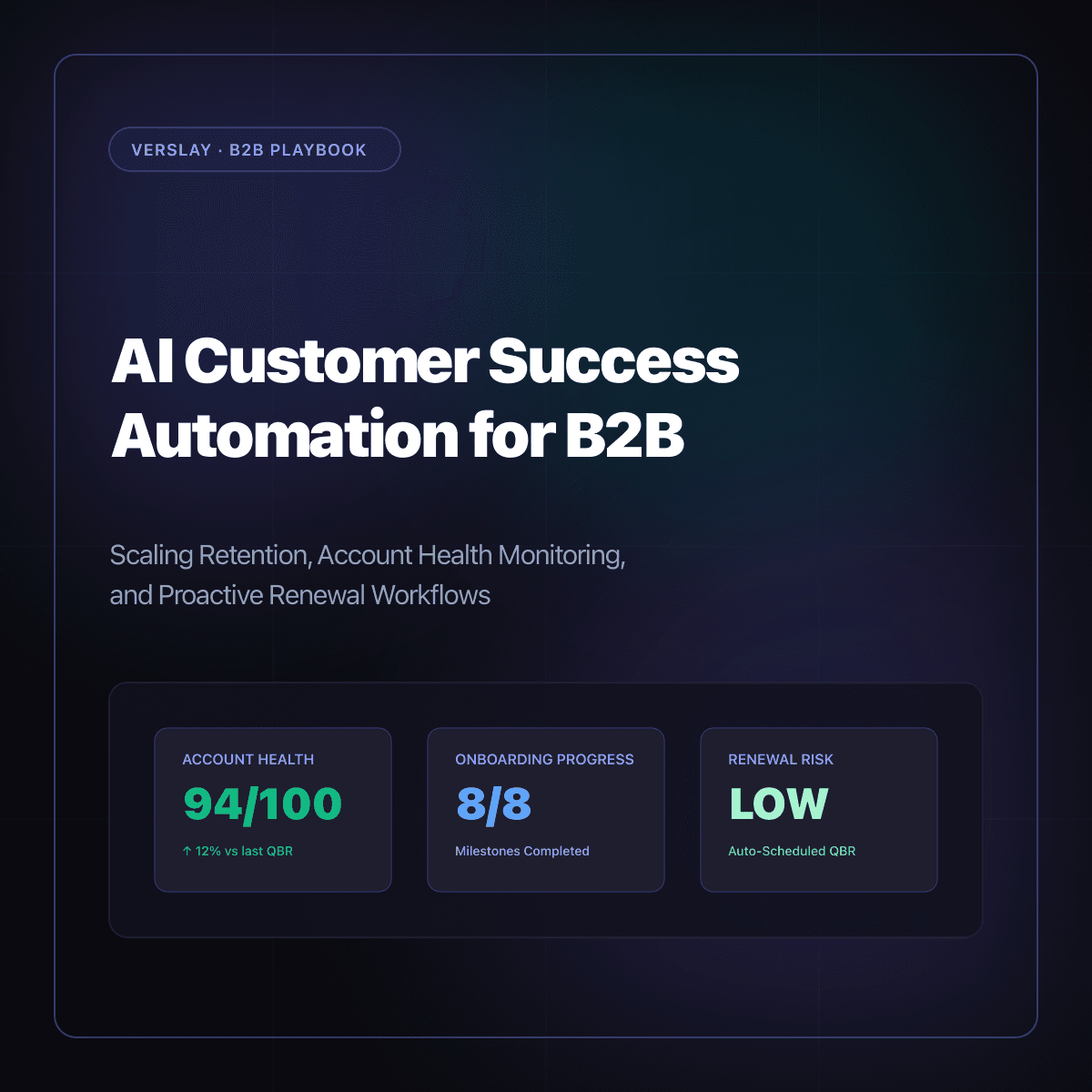
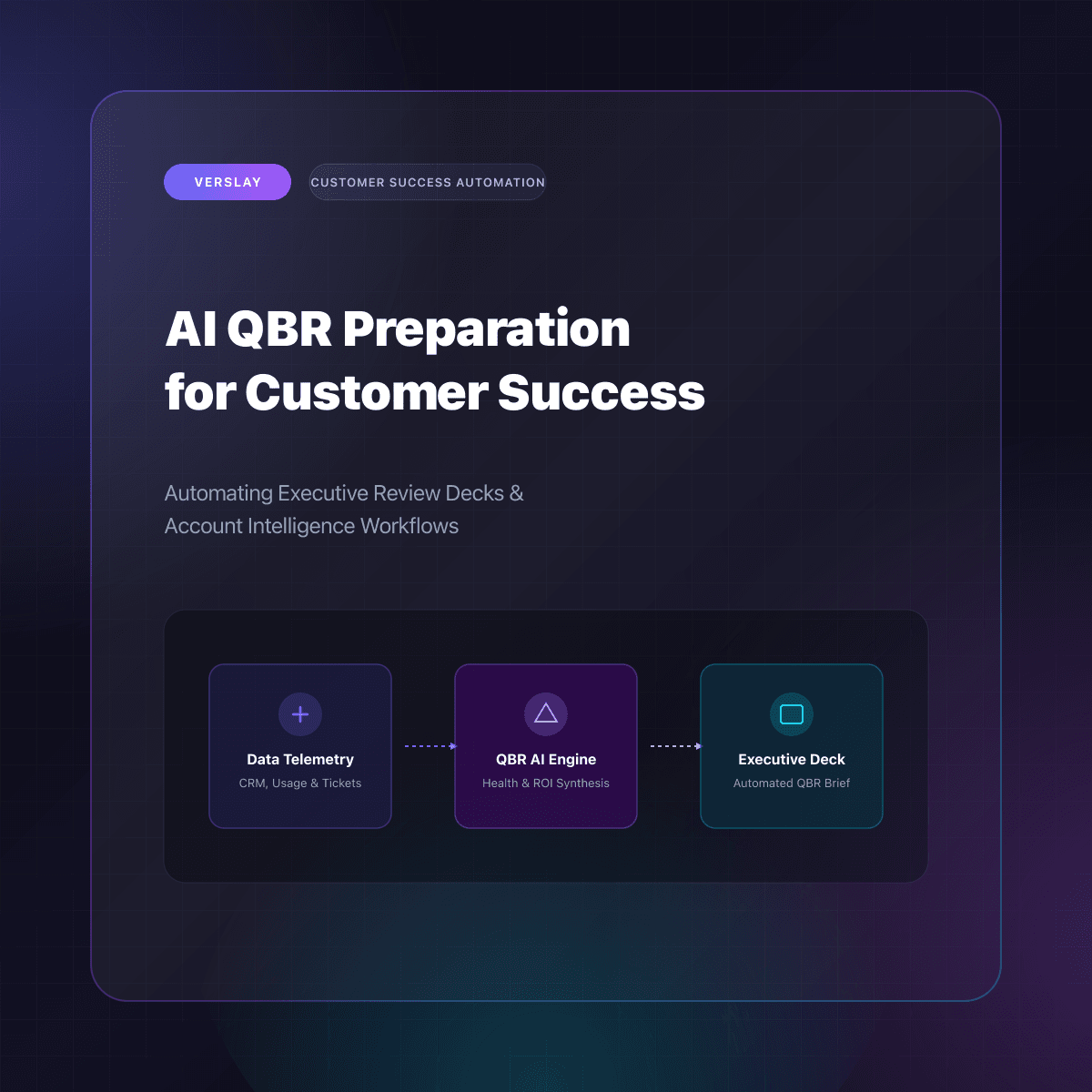
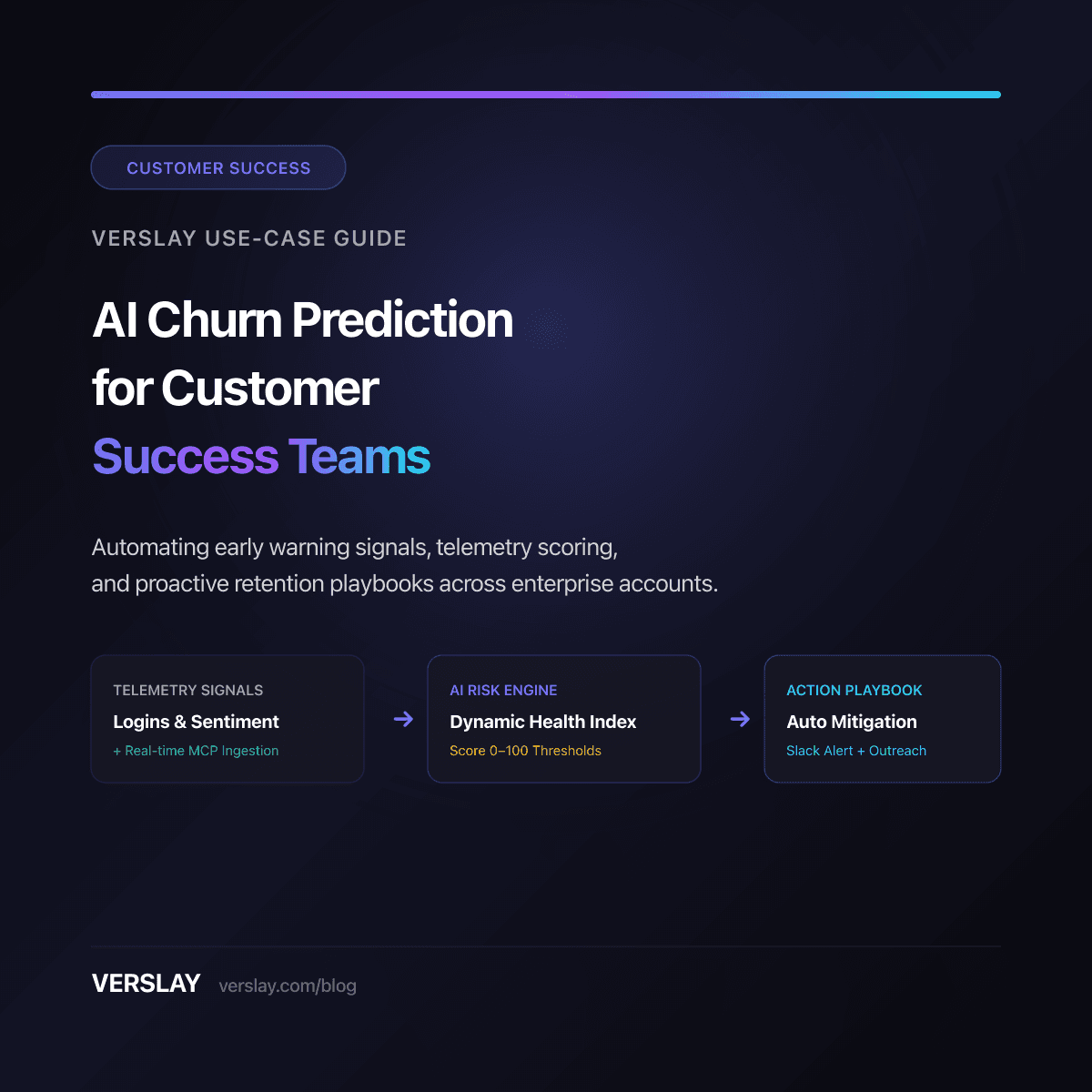
To explore how AI automates adjacent customer success operations, read our guides on AI customer success automation for B2B teams and AI churn prediction for customer success.
Core Capabilities of Autonomous AI Customer Onboarding Agents
Modern AI customer onboarding software moves beyond passive tooltips. Proactive cognitive agents monitor user behavior, anticipate roadblocks, and take autonomous actions across your tech stack:
1. Account Discovery and Tailored Journey Synthesis
The moment an opportunity changes to "Closed-Won" in your CRM:
- Contract & Use Case Parsing: Ingests sales call transcripts, proposal SOWs, and signed contracts to extract the client's stated objectives, designated champions, target integrations, and go-live deadline.
- Dynamic Playbook Assembly: Automatically constructs an onboarding project plan customized to the customer's plan tier, technical stack, and user roles—generating distinct milestone tracks for executive sponsors, system administrators, and daily end-users.
- Personalized Kickoff Communications: Drafts and dispatches tailored welcome briefs with pre-configured project boards in Asana, Linear, or Monday.com, eliminating manual administrative prep.
2. Live Telemetry Monitoring & Milestone Verification
Rather than relying on self-reported client progress:
- Continuous Product Event Ingestion: Streams real-time event logs from product analytics platforms (Segment, Mixpanel, Amplitude, PostHog) to verify milestone completion (e.g., API key generated, team members invited, first core action completed).
- Proactive Stagnation Detection: Flags accounts that stall between sequential onboarding steps (for instance, creating a workspace but failing to configure an initial integration within 72 hours).
- Automated Milestone Validation: Marks milestones complete and triggers the next activation phase without requiring manual verification by a CSM.
3. Contextual In-App Guidance & Technical Copilot
Removing technical friction before it escalates to support:
- Instant Documentation Synthesis: When an admin encounters an error during ERP or webhook configuration, the AI agent analyzes the error code and generates step-by-step resolution instructions tailored to their specific technology stack.
- Interactive Multi-Channel Nudges: Reaches out via Slack Connect, Microsoft Teams, or email with relevant context: "We noticed your team successfully connected Snowflake, but table permissions have not been granted yet. Here is the 2-minute guide to complete this step."
- Role-Based Activation Workflows: Delivers tailored micro-tutorials to secondary users as they log in for the first time, ensuring rapid team-wide adoption.
4. Risk-Weighted CSM Intervention & Escalation
Empowering customer success teams to focus where human empathy matters most:
- Predictive Health Scoring: Computes a dynamic Onboarding Velocity Score based on completion speed, active seat ratio, and support query sentiment.
- Smart Escalation Triggers: Instantly notifies assigned CSMs in Slack with full context when a key account exhibits high churn probability during onboarding, including recommended interventions and meeting talking points.
- Automated Progress Summaries: Compiles weekly executive progress digests for customer stakeholders, highlighting completed setup goals, active user metrics, and upcoming milestones.
Architecture: How an Autonomous Onboarding Engine Orchestrates Activation
The diagram below illustrates how an AI onboarding agent ingests CRM closed-won triggers, continuously analyzes product analytics, and coordinates multi-channel customer activation:
[CRM Closed-Won Trigger] (Salesforce / HubSpot)
                 │
                 ▼
     [Onboarding Orchestrator Agent]
  (Contract Parsing, Playbook Customization)
                 │
                 ▼
    [Multi-System Telemetry Monitor]
┌────────────────┼────────────────┐
▼                ▼                ▼
[Product Analytics]  [Identity & SSO]  [Support & Messaging]
(Mixpanel/PostHog)   (Okta / Auth0)   (Zendesk / Intercom)
• Feature Events     • SSO Setup       • Error Tickets
• User Logins        • Seat Provision  • Help Queries
└────────────────┬────────────────┘
                 │
                 ▼
   [Cognitive Intervention Engine]
 (Friction Detection, Contextual Nudges)
  ┌──────────────┴──────────────┐
  ▼                             ▼
[Self-Serve Path]         [Human CSM Path]
• Step-by-Step Fixes      • Slack Escalation Alerts
• Slack Connect Guidance  • Executive Brief Synthesis
• Milestone Unlocking     • Strategic Consulting
- Trigger: The closed-won deal initiates automated account staging and custom playbook generation.
- Track: Telemetry monitors event streams to evaluate activation velocity across all provisioned seats.
- Resolve: Technical barriers trigger instant, contextual self-serve guidance via Slack Connect or email.
- Escalate: Complex blockers alert the assigned CSM with pre-compiled diagnostics and corrective actions.
Traditional Manual Onboarding vs. Legacy Walkthrough Tools vs. Autonomous AI Agents
| Evaluation Criteria | Manual CSM Onboarding | Legacy In-App Walkthroughs | Autonomous AI Onboarding Agents | | :--- | :--- | :--- | :--- | | Response Time to Stalled Users | 3 to 7 business days (at next sync) | No active awareness (passive modals) | Instant (under 10 minutes from friction) | | Playbook Customization | High manual effort per account | Static, one-size-fits-all popups | Dynamic synthesis based on contract SOW & tech stack | | Telemetry Integration | Manual dashboard inspections | Basic in-app pageview triggers | Deep bidirectional sync with CRMs, analytics, and SSO | | Technical Troubleshooting | Relies on back-and-forth support tickets | Incapable of diagnosing API/data errors | Generates precise, stack-specific resolution guides | | CSM Account Capacity | 15 to 25 concurrent accounts | N/A (unassisted self-serve only) | 75 to 100+ concurrent accounts | | Average Time-to-Value (TTV) | 30 to 60 days | High abandonment on complex setups | 10 to 18 days (over 50% reduction) | | Customer Experience | High friction scheduling meetings | Intrusive, frequently dismissed tooltips | Seamless, contextual assistance across Slack and email |
Measurable Operational and Business Outcomes for SaaS Teams
Deploying autonomous AI customer onboarding delivers concrete performance gains across both efficiency and revenue retention:
- Over 50% Reduction in Time-to-Value (TTV): Removing technical bottlenecks and eliminating administrative scheduling delays accelerates full platform activation from months to days.
- 3x Increase in CSM Account Bandwidth: By automating routine milestone tracking, administrative check-ins, and documentation delivery, customer success teams can manage triple the onboarding volume without adding headcount.
- Up to 40% Increase in 90-Day Net Expansion: Customers who achieve their primary business outcomes rapidly during initial onboarding expand seat counts and upgrade feature tiers significantly faster.
- Immediate Deflection of Onboarding Support Inquiries: In-context resolution guides address common configuration errors at the point of failure, freeing support engineers from repetitive setup troubleshooting.
- Elimination of "Ghosting" Accounts: Early behavioral triggers catch stalled users within hours, allowing teams to re-engage stakeholders while interest and enthusiasm remain peak.
Frequently Asked Questions
What is AI customer onboarding?
AI customer onboarding uses autonomous software agents to guide new SaaS accounts through initial setup, monitor milestone completion, and resolve technical implementation roadblocks in real time.
How do autonomous AI agents reduce time-to-value (TTV) for SaaS teams?
AI agents detect activation friction early, trigger contextual guidance based on live product telemetry, and automatically draft customized onboarding playbooks, reducing time-to-value by more than 50%.
Can AI customer onboarding integrate with existing CRMs and analytics platforms?
Yes, AI onboarding agents connect with CRMs like HubSpot and Salesforce, product analytics platforms like Mixpanel and PostHog, and communication channels like Slack and email to orchestrate touchless customer journeys.
Scale Your SaaS Onboarding and Accelerate Activation with Verslay
Do not let implementation friction undermine your customer relationships before they begin. Verslay's autonomous AI agents connect directly to your product analytics, customer communication channels, and CRMs to shepherd every new account from contract signature to realized value on autopilot.
Explore Verslay's AI Agents to transform your customer onboarding operations today.