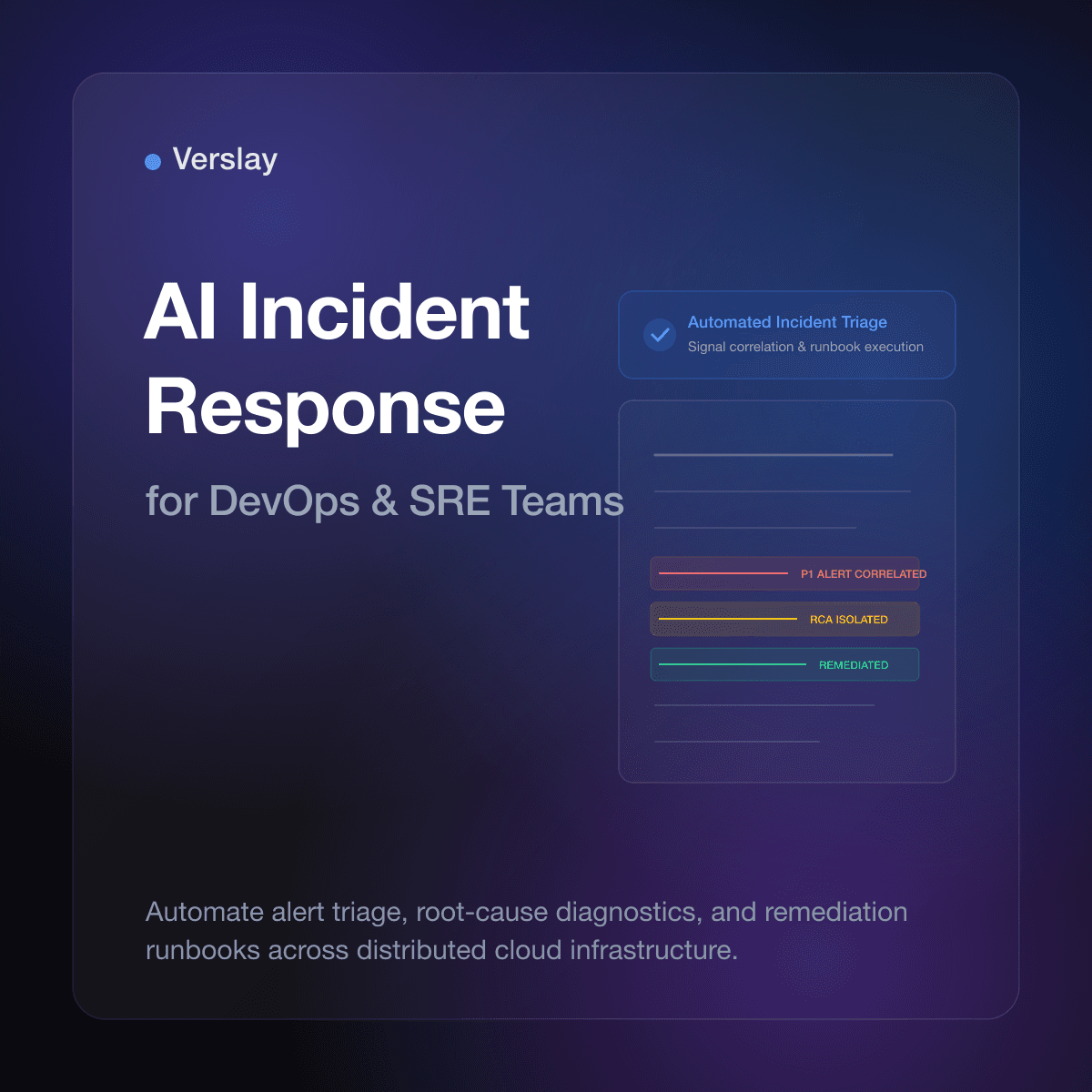
AI incident response automation for DevOps and Site Reliability Engineering (SRE) teams uses autonomous AI agents to ingest multi-source telemetry, deduplicate and correlate noise into actionable incidents, identify root causes across distributed services, and execute remediation runbooks in real time. By integrating directly with monitoring platforms, version control systems, cloud providers, and communication channels, AI agents reduce Mean Time to Resolution (MTTR) by up to 75% while preventing on-call engineer burnout.
Closest Verslay page: Workflow Orchestrator. Maps dependencies and sequences workflow steps into structured execution plans. It is the nearest live match for this topic, not a one-to-one fit.
Modern distributed architectures, microservices, and multi-cloud environments have drastically increased the complexity of maintaining 99.99% service availability. When a production anomaly strikes, on-call engineers are routinely bombarded with dozens of cascading alerts across fragmented monitoring dashboards, losing precious minutes manually piecing together what broke, what changed, and how to recover.
Deploying autonomous AI Agents connected via Model Context Protocol (MCP) and secure APIs transforms incident management from high-stress fire drills into predictable, automated, and auditable operational workflows.
Why Traditional Manual Incident Management Causes Alert Fatigue and Escalating MTTR
Modern cloud architectures generate massive volumes of telemetry. However, traditional incident response workflows rely heavily on manual human intervention at every stage, creating severe operational bottlenecks:
- Severe Alert Fatigue & Cascading Noise: When a downstream database experiences latency, dozens of upstream services fire independent alerts in PagerDuty, Opsgenie, or Slack. Engineers spend the first 15 to 20 minutes filtering duplicate notifications rather than solving the issue.
- Fragmented Observability Silos: Diagnosing an outage requires pivoting across multiple browser tabs—tracing spans in Datadog, querying logs in Elasticsearch or Grafana Loki, checking AWS CloudWatch metrics, and inspecting recent Kubernetes events.
- Tribal Knowledge & Outdated Runbooks: Remediation steps are frequently documented in static Notion or Confluence wikis that are outdated, ambiguous, or only known to a handful of senior engineers.
- Delayed Root Cause Identification: Correlating an infrastructure anomaly back to a specific commit, pull request, or configuration change deployed 10 minutes prior requires tedious manual git log and CI/CD pipeline auditing.
- Inconsistent Post-Mortem Documentation: Writing thorough, blameless post-incident reviews (PIRs) is time-consuming, resulting in skipped action items and recurring system failures.
Explore how AI SLA tracking for internal IT teams and AI support ticket triage for service teams establish continuous operational visibility across IT environments.
Core Capabilities: How Autonomous AI Agents Automate Incident Management
Autonomous AI agents act as 24/7 first responders for engineering and DevOps teams, handling the entire incident lifecycle from initial detection to resolution:
1. Intelligent Alert Correlation & Noise Suppression
AI agents continuously ingest alert webhooks from Datadog, New Relic, Prometheus, Sentry, and CloudWatch:
- Topology-Aware Grouping: Correlates hundreds of raw alerts from interdependent microservices into a single, unified incident.
- Severity & Impact Classification: Dynamically determines business impact by analyzing traffic volume, error rates, affected customer tiers, and active SLAs.
- Deduplication: Suppresses redundant noise so on-call engineers are paged only for genuine, high-severity service degradations.
2. Automated Root-Cause Analysis (RCA) & Git Traceability
The moment an incident is declared, the AI agent launches deep investigative diagnostic passes:
- Telemetry & Trace Synthesis: Queries distributed tracing spans to isolate the exact microservice, database query, or third-party API causing latency spikes or 5xx error surges.
- Deployment & Commit Mapping: Cross-references incident timestamps against recent GitHub or GitLab pull requests, ArgoCD syncs, and Kubernetes deployments.
- Anomaly Detection in Logs: Parses millions of log lines across log aggregators to surface rare stack traces and configuration mismatches without requiring manual grep queries.
3. Guardrailed Runbook Execution & Self-Healing Workflows
AI agents bridge the gap between diagnosis and remediation by executing targeted operational scripts:
- Deterministic Action Triggers: Automatically executes predefined remediation runbooks for known error signatures (e.g., restarting stalled worker pods, clearing Redis cache locks, or scaling auto-scaling groups).
- Human-in-the-Loop Approvals: For high-impact actions—such as rolling back a production release, failing over a database cluster, or toggling feature flags—the agent drafts the command and presents an interactive one-click approval in Slack or Microsoft Teams.
- Immutable Audit Trails: Records every diagnostic query, command output, and human approval in compliance-ready execution logs.
4. Automated Incident War-Room Orchestration & Stakeholder Comms
Keeping cross-functional teams and customers informed without distracting responders:
- Slack & Teams Channel Creation: Automatically provisions a dedicated #incident-response channel, invites relevant service owners based on service catalog metadata, and pins a live incident summary.
- Real-Time Status Synchronization: Updates external and internal status pages (e.g., Statuspage, Incident.io) with non-technical executive briefs.
- Continuous Timeline Tracking: As responders test hypotheses and apply fixes, the agent logs timestamps and milestones in real time.
5. Automated Blameless Post-Mortem & Knowledge Base Generation
Capturing institutional knowledge to ensure incidents never repeat:
- Chronological Timeline Generation: Compiles the complete incident history, including initial alert trigger, response actions, mitigation time, and final recovery.
- Action Item Extraction: Automatically files remediation tasks and architectural hardening tickets in Jira or Linear.
- Knowledge Base Enrichment: Updates runbooks and incident wikis with new failure modes and validated resolution steps.
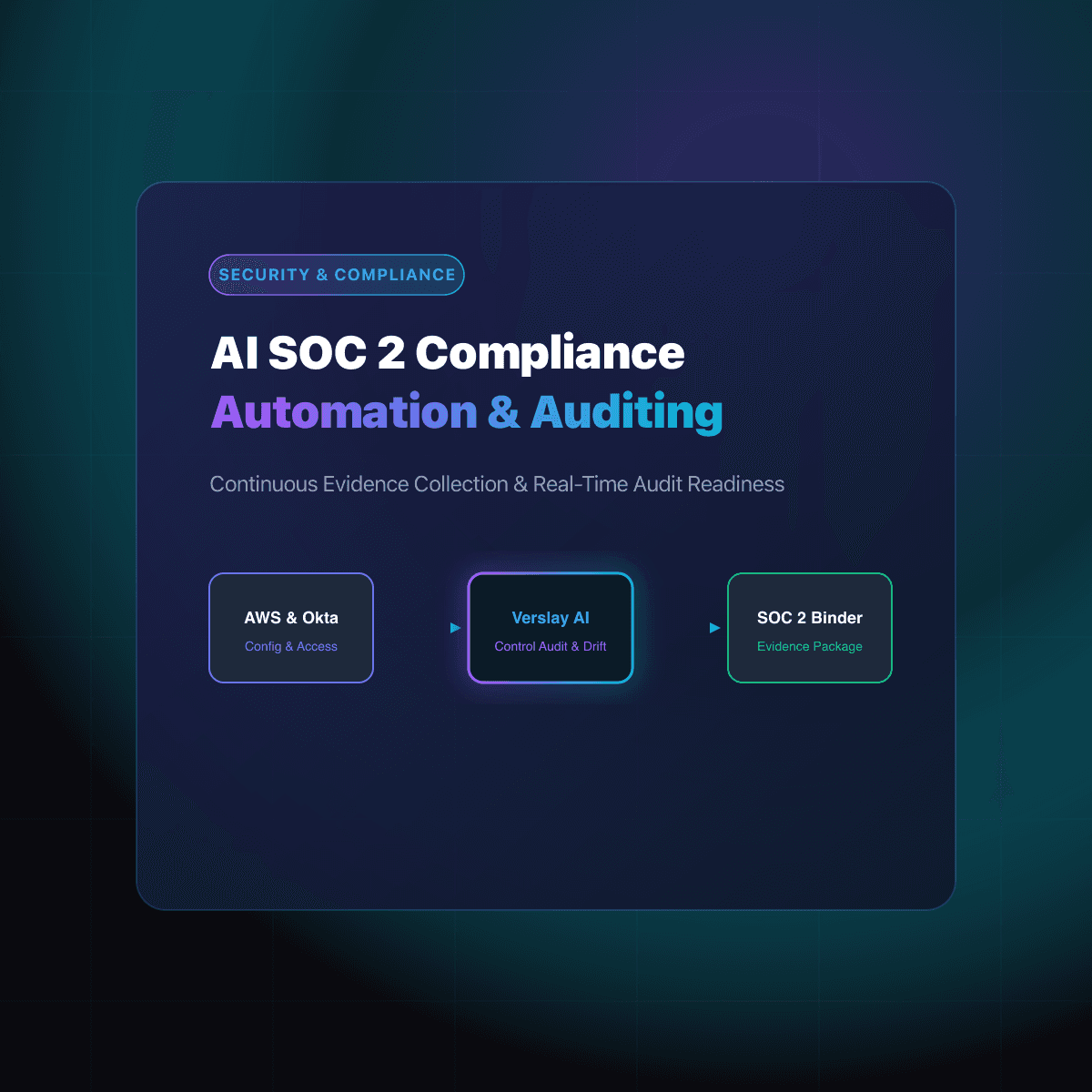
Learn how AI SOC 2 compliance automation for security teams ensures continuous change management tracking and audit readiness across your production environment.
Architecture of an Autonomous AI Incident Response Pipeline
The diagram below illustrates how an AI-driven incident management engine ingests telemetry, correlates alerts, diagnoses root causes, executes runbooks, and generates post-mortems:
[Observability & Telemetry] (Datadog, Prometheus, CloudWatch, Sentry)
                         │
                         ▼
           [AI Incident Ingestion & Correlation]
         (Noise Suppression & Severity Scoring)
                         │
                         ▼
        ┌────────────────┴────────────────┐
        ▼                                 ▼
[Root Cause Diagnostics]        [War Room Orchestration]
(Log Analysis, Git Traces)      (Slack Channel, Statuspage)
        │                                 │
        ▼                                 ▼
[Automated Runbook Engine]      [Human-in-the-Loop Gate]
(Pod Restart, Cache Flush)      (One-Click Rollback Approval)
        │                                 │
        └────────────────┬────────────────┘
                         ▼
         [Blameless Post-Mortem Generator]
        (Jira / Linear Tasks & Confluence Docs)
- Ingest & Correlate: Ingest multi-channel alerts, suppress duplicate noise, and group correlated symptoms into a single master incident.
- Diagnose & Trace: Inspect distributed traces, query log clusters, and map recent code deployments to pinpoint the root cause in seconds.
- Remediate with Guardrails: Run automated recovery scripts or request one-click engineer authorization for stateful changes.
- Learn & Prevent: Publish comprehensive post-mortems, update documentation, and track preventative backlog issues automatically.
Comparing Manual Incident Triage vs. Autonomous AI Incident Response
| Incident Management Dimension | Traditional Manual Incident Response | Autonomous AI Incident Response | | :--- | :--- | :--- | | Alert Ingestion & Triage | Responders flooded with dozens of disconnected alerts | Intelligent deduplication and multi-service alert correlation | | Initial Triage Time | 15–30 minutes spent locating logs and on-call rosters | Under 30 seconds for complete signal analysis and room setup | | Root Cause Isolation | Manual log searching and git commit diffing | Instant span tracing, log anomaly isolation, and commit mapping | | Runbook Execution | Manual command-line execution prone to human error | Automated, idempotent runbook orchestration with safety gates | | Communication Overhead | Engineers split attention between fixing and writing updates | Automated stakeholder updates and status page syncing | | Post-Mortem Turnaround | Days or weeks to draft post-incident reviews | Instant, comprehensive timeline and PIR drafts generated upon resolution | | On-Call Engineer Impact | High burnout, frequent off-hours paging for noise | Minimized interruptions with self-healing background automation |
Measurable Operational ROI for DevOps and SRE Organizations
Implementing autonomous AI agents for incident response automation delivers transformative business and operational gains:
- Up to 75% Reduction in MTTR: Slashing time-to-diagnosis from 30+ minutes to under 2 minutes directly restores revenue-generating services faster.
- 90% Reduction in Alert Fatigue: Filtering duplicate and transient alerts ensures on-call engineers only respond to actionable, critical events.
- Zero Configuration Drift in Remediation: Standardized runbook execution eliminates inconsistent manual fixes and accidental production misconfigurations.
- Accelerated Engineering Velocity: By eliminating hours of manual incident firefighting and post-mortem administration, engineers stay focused on high-value feature development.
Explore how deploying specialized AI agents for business operations and AI-driven internal IT management helps engineering organizations achieve peak reliability.
See it in Verslay
Verslay agents work through the tools you already connect and prepare drafts and staged actions for a person to approve. The Workflow Orchestrator page shows the real workflow. You can also browse all use cases or book a 30-minute walkthrough.
Frequently Asked Questions
What is incident response automation for DevOps and SRE teams?
AI incident response automation uses autonomous AI agents to ingest alerts from monitoring tools, correlate signals to eliminate alert fatigue, diagnose root causes via log analysis, and execute safe remediation runbooks.
How do AI agents reduce Mean Time to Resolution (MTTR)?
AI agents immediately correlate multi-service alerts, query telemetry from Datadog, CloudWatch, and Grafana, pinpoint anomalous deployments or commits, and suggest or execute rollback and restart scripts in seconds.
Can AI agents execute automated runbooks safely without human error?
Yes, AI agents operate with strict guardrails and role-based access control, executing predefined remediation workflows while requesting one-click human-in-the-loop approvals for high-risk production actions.
Elevate Production Reliability with Verslay
By automating incident response triage, diagnostics, and remediation workflows, engineering leaders safeguard uptime and protect their teams from burnout.
Explore Verslay's AI Agents and IT Operations Solutions to build resilient, automated cloud operations today.