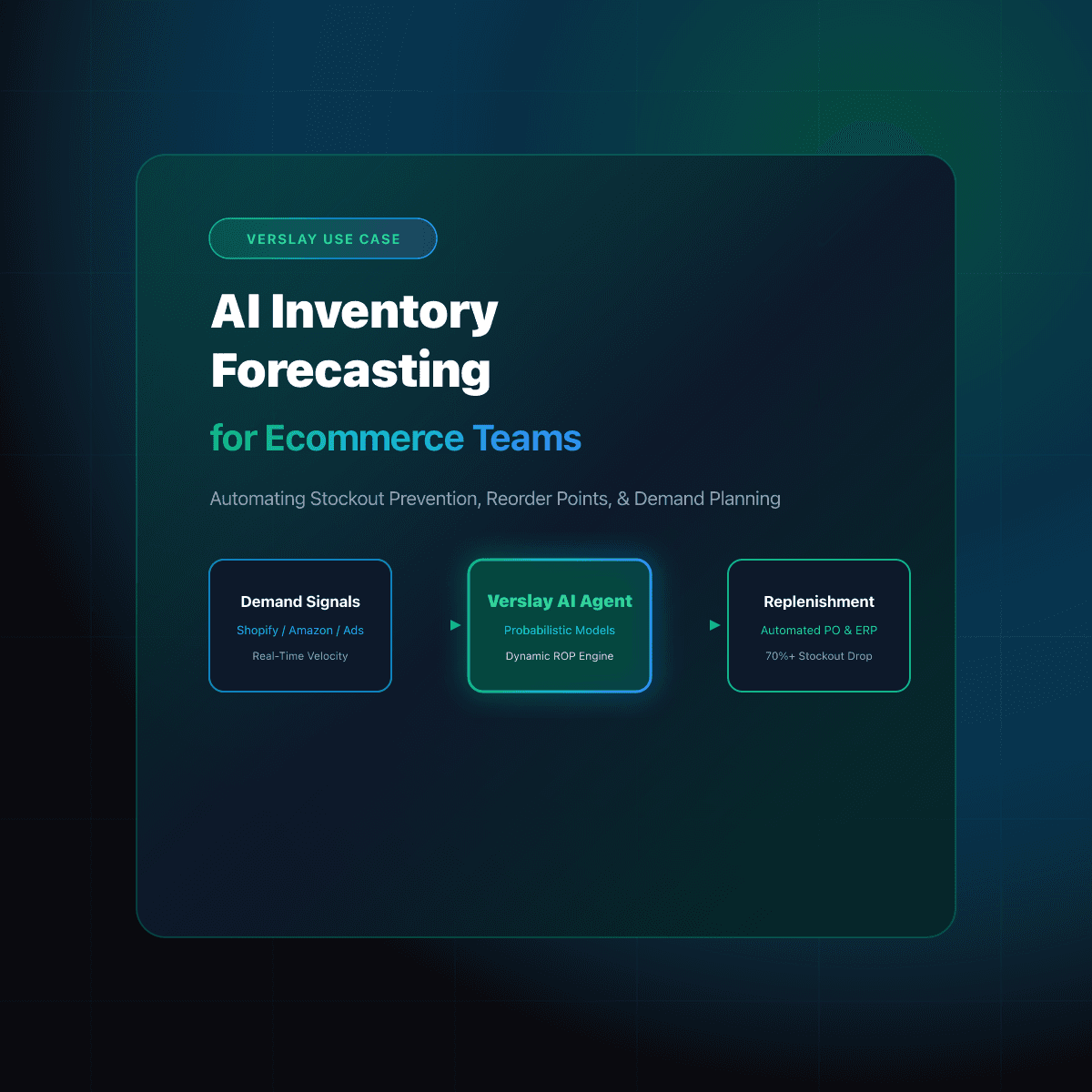
AI inventory forecasting for ecommerce uses autonomous AI agents to predict SKU-level demand fluctuations, calculate dynamic reorder points, and automate purchase order creation across multichannel retail operations. By ingesting real-time sales velocity from Shopify and Amazon, marketing campaign calendars, and supplier lead times, AI agents prevent costly stockouts during sales surges while eliminating excess holding capital from overstocking. This straight-through forecasting workflow reduces stockouts by over 70% and frees ecommerce operations teams from brittle spreadsheets.
How this maps to Verslay: the Inventory & Reorder page covers this workflow. SKUs heading toward stockout, ranked by revenue at risk.
For high-growth direct-to-consumer (DTC) brands and multichannel retailers, inventory represents both the core engine of revenue and the single largest balance-sheet risk. Locking working capital into slow-moving inventory constrains growth and drives up warehouse holding costs, while underestimating demand on hero products results in lost sales, suppressed marketplace search rankings, and alienated customers.
By deploying autonomous AI Agents capable of synthesizing multi-source sales data, ad spend signals, and supply chain timelines, modern E-Commerce & DTC brands transform static quarterly planning into an adaptive, continuous demand planning system.
The Breaking Point of Spreadsheet Forecasting: Why Manual Planning Fails Modern Ecommerce
While simple spreadsheet models and static safety stock rules once sufficed for single-store retailers, multichannel ecommerce operations quickly outgrow manual planning:
- Static Historical Averages vs. Dynamic Velocity: Relying on 30- or 60-day historical moving averages fails to account for non-linear demand drivers such as influencer marketing pushes, sudden viral trends, or seasonal holidays. By the time a sales spike appears in retrospective reports, inventory has already depleted.
- Multichannel Inventory Fragmentation: Modern brands sell across Shopify storefronts, Amazon FBA, TikTok Shop, wholesale accounts, and international portals. Operating disparate inventory pools leads to phantom stockouts on one channel while surplus units sit dormant in another warehouse.
- Unreliable Supplier Lead Times & Supply Chain Delays: Static lead-time assumptions collapse when container shipping schedules, port congestion, or factory manufacturing queues fluctuate. Failing to model supplier variability leads to stock arriving weeks too late or prematurely crowding warehouse aisles.
- The Compounding Penalties of Stockouts: Running out of stock on high-velocity items does more than forfeit immediate revenue; on marketplaces like Amazon and Walmart, stockouts reset algorithm search rankings and increase customer acquisition costs when campaigns restart.
- Excess Holding Costs & Working Capital Drag: Overcompensating for stockout risk by placing blanket bulk orders ties up critical working capital, increases borrowing expenses, and exposes brands to punitive aged inventory surcharges from 3PLs and Amazon FBA.
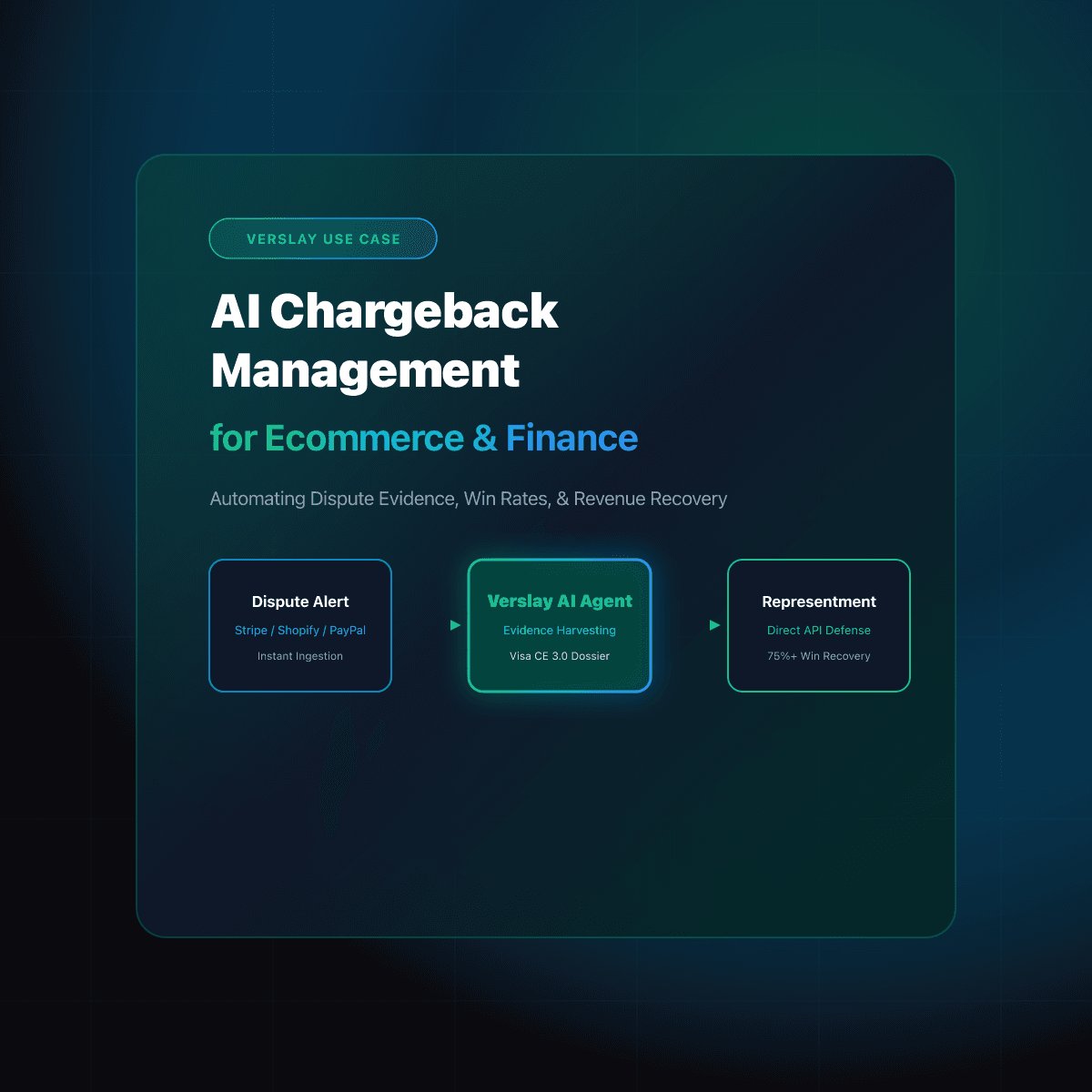
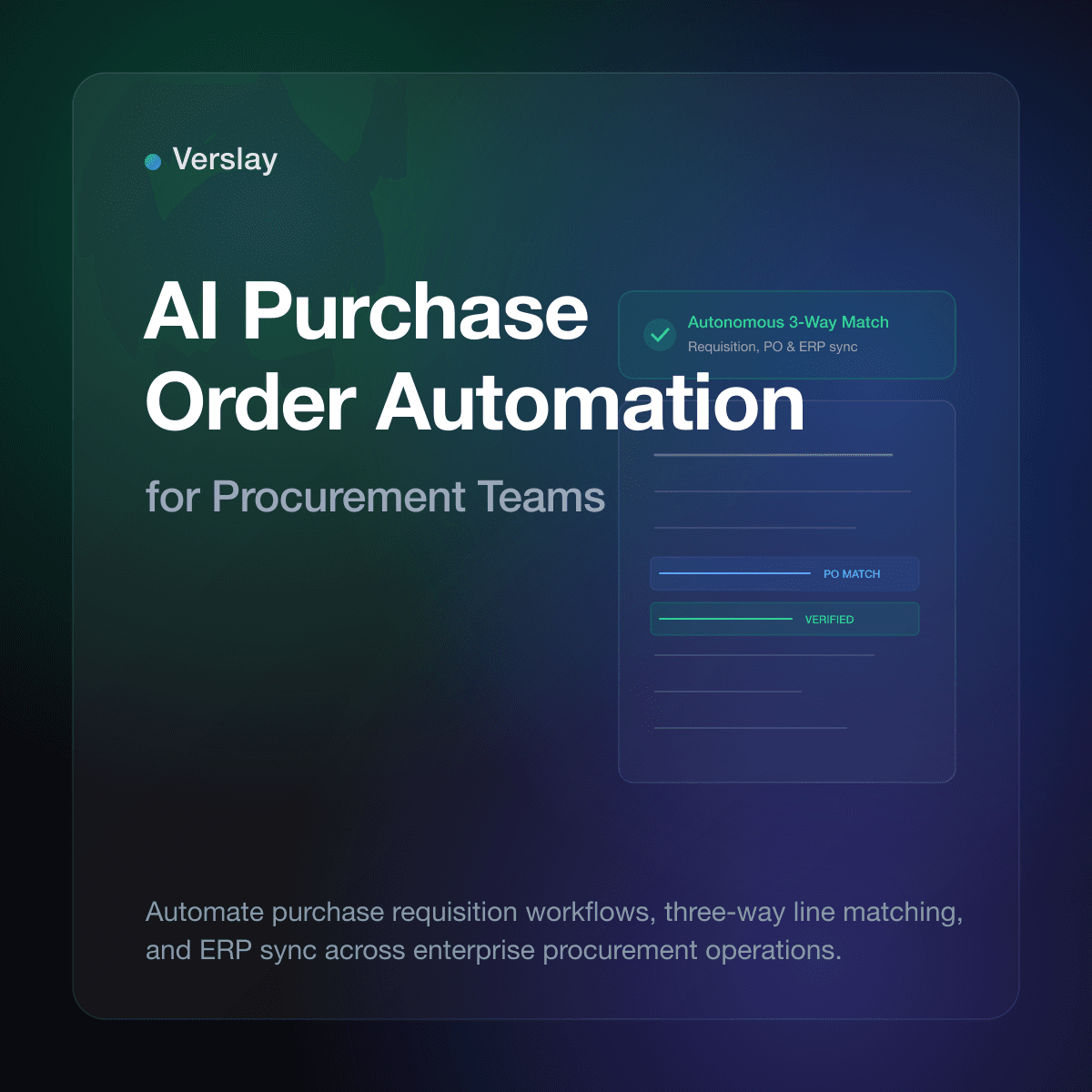
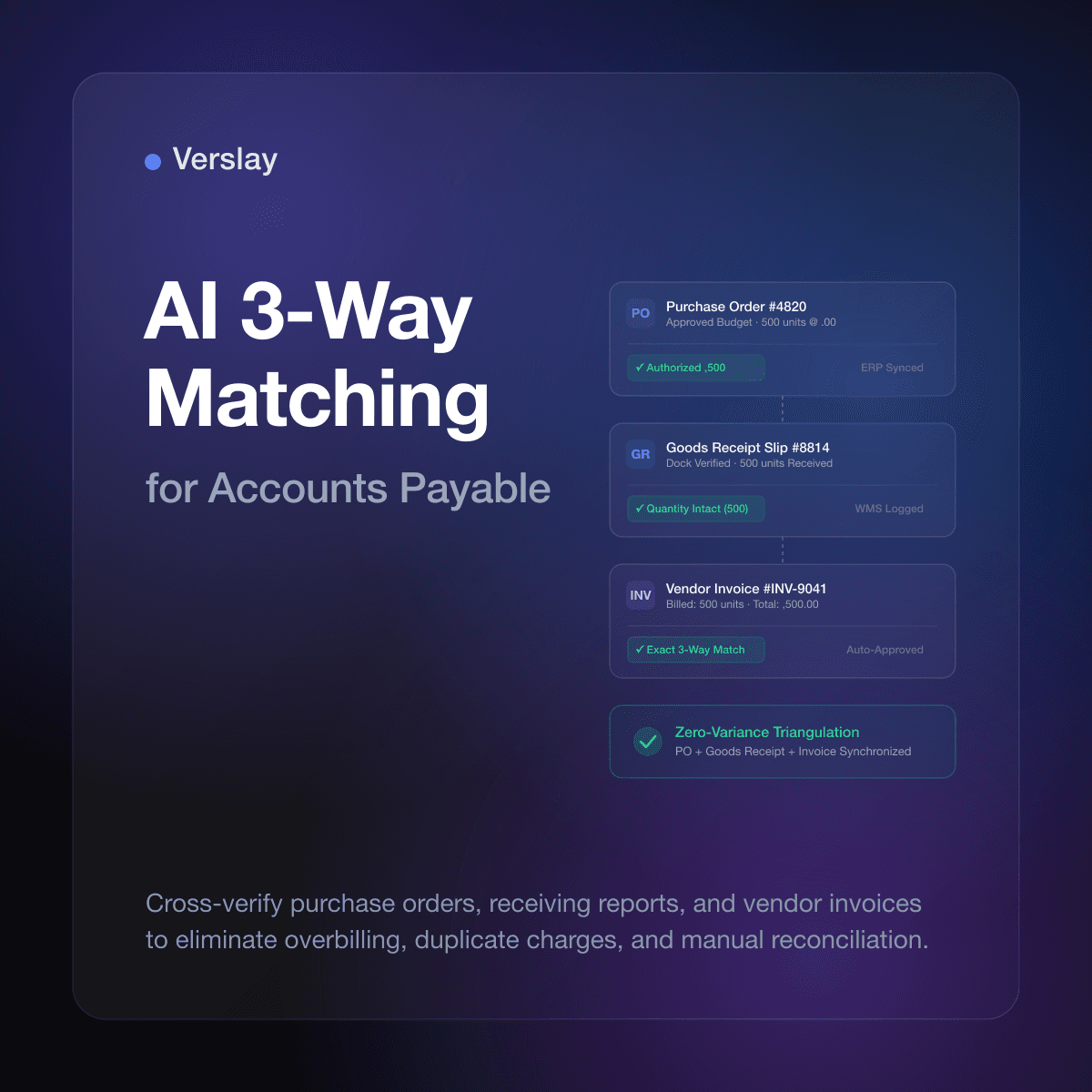
To see how autonomous agents streamline adjacent operational and financial workflows, explore our guides on AI chargeback management for ecommerce, AI purchase order automation for procurement teams, and AI 3-way matching for accounts payable teams.
Core Capabilities of Autonomous AI Inventory Forecasting
Modern AI inventory management software moves beyond rigid min/max rules. By utilizing specialized cognitive agents connected directly to commerce APIs and warehouse data, AI inventory forecasting coordinates the entire planning lifecycle:
1. Multichannel Demand Signal Ingestion
Rather than waiting for manual weekly data exports:
- Real-Time Channel Synchronization: Ingests sales velocity, order volumes, and return rates every few minutes from Shopify, Amazon Seller Central, TikTok Shop, and wholesale EDI connections.
- Marketing & Promotion Telemetry: Connects to Meta Ads, Google Ads, and Klaviyo email schedules to incorporate planned marketing campaigns, promotional discounts, and projected conversion lifts into SKU demand models.
- Macro & Seasonal Trend Factoring: Automatically adjusts baseline projections for regional holidays, seasonal buying cycles, and weather patterns without requiring manual calendar adjustments.
2. Probabilistic SKU-Level Demand Modeling
Replacing guesswork with high-resolution forecasting:
- Granular Variant Projections: Generates probabilistic demand curves for individual SKUs, size variants, and product bundles rather than broad category generalizations.
- Confidence Interval Forecasting: Provides best-case, expected, and conservative demand scenarios, allowing operations leaders to align inventory investments with organizational risk tolerance.
- New Product Demand Cold-Start: Estimates sales velocity for newly launched products by matching product attributes, price tiers, and marketing plans to historical product launch benchmarks.
3. Dynamic Reorder Points & Safety Stock Optimization
Continuously tuning inventory buffers:
- Lead-Time Variance Tracking: Monitors actual vendor fulfillment timelines against stated purchase order agreements, dynamically widening safety buffers for volatile suppliers while tightening them for consistent partners.
- Dynamic Reorder Triggers: Recalculates reorder points daily based on shifting sales velocity and real-time transit times, ensuring replenish orders are triggered at the mathematically optimal moment.
- Carrying Cost vs. Stockout Cost Optimization: Balances holding costs, cost of capital, and potential margin loss to determine optimal economic order quantities (EOQ).
4. Automated Purchase Order Drafting & Vendor Routing
Closing the loop between forecasting and procurement:
- Automated PO Generation: Drafts comprehensive purchase orders with itemized SKU counts, delivery schedules, and agreed unit pricing the instant inventory hits dynamic replenishment thresholds.
- ERP & Accounting Synchronization: Pushes draft purchase orders directly into NetSuite, QuickBooks, or Dear Systems, awaiting human review or triggering straight-through execution.
- Supplier Notification & Tracking: Dispatches purchase orders to supplier portals or vendor email contacts, tracking acknowledgment confirmations and production status milestones.
5. Multi-Node 3PL Balancing & Dead-Stock Liquidation
Optimizing inventory placement across the fulfillment network:
- Regional Warehouse Allocation: Recommends inter-warehouse transfer orders between regional 3PL nodes to keep stock closest to geographic customer demand clusters, slashing delivery zones and shipping surcharges.
- Dead Stock & Aging Inventory Alerts: Flags slow-moving variants before they cross 90-day aging thresholds, proposing targeted discount campaigns, bundling strategies, or clearance plays to recover capital.
Architecture: How an AI Inventory Demand Engine Orchestrates Stock Planning
The diagram below illustrates how an autonomous demand planning agent bridges sales channels, marketing signals, probabilistic modeling, and supplier procurement:
[Multichannel Sales Signals] (Shopify, Amazon FBA, TikTok Shop)
[Marketing & Ad Telemetry]   (Meta Ads, Google Ads, Klaviyo)
                         │
                         ▼
        [AI Demand Ingestion & Modeling Agent]
       (SKU-Level Velocity, Seasonality, Cold Starts)
                         │
                         ▼
     [Dynamic Reorder Point & Safety Stock Engine]
    (Supplier Lead Time Variance, Holding vs. Lost Margin)
                         │
        ┌────────────────┴────────────────┐
        ▼                                 ▼
[Inventory Buffer Healthy]      [Reorder Trigger Breached]
   • Monitor Daily Velocity        • Calculate Optimal Batch
   • Balance Regional 3PLs         • Auto-Draft Supplier PO
        └────────────────┬────────────────┘
                         │
                         ▼
         [ERP & Supplier Execution Engine]
      (NetSuite / QuickBooks Sync -> Vendor PO)
- Ingest: Continuously collects orders, ad spend pacing, and warehouse levels across every channel.
- Predict: Updates probabilistic SKU demand curves factoring in planned promotions and historical seasonality.
- Trigger: Compares projected stockout dates against vendor lead times to calculate the precise replenishment window.
- Execute: Generates purchase orders in the ERP and delivers supplier notifications for immediate confirmation.
Traditional Static Forecasting vs. Autonomous AI Inventory Forecasting
| Evaluation Criteria | Manual Spreadsheet Planning | Legacy ERP Min/Max Rules | Autonomous AI Inventory Agents | | :--- | :--- | :--- | :--- | | Data Ingestion Frequency | Weekly or monthly batch exports | Daily static database sync | Continuous real-time API webhooks | | Demand Drivers Considered | Historical sales only | Historical sales + manual safety buffer | Sales velocity, ad spend, promotions, weather, seasonality | | Reorder Point Adaptability | Fixed formula updated quarterly | Manually tuned min/max thresholds | Dynamically recalculated daily per SKU and supplier | | Supplier Lead Time Handling | Assumes static contracted days | Fixed vendor parameter | Continuous tracking of real-world fulfillment variance | | Multichannel Balancing | Manual reconciliation across portals | Fragmented inventory pools | Unified real-time stock allocation across channels | | Replenishment Workflow | Hours of manual data entry per PO | Rigid batch generation | Instant automated PO drafting and ERP synchronization | | Stockout & Overstock Rate | High (15% to 25% variance) | Moderate (10% to 18% variance) | Minimized (under 3% variance, 70%+ stockout reduction) |
Measurable Financial and Operational Impact for Ecommerce Brands
Deploying autonomous AI inventory forecasting delivers substantial improvements to profitability, working capital liquidity, and brand performance:
- Up to 70% Reduction in Costly Stockouts: Timely automated reordering ensures hero products stay in stock, protecting revenue streams and algorithmic marketplace search rankings.
- 25% to 35% Lower Inventory Holding Overhead: By right-sizing safety stock and identifying aging inventory early, brands prevent surplus holding costs and avoid steep warehouse aging fees.
- Liberated Working Capital for Growth: Eliminating over-purchasing on slow-moving variants frees up tens or hundreds of thousands of dollars in operating cash for product development and marketing expansion.
- 90% Reduction in Procurement Administrative Hours: Operations managers transition from manual spreadsheet manipulation to approving pre-compiled, mathematically validated supplier purchase orders.
See it in Verslay
Verslay agents work through the tools you already connect and prepare drafts and staged actions for a person to approve. The Inventory & Reorder page shows the real workflow. You can also browse all use cases or book a 30-minute walkthrough.
Frequently Asked Questions
How does AI improve inventory forecasting for ecommerce brands?
AI inventory forecasting analyzes multichannel sales velocity, marketing spend, seasonality, and supplier lead times to predict demand at the SKU level, eliminating stockouts and overstocking.
How do AI agents automate inventory reorder points and purchase orders?
AI agents continuously monitor real-time warehouse stock levels against forecasted consumption, dynamically adjusting safety stock buffers and drafting supplier purchase orders before inventory thresholds breach.
Can AI inventory forecasting integrate with platforms like Shopify, Amazon, and ERPs?
Yes, modern AI inventory forecasting connects bi-directionally with sales channels like Shopify and Amazon Seller Central, 3PL warehouse management systems, and ERPs like NetSuite to synchronize stock data in real time.
Eliminate Stockouts and Scale Your Ecommerce Brand with Verslay
Never lose another sale to preventable stockouts or tie up your cash flow in dead stock. Verslay's autonomous AI agents connect directly to your ecommerce storefronts, marketing channels, and warehouse management systems to forecast demand and automate replenishment on autopilot.
Explore Verslay's AI Agents to transform your inventory and supply chain operations today.