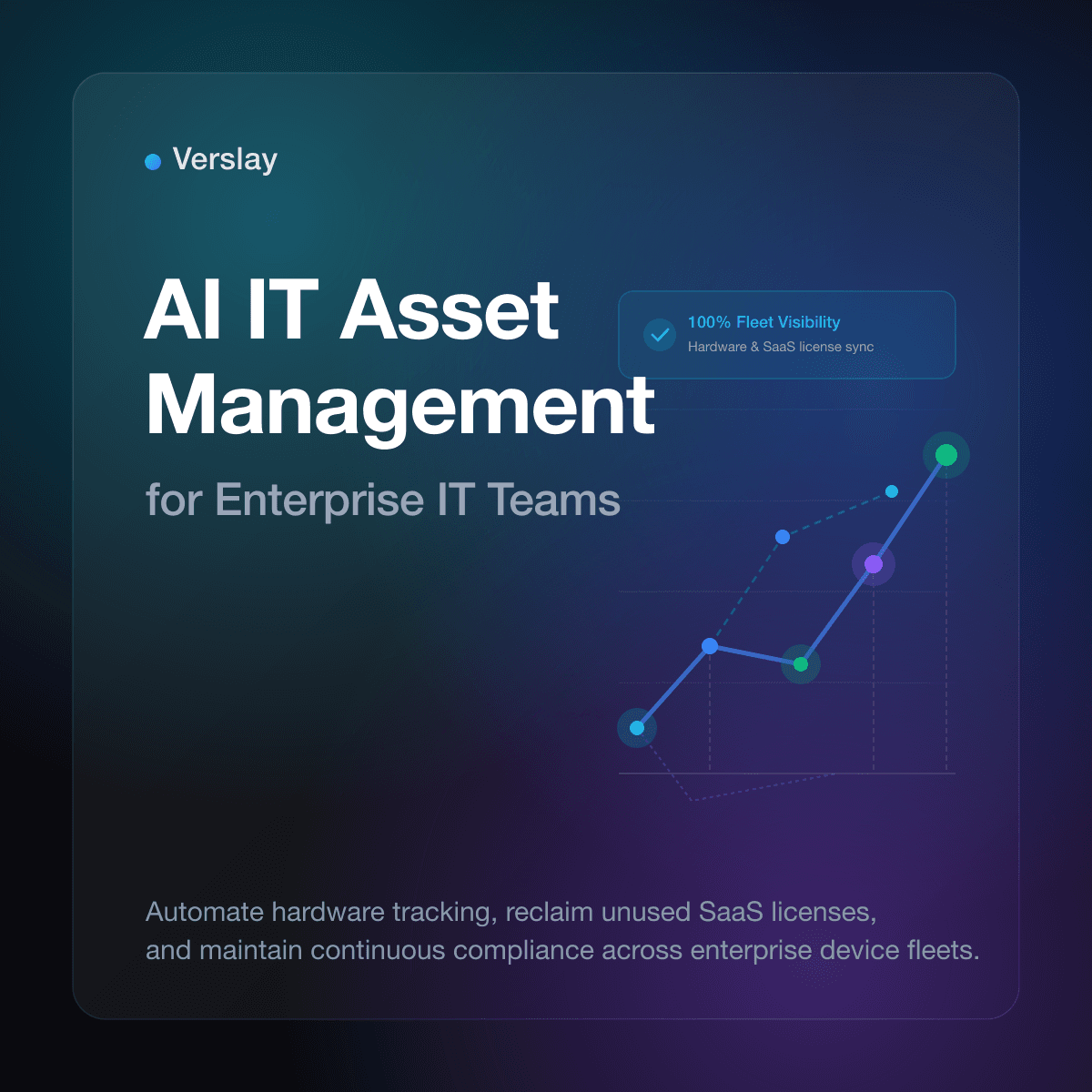
AI IT asset management for enterprise IT teams automates hardware lifecycle tracking, software license reclamation, shadow IT discovery, and fleet compliance by connecting autonomous AI agents across mobile device management (MDM) platforms, identity providers (IdPs), and enterprise procurement systems. By continuously reconciling serial numbers, active employee directory statuses, and SaaS utilization telemetry in real time, AI agents eliminate manual inventory spreadsheets, claw back millions in idle software spend, and ensure 100% audit readiness across hybrid device fleets. This touchless architecture frees IT engineering bandwidth and eliminates security vulnerabilities caused by unmanaged endpoints.
As enterprises scale remote and distributed workforces, IT asset management (ITAM) has outgrown manual tracking tools and static configuration management databases (CMDBs). IT and security leaders find themselves juggling disconnected data silos: hardware registered across Jamf, Microsoft Intune, and Kandji; user entitlements in Okta and Microsoft Entra ID; software subscriptions spread across hundreds of SaaS vendors; and financial depreciation schedules locked inside NetSuite or SAP. Without continuous, automated reconciliation, organizations face uncontrolled software spend, lost physical equipment, and critical compliance blind spots.
Deploying AI agents for IT operations empowers technology teams to replace reactive quarterly audits with continuous, proactive fleet and entitlement governance.
The Operational Bottlenecks in Traditional ITAM
Managing modern corporate hardware and software ecosystems involves constant logistical friction. When IT asset managers rely on ticket-based updates and periodic physical inventory counts, operational vulnerabilities inevitably emerge:
- Hardware Sprawl and "Ghost" Endpoints: In distributed workplaces, corporate laptops, mobile devices, and peripherals are shipped directly to remote employees. When team members change roles or depart without returning equipment, devices slip off the IT radar. These unmanaged "ghost" machines consume endpoint licenses, fall behind on OS security patches, and create severe corporate data leakage vectors.
- Runaway SaaS Bloat and Zombie Seats: Organizations frequently purchase large batches of SaaS seats—such as Salesforce, Figma, Zoom, or GitHub Enterprise—under annual enterprise agreements. When employees transition projects or stop using specific tools, their premium accounts remain active. Without automated usage tracking, companies waste 25% to 35% of their total software budget on inactive seats.
- Stale CMDBs and Ledger Drift: Configuration management databases (CMDBs) are supposed to serve as the single source of truth for corporate infrastructure. In practice, they require manual updates whenever a device is re-imaged, reassigned, or repaired. As technicians rush through high-priority helpdesk queues, CMDB records quickly drift from actual fleet reality.
- Shadow IT and Unsanctioned Cloud Adoption: Departmental leaders frequently swipe corporate credit cards for generative AI tools, collaborative workspaces, and project management apps without security approval. These unsanctioned tools bypass single sign-on (SSO), evade endpoint data loss prevention (DLP) controls, and lead to unbudgeted subscription renewals.
- High-Stress Compliance and Audit Scrambles: Regulatory frameworks such as SOC 2, ISO 27001, and HIPAA require verified evidence that all active endpoints enforce disk encryption, run operational endpoint detection and response (EDR) agents, and adhere to minimum OS version standards. Proving compliance manually requires days of exporting CSVs and cross-referencing device serial numbers across disconnected consoles.
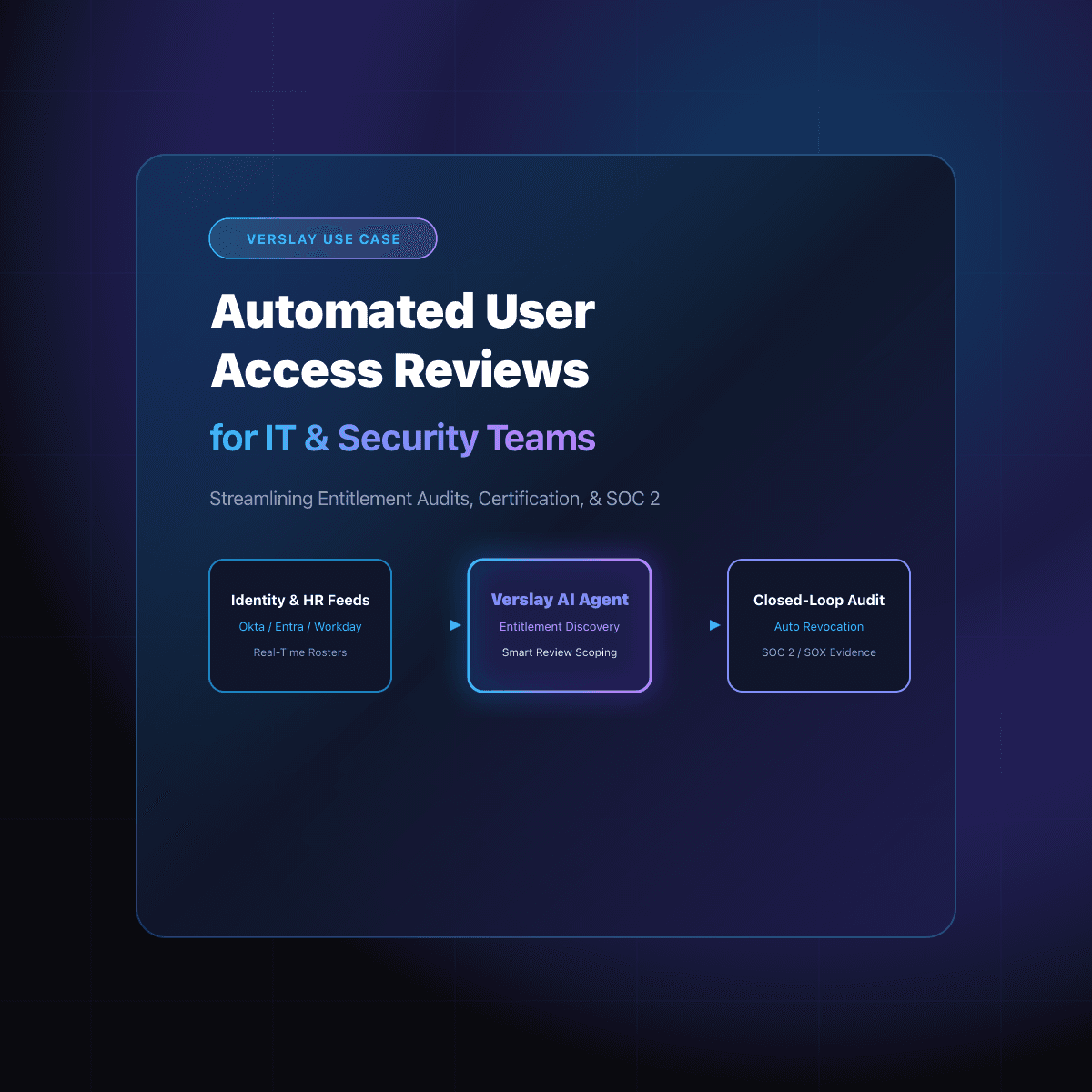
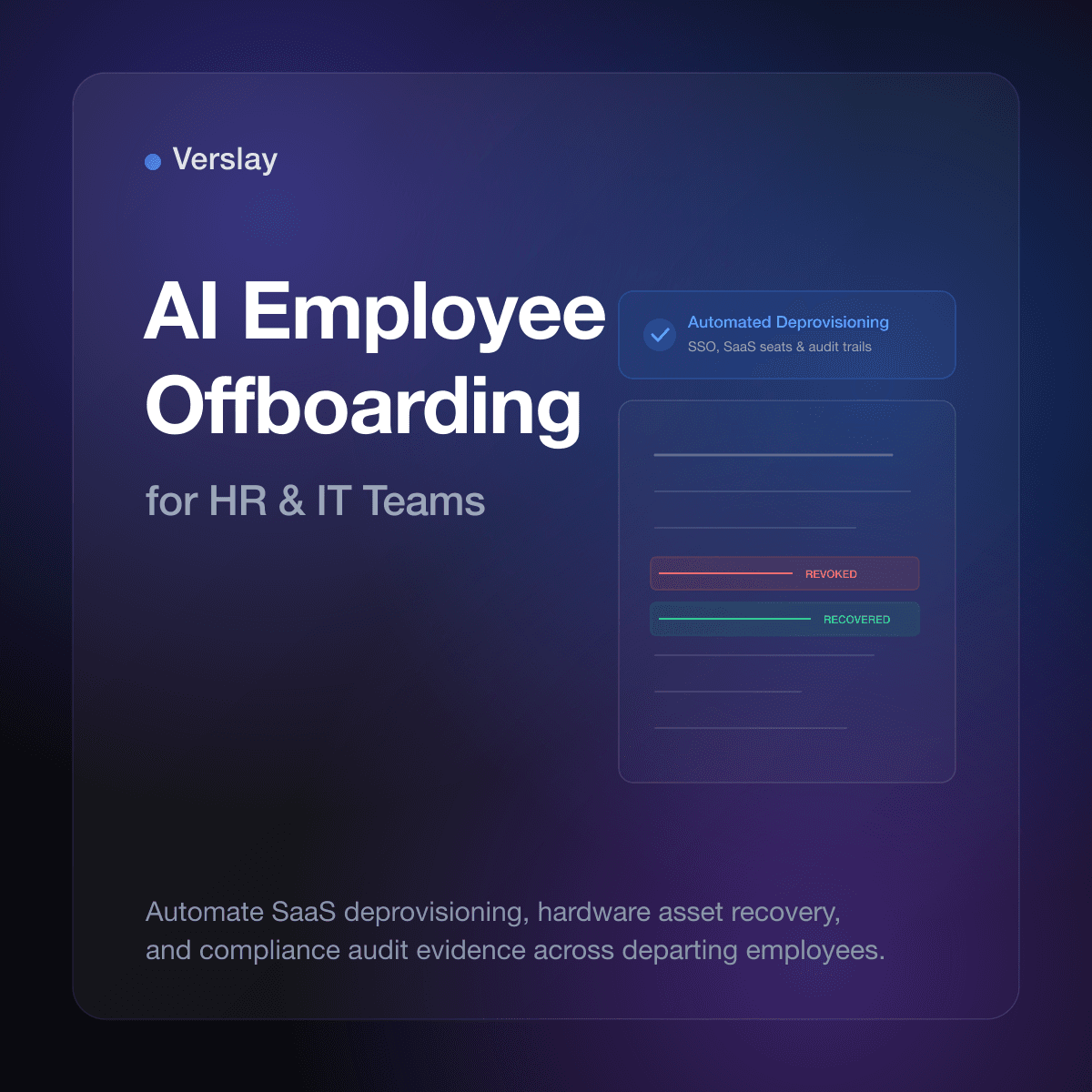
To learn how automated governance safeguards identity and infrastructure perimeters, read about automated user access reviews for IT and security teams and AI employee offboarding for HR and IT teams.
How Autonomous AI Agents Automate IT Asset Management
Autonomous AI agents transform ITAM from a reactive spreadsheet-updating chore into a continuous, real-time optimization loop. Integrated securely via Model Context Protocol (MCP) and API connectors, AI agents execute five critical functions across enterprise fleets:
1. Multi-Vector Fleet Discovery and Continuous Reconciliation
Rather than relying on periodic manual audits, AI agents continuously poll and cross-correlate asset records across all operational systems:
- Device Management Telemetry: Collects serial numbers, hardware models, battery health metrics, OS versions, and disk encryption statuses from MDMs (Jamf, Intune, Kandji).
- Identity and Directory Verification: Cross-references every active hardware record against employee status in Okta, Microsoft Entra ID, or Google Workspace to ensure every machine maps to a verified, employed user.
- Procurement & Financial Matching: Verifies purchase orders, serial numbers, and invoice records in NetSuite, SAP, or Coupa to ensure newly acquired equipment is tagged and booked to correct cost centers upon arrival.
2. Intelligent SaaS License Reclamation and Rightsizing
AI agents inspect login timestamps, API activity, and feature utilization telemetry across enterprise software applications:
- Idle Seat Detection: Automatically identifies users who have not logged into a SaaS tool for a configurable threshold (such as 30 or 60 days).
- Automated Reclamation Workflows: Sends an automated verification notification to the user via Slack or email asking if they still require the license. If unconfirmed within a grace period, the agent revokes or reallocates the seat.
- Tier Rightsizing: Flags users assigned to expensive "Enterprise" or "Creator" seats who only utilize view-only capabilities, suggesting immediate downgrades to lower-cost tiers before contract renewal windows.
3. Predictive Hardware Lifecycle and Refresh Scheduling
Rather than waiting for laptops to fail or relying on arbitrary 3-year replacement cycles, AI agents evaluate real-time hardware telemetry:
- Battery & Performance Degradation: Monitors device diagnostics, thermal throttling events, and crash logs to predict device failure before it impacts employee productivity.
- Warranty and Lease Expiration Tracking: Alerts IT procurement teams 90 days before manufacturer warranties or equipment lease agreements expire, pre-generating bulk order proposals for approved replacement hardware.
4. Touchless Offboarding and Reverse Logistics Orchestration
When an employee departure is scheduled in the HRIS (Workday, BambooHR), the AI agent orchestrates asset recovery end-to-end:
- Asset Return Kit Dispatch: Automatically generates shipping labels, dispatches prepaid return boxes to the departing employee's home address, and tracks carrier delivery status.
- Remote Lock and Cryptographic Wipe: Verifies that departing accounts are suspended in the IdP, triggers remote cryptographic wiping via MDM upon confirmation of asset custody, and logs tamper-proof verification certificates for audit records.
5. Continuous Fleet Security and Compliance Auditing
- Endpoint Hygiene Verification: Flags any machine missing required security software (EDR, MDM profiles, firewall enforcement, or disk encryption) and attempts automated remediation via MDM commands.
- Audit-Ready Reporting: Compiles real-time compliance matrices demonstrating fleet health, patch distribution, and asset ownership history for internal security reviews and external SOC 2 audits.
Explore how deploying AI agents for business operations allows organizations to automate core technical, financial, and administrative operations.
Architecture of an AI-Driven IT Asset Management System
The diagram below illustrates how an autonomous AI agent synchronizes hardware, software, and financial records to maintain complete fleet visibility and automated license optimization:
[MDM & Telemetry]         [Identity & HRIS]        [Procurement & ERP]
(Intune, Jamf, Kandji)    (Okta, Entra ID, Workday)  (NetSuite, Coupa, SAP)
         │                         │                          │
         └─────────────────────────┼──────────────────────────┘
                                   │
                                   ▼
                    [Multi-Source Fleet Data Ingestion]
                                   │
                                   ▼
                       [AI ITAM Agent Engine]
                      ┌─────────────┴─────────────┐
                      ▼                           ▼
          [Deterministic Rules]       [Contextual Telemetry Engine]
         - Serial Number Matching     - SaaS Idle Activity Analysis
         - OS Patch Requirements      - Predictive Battery Failure
         - Encryption Verification    - Shadow IT Domain Detection
                      │                           │
                      └─────────────┬─────────────┘
                                    │
                                    ▼
                     [Autonomous Orchestration Gate]
                      /             │             \
                     ▼              ▼              ▼
           [Reclaim License]  [Order Return Kit]  [Remediate Endpoint]
           - Downgrade Seat   - Track Delivery   - Push MDM Profile
           - Notify User      - Remote Lock      - Alert Security
- Continuous Telemetry Ingestion: The agent ingests event streams and state snapshots across device fleets, identity providers, and procurement systems.
- Deterministic & Contextual Passes: Strict compliance policies verify security prerequisites, while predictive machine learning models analyze software usage trends and hardware degradation patterns.
- Autonomous Remediation: Routine optimizations (reclaiming idle licenses, sending return packaging, updating CMDB records) execute automatically without requiring manual IT technician intervention.
- Audit Trail Logging: Every action, license reallocation, and hardware status change is recorded to an immutable audit ledger.
IT Asset Lifecycle & Reclamation Matrix
The table below summarizes common enterprise asset management challenges and how autonomous AI agents resolve them in real time:
| Asset Category | Traditional ITAM Vulnerability | AI Agent Autonomous Remediation | Measurable Impact | | :--- | :--- | :--- | :--- | | SaaS License Over-Provisioning | Inactive users retain expensive creator seats indefinitely; renewals lock in wasted spend | Scans last-login and API interaction logs; prompts users and reclaims seats automatically after 30 days of inactivity | 25%–35% direct reduction in annual enterprise software expenditures | | Departing Employee Hardware | Manual offboarding checklists miss remote equipment; unrecovered laptops become lost assets | Correlates HRIS termination dates with MDM serial numbers; dispatches automated return kits and tracks return shipments | Recovers 98%+ of distributed remote hardware without technician phone tag | | Non-Compliant Endpoints | Laptops disable FileVault, fall behind OS versions, or uninstall EDR agents without IT noticing | Continuously audits endpoint configurations against security baselines; pushes remediation profiles or isolates endpoints | 100% continuous SOC 2 and ISO 27001 fleet compliance posture | | Hardware Warranty Expirations | Laptops age out unmonitored; sudden motherboard or battery failures cause unscheduled downtime | Tracks manufacturer warranty expiration dates and battery cycle telemetry; schedules proactive replacements | Eliminates emergency hardware procurement premiums and employee downtime | | Shadow IT Subscriptions | Teams adopt unvetted cloud software via corporate cards without IT knowledge | Analyzes corporate card feeds and SSO directory patterns; flags new SaaS domains and initiates security intake reviews | Prevents compliance exposure and eliminates unauthorized departmental software spend |
For details on improving technical response times and maintaining internal service levels, read about AI SLA tracking for internal IT teams.
Resolving Complex ITAM Edge Cases Autonomously
Enterprise IT asset management often involves nuanced operational scenarios that static rule engines cannot handle without human intervention. Autonomous AI agents resolve these complexities using contextual reasoning:
- Activity-Based vs. Job-Title License Allocation: Traditional IT provisioning assigns software tiers based on generic department rules—giving every product designer an enterprise CAD or Figma license. AI agents inspect actual in-app artifact creation and editing activity. If a user only views shared prototypes, the agent automatically transitions them to a free viewer seat while preserving their file permissions.
- Contractor and Ephemeral Worker Asset Governance: External contractors and temporary personnel often require access for discrete, multi-month engagements. AI agents link contractor contract expiration dates directly to MDM configuration profiles, automatically triggering credential revocation, session termination, and device locking the moment a statement of work concludes.
- Cross-Border Hardware Logistics & Custom Depots: For international team members, shipping replacement laptops or reclaiming equipment requires handling customs declarations and international courier coordination. The AI agent routes return requests to regional IT asset disposition (ITAD) partners based on the employee's country of residence, minimizing shipping delays and import tariffs.
- Secure Asset Disposition and E-Waste Certification: When retired devices reach their end-of-life cycle, regulatory frameworks require certified data destruction. AI agents track devices through certified ITAD partners, matching serialized certificates of data sanitization (DoD 5220.22-M / NIST 800-88) against decommissioned asset IDs in the CMDB before closing disposal records.
Strategic Business Outcomes for IT and Operations Leaders
Implementing autonomous AI IT asset management yields measurable improvements across financial governance, security resilience, and team operational velocity:
- Elimination of Software License Waste: Automated reclamation and proactive seat rightsizing claw back significant software expenditures before annual contract renegotiations.
- 100% Real-Time CMDB Accuracy: Replaces error-prone manual recordkeeping with a verified, continuously reconciled asset graph across hardware, cloud resources, and SaaS applications.
- Elimination of Endpoint Security Blind Spots: Ensures that zero devices operate within the corporate ecosystem without active disk encryption, compliant patch versions, and operational security monitoring agents.
- Reclaimed Engineering Bandwidth: Eliminates hundreds of hours spent by IT support teams chasing down unreturned laptops, formatting inventory spreadsheets, and compiling evidence for annual audits.
Frequently Asked Questions
How to use AI in IT asset management?
Organizations use AI in IT asset management by connecting autonomous agents to MDM, IdP, and SaaS directories to continuously map device inventories, detect idle licenses, predict hardware refresh cycles, and enforce security compliance.
How can AI help with asset management across enterprise IT fleets?
AI agents automate end-to-end ITAM workflows by reconciling hardware serial numbers against procurement purchase orders, deprovisioning unused SaaS seats upon employee offboarding, and alerting teams to non-compliant configurations before audits.
How will AI affect IT asset management and license reclamation?
AI shifts ITAM from reactive annual inventory audits to real-time, touchless optimization—identifying underutilized software subscriptions, reclaiming inactive licenses automatically, and slashing enterprise software spend by up to 30%.