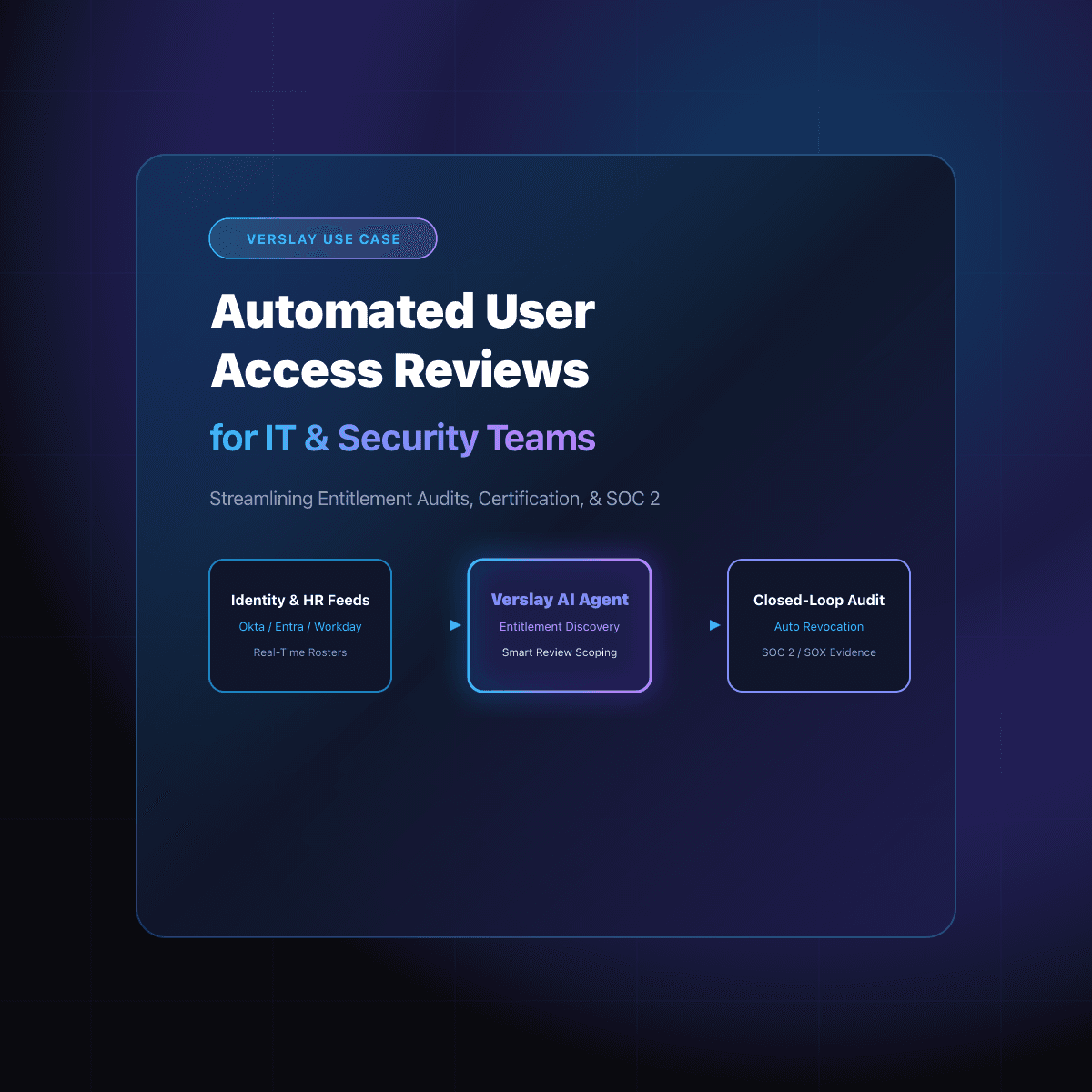
Automated user access reviews for IT and security teams eliminate manual spreadsheet auditing by using autonomous AI agents to continuously inventory SaaS entitlements, orchestrate manager certification campaigns, and revoke orphaned accounts. By synchronizing identity providers like Okta and Microsoft Entra ID directly with HR rosters and downstream cloud environments, automated reviews reduce audit preparation time by up to 85% while guaranteeing continuous compliance with SOC 2, ISO 27001, and SOX frameworks. Rather than spending weeks chasing managers over email, IT and compliance leaders maintain a cryptographically verifiable, real-time audit trail of least-privilege access.
Periodic user access reviews (UARs) are a cornerstone of modern cybersecurity and enterprise compliance frameworks, including AICPA SOC 2 (CC6.1, CC6.2, CC6.3), ISO/IEC 27001 (Control A.9.2.5), HIPAA, and Sarbanes-Oxley (SOX 404). However, for growing enterprises operating dozens of cloud applications, manual access certification has become an unsustainable operational bottleneck. Security engineers and IT administrators spend hundreds of hours every quarter exporting CSVs, formatting pivot tables, and chasing department managers for approvals—only to end up with rubber-stamped spreadsheets that fail to prevent privilege creep or satisfy discerning external auditors.
By deploying autonomous AI Agents integrated via standard APIs and Model Context Protocol (MCP), IT and security organizations replace chaotic quarterly fire drills with continuous, automated identity governance that protects sensitive corporate data on autopilot.
The Access Review Crisis: Why Manual Spreadsheets Compromise Enterprise Security
Traditional user access reviews rely heavily on static spreadsheets, ad-hoc calendar reminders, and disconnected email threads. This antiquated methodology introduces severe security vulnerabilities and administrative friction:
- Rampant Privilege Creep & Dormant Accounts: As employees change departments, take on new projects, or transition into management, their permissions expand—yet legacy entitlements are almost never rescinded. Over time, employees accumulate toxic combinations of administrative permissions across AWS, GitHub, Salesforce, and Snowflake that violate segregation of duties (SoD).
- Reviewer Fatigue & Blind Rubber-Stamping: When department heads receive an overwhelming spreadsheet containing hundreds of raw, cryptic permission strings, they lack the contextual visibility required to make informed security decisions. Exhausted managers routinely click "Approve All," defeating the primary security objective of the certification.
- Disconnected Offboarding & Zombie Accounts: While primary SSO accounts are disabled during offboarding, direct credentials, local database logins, and API tokens frequently remain active in niche SaaS applications or staging cloud environments. Without continuous cross-system reconciliation, these zombie accounts sit unmonitored for months.
- Unenforced Revocation Workflows: In manual reviews, identifying that an access right should be revoked is only half the battle. Remediations often get lost in Jira backlogs or forgotten in Slack DMs, creating severe compliance non-conformities when auditors cross-reference review findings against actual production user rosters.
- Audit Evidence Scramble: When annual audit periods commence, security teams lose weeks searching for signed approval emails, compiling historical change logs, and reconstructing timestamps to prove when reviews were launched and completed.
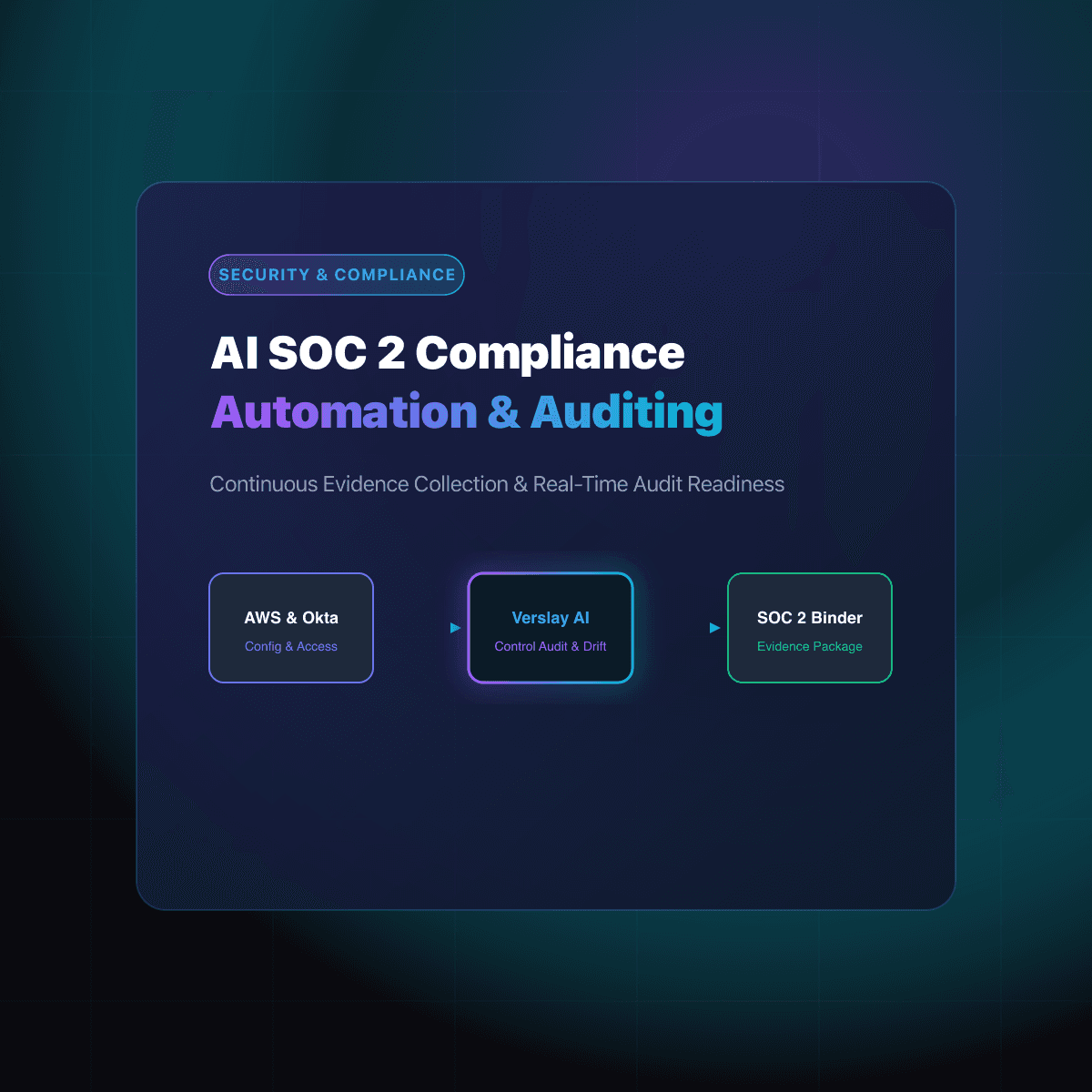
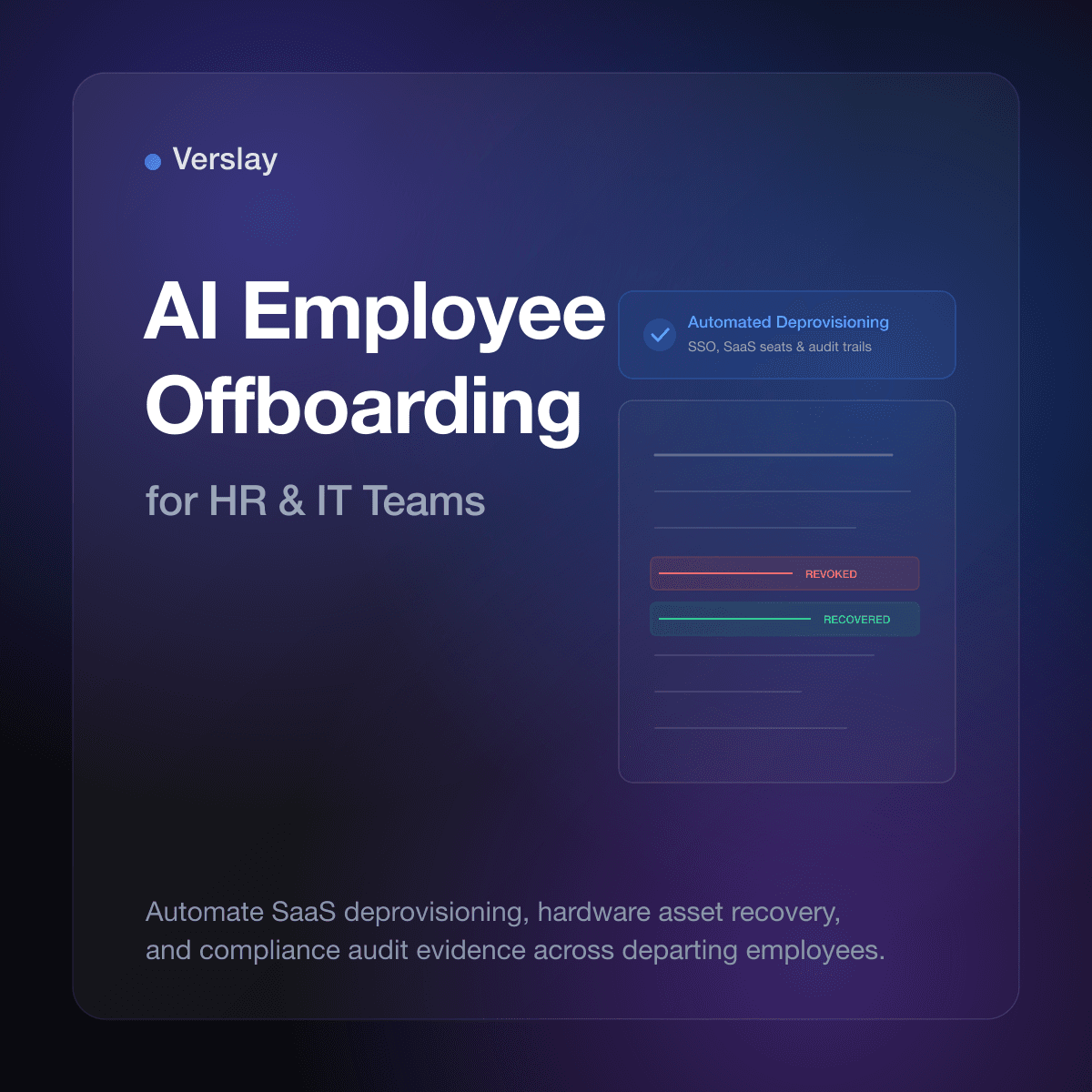
To understand how automated governance resolves adjacent operational security bottlenecks, read our guides on AI SOC 2 compliance automation for security teams and AI employee offboarding for HR and IT teams.
Core Capabilities of Autonomous AI User Access Review Agents
Autonomous access review agents act as dedicated identity governance analysts, continuously discovering entitlements, orchestrating targeted micro-campaigns, and enforcing least privilege across the entire SaaS and cloud footprint:
1. Continuous Multi-System Entitlement Discovery
Eliminating manual CSV exports and fragmented identity silos:
- Comprehensive API & SCIM Ingestion: Continuously connects to identity providers (Okta, Microsoft Entra ID, Google Workspace), HRIS platforms (Workday, Rippling, BambooHR, Hibob), and downstream cloud apps (AWS, GCP, GitHub, Salesforce, Jira, Datadog).
- Deep Entitlement Mapping: Discovers fine-grained permissions beyond basic group memberships, including AWS IAM policies, GitHub repository collaborator access, Salesforce permission sets, and database read/write grants.
- Orphan & External User Detection: Automatically identifies contractor accounts approaching contract termination, personal email logins, shared service accounts, and former employees whose application accounts were never deprovisioned.
2. Contextual Risk Scoring & Anomaly Detection
Providing reviewers with actionable intelligence rather than raw data dumps:
- Usage-Based Inactivity Scoring: Correlates last login timestamps, API call volumes, and SSO telemetry to flag dormant permissions. If an engineer has not touched production AWS roles in over 90 days, the AI agent proactively recommends revocation.
- Peer Group Anomaly Detection: Analyzes role benchmarks across departments. If an account executive possesses admin access to GitHub or Jira settings while none of their peers do, the AI highlights the outlier with an explicit security warning.
- Privileged Access Flagging: Elevates high-risk entitlements—such as root credentials, global administrator roles, and sensitive customer data access—ensuring they receive heightened scrutiny during review cycles.
3. Intelligent Campaign Scoping & Smart Delegation
Replacing massive quarterly spreadsheets with lightweight, bite-sized review campaigns:
- Micro-Certification Cycles: Breaks cumbersome company-wide audits into focused, recurring micro-reviews (e.g., monthly reviews for privileged cloud access, quarterly reviews for standard SaaS tooling).
- Automated Manager Routing: Traverses organizational hierarchy charts from the HRIS to route certification items directly to each employee's current direct manager, eliminating manual distribution overhead.
- Resource Owner Routing: Dynamically directs approvals for specialized resources—such as sensitive production databases or proprietary code repositories—to designated technical resource owners rather than generalist managers.
4. Frictionless In-Flow Certification (Slack & Teams)
Meeting business managers directly within their daily communication channels:
- Interactive Chat Approvals: Delivers contextual review summaries directly into Slack or Microsoft Teams. Managers review plain-language descriptions of permissions, see peer comparison stats, and confirm or revoke access with a single click.
- Automated Escalations & Gentle Reminders: Enforces completion deadlines autonomously by sending polite reminders and escalating unreviewed certifications to IT leadership before audit windows close.
- Conversational Querying: Allows managers to ask natural-language questions (e.g., "When did Jane last log into Salesforce?" or "Why does Alex need this GitHub role?") and receive instant data-backed answers before making certification decisions.
5. Closed-Loop Automated Remediation & Deprovisioning
Ensuring every revocation decision translates immediately into production security:
- Zero-Touch API Deprovisioning: When a reviewer marks an entitlement for removal, the AI agent executes automated deprovisioning via SCIM or native APIs in real time, updating the identity provider immediately.
- IT Service Management (ITSM) Ticket Generation: For legacy or on-premise applications lacking direct API endpoints, the agent automatically opens a pre-populated remediation ticket in Jira Service Management or ServiceNow, tracks it to resolution, and alerts the reviewer upon closure.
- Cryptographic Audit Log Generation: Generates immutable, timestamped audit records linking the original reviewer decision, justification notes, execution logs, and post-deprovisioning state confirmation.
Explore how AI SLA tracking for internal IT teams ensures that access revocations and security tickets meet strict operational timelines.
Technical Architecture: How Autonomous Access Certification Works
The diagram below illustrates how an autonomous user access review agent aggregates identity data, scores permission risks, drives conversational manager certifications, and enforces automated closed-loop remediation:
[Identity & HR Telemetry] (Okta, Entra ID, Workday, AWS, GitHub)
                         │
                         ▼
          [Verslay Identity Governance Core]
┌────────────────────────────────────────────────────────┐
│  • Continuous Entitlement & Account Ingestion          │
│  • Behavioral Activity & Dormancy Scoring              │
│  • Peer-Group Anomaly & Toxic Combination Detection    │
│  • Automated Organization Hierarchy Traversal          │
└───────────────────────────┬────────────────────────────┘
                            │
                            ▼
          [Intelligent Certification Orchestrator]
┌────────────────────────────────────────────────────────┐
│  • Scoped Micro-Campaign Creation                      │
│  • Frictionless Slack / Teams In-Flow Review Prompts   │
│  • Real-Time Contextual Decision Support & AI Insights │
└───────────────────────────┬────────────────────────────┘
                            │
                            ▼
               [Closed-Loop Remediation]
┌───────────────────────────┴────────────────────────────┐
▼                                                        ▼
[Direct API Deprovisioning]            [Auditor-Ready Compliance Vault]
• Instant SCIM Role Removal            • Immutable Decision Logs
• Orphan Account Disablement           • SOC 2 / ISO 27001 Evidence Binders
• Jira / ServiceNow Ticket Escalation  • Complete Proof of Least Privilege
- Ingest & Correlate: The system continuously syncs employee master rosters from HRIS platforms with active accounts and deep entitlements across cloud infrastructure and SaaS applications.
- Analyze & Score: AI models cross-reference login activity, peer permissions, and privilege levels to assign risk scores and generate revocation recommendations.
- Certify: Scoped review items are delivered to line managers via interactive Slack and Teams cards, providing rich context and one-click approvals.
- Remediate & Audit: Revocations are immediately executed via API or tracked tickets, and tamper-proof evidence is filed directly into the compliance repository for external auditors.
Manual Spreadsheets vs. Legacy IGA Suites vs. Autonomous AI Access Reviews
| Dimension | Manual Spreadsheets | Legacy IGA Suites (SailPoint, Saviynt) | Autonomous AI Access Reviews | | :--- | :--- | :--- | :--- | | Setup & Deployment | Immediate, but ongoing manual labor | 6–18 months heavy systems integration | Days via modern API connectors & MCP | | Entitlement Discovery | Static, error-prone manual exports | Periodic scheduled batch synchronizations | Continuous real-time ingestion across all apps | | Reviewer Experience | Cryptic, overwhelming CSV files | Complex, multi-tab web administrative portals | Interactive, contextual Slack & Teams cards | | Context & Recommendations | None; managers guess or rubber-stamp | Basic static rules and role matrices | AI usage scoring & peer anomaly insights | | Revocation Velocity | Days to weeks; manual ticket creation | Configurable workflow, often delayed | Immediate automated API deprovisioning | | Review Frequency | Painful quarterly or annual fire drills | Semi-annual scheduled campaigns | Continuous, frictionless rolling micro-reviews | | Auditor Readiness | Scrambling to reconstruct email approvals | Complex custom reporting queries | One-click cryptographically signed audit binders |
Measurable Security and Compliance Outcomes
Implementing automated user access reviews delivers dramatic security enhancements and operational cost savings:
- 85% Reduction in IT and Manager Time: Eliminates the weeks spent generating spreadsheets, emailing department heads, and manually chasing signatures.
- 100% Elimination of Dormant Orphan Accounts: Continuous identity correlation identifies and revokes separated employees and forgotten contractor accounts within minutes.
- Zero Compliance Deficiencies During Audits: Provides AICPA and ISO auditors with comprehensive, timestamped proof of every review cycle, reviewer identity, and remediation action.
- Eradication of Rubber-Stamping: Contextual recommendations and usage data enable managers to make informed decisions quickly, significantly reducing unnecessary privileged access.
- Enforcement of Zero Trust & Least Privilege: Automated right-sizing ensures employees only retain permissions strictly necessary for their current job responsibilities.
Discover how AI vendor risk assessment for procurement teams and AI SOC 2 compliance automation for security teams complement identity governance to deliver end-to-end security compliance.
Frequently Asked Questions
What are automated user access reviews?
Automated user access reviews use autonomous AI agents and API integrations to continuously discover accounts, map entitlements across SaaS and cloud infrastructure, coordinate manager certifications, and generate audit-ready compliance evidence without spreadsheets.
How do you automate the user access review process for SOC 2 and ISO 27001?
Automation connects identity providers like Okta and Entra ID with HR systems and downstream applications, automatically distributes scoped review tasks to department managers via Slack or email, and tracks sign-offs in real time.
What happens when a manager revokes access during an automated review?
When a manager flags an entitlement for revocation, the automated system either orchestrates instant deprovisioning via API or opens a tracked remediation ticket for IT, ensuring orphaned permissions are eliminated within compliance SLAs.
Automate User Access Reviews and Enforce Least Privilege with Verslay
Do not let spreadsheet fatigue jeopardize your enterprise security or derail your next compliance audit. Verslay's autonomous AI agents integrate directly with your identity providers, HR systems, and cloud infrastructure to deliver continuous, closed-loop access certification with zero manual friction.
Explore Verslay's AI Agents to transform your identity governance and compliance operations today.