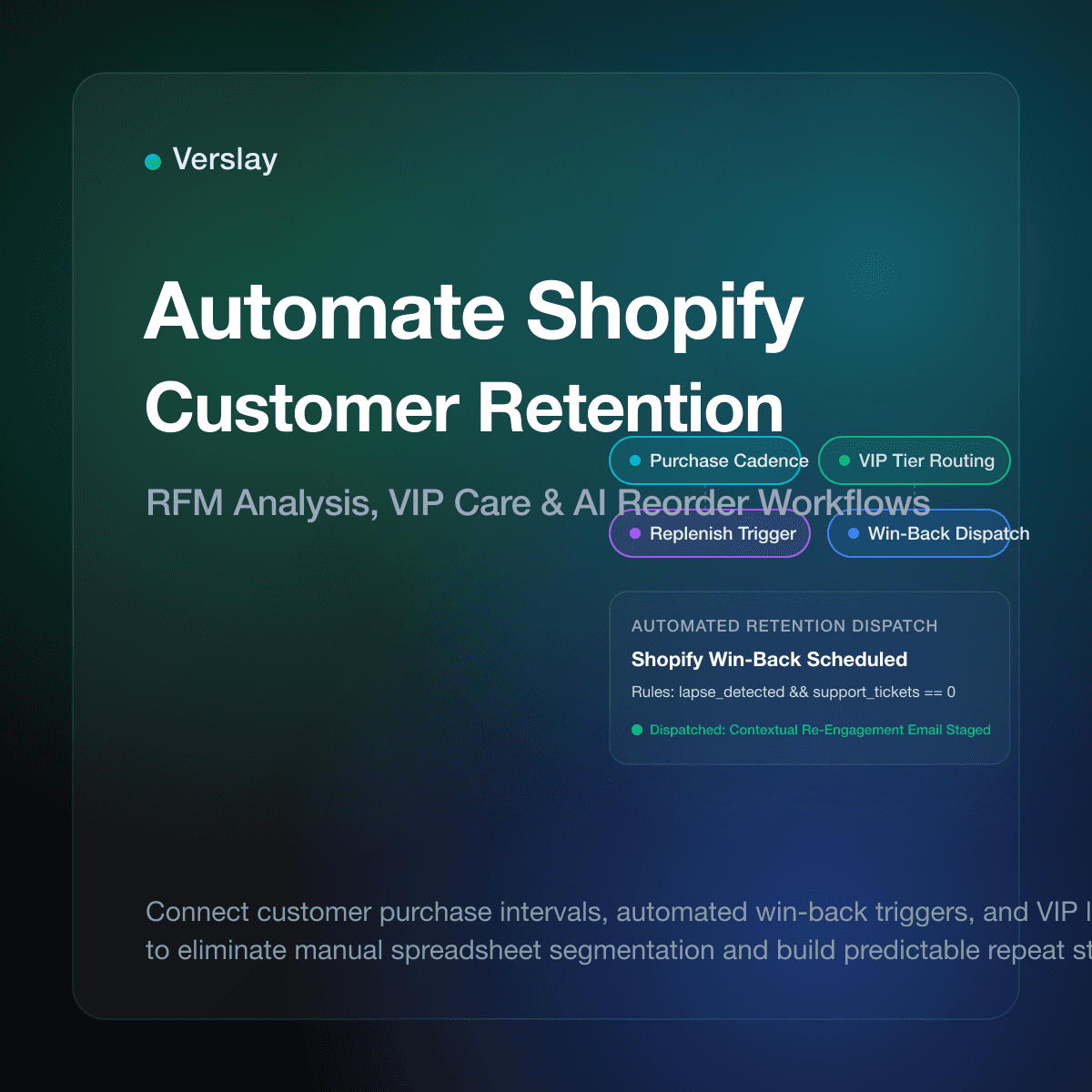
Automate Shopify Customer Retention: Complete Store Guide
Automate Shopify customer retention by integrating Claude through the Verslay Model Context Protocol (MCP) server to monitor customer purchase frequency, predict churn risk, calculate personalized replenishment timing, and dispatch tailored win-back incentives without manual spreadsheet exports. Connecting agent workflows directly to your store records turns one-off shoppers into repeat buyers, protects margins, and scales personalized communication. As order volume increases, automated retention routines deliver sustained repeat revenue while keeping operational effort low.
At a glance:
- Churn risk detection: Detect when repeat buyers exceed their usual reorder cycle and trigger proactive re-engagement before they defect.
- Automated VIP recognition: Segment high-value customers based on lifetime spend and grant exclusive loyalty perks with zero manual tagging.
- Product replenishment timing: Calculate personalized reorder intervals per SKU and deliver timely replenishment reminders.
- Tailored win-back messaging: Draft context-aware email and SMS communication that references past purchases and preferences.
- Zero custom code: Run production-ready agent workflows through your existing Claude setup via the Verslay MCP server.
What is customer retention in Shopify and why should store owners automate it?
Customer retention measures the ability of an online store to turn first-time purchasers into repeat buyers over time. In Shopify, retention performance is tracked through key operational indicators including repeat customer rate, purchase frequency, average order value (AOV), and customer lifetime value (LTV).
According to the official Shopify customer retention guide, acquiring a new customer costs significantly more than retaining an existing one. Paid social and search clicks continue to grow more expensive, squeezing margins for direct-to-consumer (DTC) brands. When stores focus exclusively on acquisition, advertising spend eats into profits.
Prioritizing retention alters unit economics. Repeat customers spend more per transaction and convert at higher rates. However, managing retention by hand across thousands of past orders quickly overwhelms store operators. Calculating which buyers need a reminder, win-back discount, or VIP perk demands hours of manual spreadsheet work. Automating customer retention transforms reactive marketing into a reliable, continuous retention engine.
Which retention tasks consume the most manual administrative hours?
Growing ecommerce brands spend considerable operational time managing customer data across multiple tools. Pinpointing where manual friction concentrates reveals where automated agents produce the highest immediate return.
- RFM Segmentation and Data Pulls: Running recency, frequency, and monetary (RFM) analysis requires exporting customer CSVs, grouping customers into tiers, and re-importing tags into Shopify. By the time lists update, customer behavior has already shifted.
- Lapsed Customer and Churn Detection: Tracking when an individual customer has gone silent requires comparing current dates against their typical order interval. Manually spotting lapse patterns across thousands of accounts is nearly impossible.
- Replenishment Cycle Timing: Consumable goods such as skincare, supplements, coffee, and apparel basics have natural reorder lifecycles. Hand-scheduling replenishment emails for distinct product variants leads to missed windows and lost sales.
- VIP Loyalty and Personalized Outreach: High-value customers who spend hundreds or thousands of dollars expect attentive communication. Manually reviewing high-tier accounts and drafting personalized thank-you notes absorbs days of staff time.
To see how modern online brands automate similar operational tasks, explore our comprehensive catalog of use cases and discover how teams connect store events to automated agent workflows.
How do AI agents automate Shopify customer retention workflows?
Traditional marketing automation platforms rely on rigid, static time-delay sequences. For instance, they send a generic email 30 days after every purchase, regardless of whether the customer ordered a 15-day supply, a 90-day bundle, or submitted an unresolved support ticket yesterday.
AI agents resolve these limitations by uniting contextual reasoning with direct store data access via the Model Context Protocol (MCP). Connected to Shopify through the Verslay MCP server, Claude inspects live order records, evaluates SKU replenishment intervals, checks customer support status, and personalizes communication based on actual purchase context.
The automated retention workflow follows four systematic phases:
- Purchase Interval Analysis: Claude analyzes historical order cadence across your customer base, identifying product-specific reorder velocity and establishing baseline repurchase intervals for each SKU collection.
- Predictive Churn Scoring: The agent checks customer order dates against predicted reorder intervals. When a buyer drifts past their expected reorder date, the agent flags the account for retention action.
- Context-Aware Message Drafting: Claude generates tailored retention communication. It mentions the exact items the customer ordered, highlights complementary accessories, and includes calibrated incentives without eroding profit margins.
- Execution and Merchant Review: Claude drafts messages or stages customer tags in Shopify for merchant inspection, allowing store operators to review offers before dispatch with a single confirmation.
Store operators maintain complete control: the AI agent computes the timing, segments the profiles, and drafts the copy, while the merchant oversees and approves the outreach strategy.
How does AI retention automation compare to basic email apps?
Evaluating manual retention routines against basic email autoresponders and modern AI agent automation highlights the strategic advantages available to growing stores.
| Retention Capability | Manual Spreadsheet Tracking | Basic Email Marketing Plugin | Claude + Verslay AI Agents | | :--- | :--- | :--- | :--- | | Reorder Timing | Guessed intervals based on monthly reviews | Fixed time delays (e.g., 30 days post-purchase) | Dynamic intervals calculated per customer and SKU consumption | | Message Personalization | High effort, limited to top 10 VIPs per month | Basic merge tags (first name, last purchased item) | Deep contextual copy referencing order history and product use | | Support Status Awareness | Must check Zendesk/Gorgias manually | Blind to active support tickets or returns | Checks support history to pause marketing during disputes | | Churn Detection | Discovered long after customer has departed | Broad segment thresholds without cadence insight | Early warning flags when individual order rhythm slows down | | Catalog Awareness | Manual cross-referencing of current stock | May recommend out-of-stock or discontinued items | Cross-checks live Shopify inventory before recommending add-ons |
Transitioning from static autoresponders to intelligent AI agents ensures every customer interaction feels timely, relevant, and considerate of store realities.
What sample prompt lets you automate retention workflows in Claude?
Store operators using the Verslay MCP server can execute complete retention analysis and win-back campaigns directly inside Claude using natural language, without maintaining custom API scripts.
Here is a production prompt an ecommerce manager uses to identify at-risk repeat buyers and draft personalized re-engagement messages:
Our store sells specialty organic coffee beans and brew accessories.
Please analyze our Shopify customer order history for the past 90 days.

Execute the following retention steps:
1. Identify customers who have purchased at least twice in the past year, but have not placed an order in the last 45 days.
2. For each customer in this segment:
   - Check the primary coffee roast they previously ordered.
   - Calculate their historical average reorder interval.
   - Verify whether their preferred roast is currently in stock.
3. Exclude any customer who has an open return, refund request, or unfulfilled order in Shopify.
4. Group qualified customers into two tiers:
   - Tier 1 (VIP): Lifetime spend above $250.
   - Tier 2 (Standard Repeat): Lifetime spend between $75 and $250.
5. For Tier 1 VIPs, draft a warm, personalized re-engagement email offering a sample pack of our newly arrived single origin roast on their next order.
6. For Tier 2 customers, draft a concise replenishment email referencing their favorite roast and providing a 10% restock code valid for 7 days.
7. Present a summary table showing Customer Name, Lifetime Spend, Last Order Date, Preferred Roast, and Recommended Offer for my review.
Claude queries your store catalog and customer records through the Verslay MCP server, computes individual order cadence, filters out customers with active support issues, and formats personalized outreach directly in your conversation window. Once you verify the list and copy, a single command approves the campaign.
To learn more about connecting your store tools to Claude, consult our step-by-step integration guides and detailed connection guides.
What common customer retention mistakes should store owners avoid?
While automated retention routines generate significant recurring revenue, implementing campaigns without clear guardrails can damage brand perception. Avoid these operational missteps:
- Broad-Brush Discounting: Offering heavy discounts to every lapsed customer trains shoppers to wait for coupons before buying. Reserve aggressive price incentives for true churn-risk cases, and lead with product value, education, or gift incentives for standard repeat buyers.
- Ignoring Product-Specific Consumption Cycles: Sending a replenishment prompt for a 60-day supply after only 14 days annoys customers. Calculate replenishment schedules tailored to actual pack sizes and usage guidelines.
- Messaging Customers with Active Complaints: Pitching promotional products to a shopper who is currently dealing with a damaged delivery or missing shipment causes immediate frustration. Always verify support status before sending marketing touches.
- Failing to Synchronize Customer Tags: If customer retention status updates in Shopify, ensure tags reflect in your messaging tools to avoid conflicting communication across email and SMS.
- Neglecting Transactional Quality: Outstanding retention starts with flawless order execution. If packages arrive late or inventory runs out, marketing campaigns cannot overcome poor logistics.
For additional ecommerce automation strategies, explore our operational guides on AI customer segmentation for Shopify, Shopify abandoned cart recovery with AI, and how to automate Shopify purchase orders.
Frequently Asked Questions
Does Shopify automatically trigger retention campaigns when customer activity drops?
No. Core Shopify provides customer segmentation tags and basic email templates, but does not autonomously calculate individual reorder intervals or deploy personalized win-back workflows without manual merchant configuration or automated AI agents.
How do AI agents calculate the ideal replenishment interval for repeat purchases?
AI agents analyze customer order histories, product consumption rates, and SKU repurchase velocity. By establishing dynamic reorder cycles per product category, agents engage shoppers precisely when replenishment needs peak.
Can AI agents personalize Shopify customer win-back emails without manual exports?
Yes. Connected directly through the Verslay MCP server, Claude references purchase histories, past support interactions, and customer preferences to draft highly tailored retention emails for one-click merchant approval.
How does customer retention automation protect ecommerce operating margins?
Automated retention reduces dependence on expensive customer acquisition ad spend. By systematically re-engaging existing buyers before churn occurs, stores sustain higher lifetime value (LTV) and predictable revenue.
Build Sustainable Repeat Revenue for Your Store
Automating Shopify customer retention transforms one-off purchasers into loyal repeat customers, protects your operating profit, and scales relationship management effortlessly. Equipping your store with Claude and dedicated AI agents delivers proactive operational execution without expanding your administrative team.
Review our transparent pricing plans to select the right package for your store, or schedule an introductory consultation directly at https://calendly.com/verslay/30mins to see automated customer retention running live.