Shopify Customer Segmentation with AI: A Store Guide
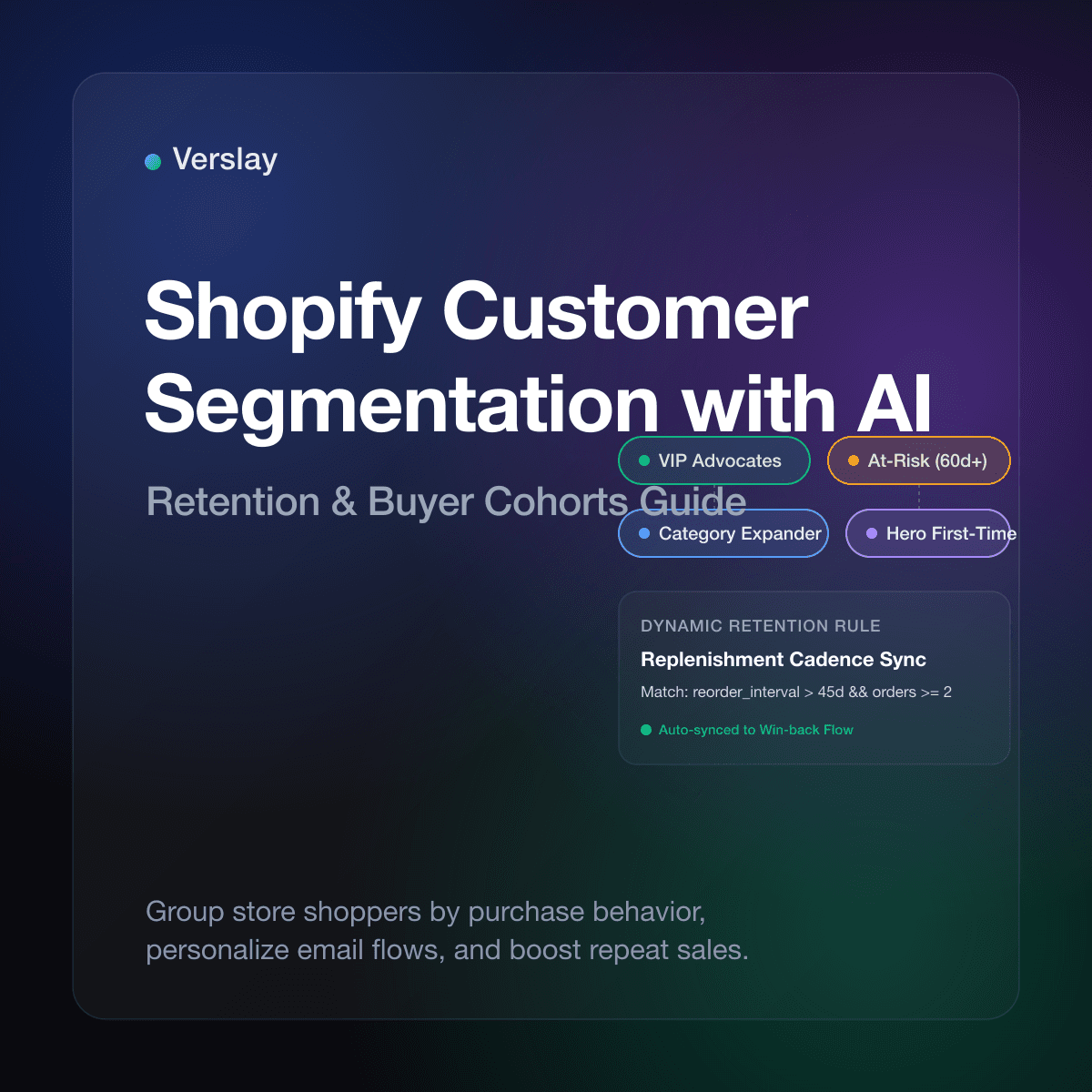
Shopify customer segmentation with AI groups online store buyers into precise behavioral cohorts by analyzing order history, repurchase frequency, and product preferences directly within your Claude workspace. Connecting store data via Model Context Protocol (MCP) allows ecommerce brands to uncover high-value buyers, detect at-risk customers before churn occurs, and personalize email campaigns without manual spreadsheet exports. Store operators maintain complete oversight, inspecting and approving segment criteria before tags or marketing lists sync to live channels.
At a glance
- Core function: Analyzes order patterns, basket composition, and buying cadences to generate dynamic customer segments.
- How it runs: Operates inside your existing Claude workspace via the Verslay MCP server, connecting directly to Shopify APIs without custom server hosting.
- Operational benefit: Eliminates hours of manual CSV filtering, speeds up campaign targeting, and surfaces hidden repeat purchase opportunities.
- Target merchant: Shopify and Shopify Plus stores, DTC consumer brands, and multi-channel retailers processing 500 to 50,000 monthly orders.
What is Shopify customer segmentation with AI?
Shopify customer segmentation with AI refers to the automated grouping of storefront shoppers into actionable lists based on purchase history, product affinity, and engagement signals. As detailed in the official Shopify Customer Segmentation documentation, segmentation helps merchants target messaging so customers receive relevant promotions based on purchase context.
Traditionally, store managers group customers using basic single-dimension filters: shoppers who bought once, customers who spent over a certain dollar amount, or subscribers in a specific state. While useful, static filters miss the behavioral nuances that determine whether an online shopper will purchase again.
Connecting conversational AI to your store data through Model Context Protocol elevates segmentation to predictive action. The AI examines transaction records to answer operational questions:
- Which first-time buyers showed high affinity for your flagship product line?
- Which repeat customers have drifted past their typical 45-day replenishment cycle?
- Which shoppers buy during promotional events versus full-price releases?
- What product pairs frequently lead to second purchases within 30 days of the first order?
Store teams interact with customer data conversationally, generating tailored segment definitions in plain English and pushing verified customer tags back into Shopify for immediate campaign use.
Explore our AI Agents catalog to see how intelligent assistants handle catalog management, customer support triage, and inventory monitoring alongside customer intelligence.
Why do manual customer segmentation methods fail for growing stores?
As an online store grows past a few hundred orders each month, manual customer list management quickly becomes unsustainable. Growing merchants encounter four operational friction points:
- Spreadsheet Stagnation: Marketing leads export customer CSV files into spreadsheets, perform manual lookups, and upload static lists into email tools. By the time a campaign sends, the data is days out of date.
- Oversimplified RFM Rules: Standard Recency, Frequency, and Monetary (RFM) calculations treat all product categories identically. A customer buying seasonal summer items behaves differently from someone purchasing consumable daily skincare, yet rigid rules group them together.
- Missed Early Churn Warning Signals: Churn begins with small behavioral shifts, such as moving from full-price collections to discounted items or extending days between reorders. Static dashboards fail to catch these signals in time.
- Disjointed Marketing Handoffs: Store founders spend hours writing export queries, leaving marketing teams waiting on segment refreshes before launching promotions or product drops.
Using conversational AI connected directly to store APIs removes the bottleneck. Store operators query customer behavior in seconds, evaluate cohort characteristics, and stage target tags without writing database scripts.
How does AI customer segmentation compare to static RFM rules and basic apps?
Growing online stores manage customer grouping through manual spreadsheets, static CRM filters, or an AI agent workflow connected via Model Context Protocol.
The comparison table below highlights how these operational approaches compare across key store needs:
| Operational Dimension | Manual Spreadsheet Filters | Static Rule Apps & CRM Filters | Verslay AI Agent Workflow | | :--- | :--- | :--- | :--- | | Cohort Generation Speed | 2–5 hours per segment pull | Instant, but limited to basic logic | Seconds via natural language prompts | | Behavioral Depth | Single metrics (e.g., total spend) | Hardcoded threshold rules | Multi-factor analysis across SKU cadences | | Catalog Context | Misses product category dynamics | Treats all products identically | Understands consumable vs. durable lifecycles | | Tagging & Execution | Manual CSV upload to admin | Scheduled batch syncs | Staged tag review in Claude before updating | | Merchant Governance | Prone to copy-paste spreadsheet errors | Black-box automation without nuance | Human review of cohort logic before live sync | | Data Privacy | Raw customer files saved on desktops | Third-party cloud storage risks | Operates in Claude using direct store API calls |
Basic rules apps force store owners into rigid pre-built buckets that cannot adapt to unique merchandising models. In contrast, an AI agent understands product lifecycles, recognizing that a buyer purchasing coffee beans requires a 21-day replenishment reminder while someone buying durable kitchen hardware needs care tips instead.
To see the marketing and support platforms that connect alongside your store, visit our integrations directory.
Key ecommerce customer segments AI can identify automatically
By querying order histories with multi-factor prompts, store teams discover high-converting customer groups that static rules miss:
- High-Potential First-Time Buyers: Shoppers who made an initial purchase of your hero product, paid full price without coupon codes, and bought multiple units. These customers convert well on brand education flows rather than steep discounts.
- At-Risk Replenishment Buyers: Customers who reorder consumable goods every 30 to 45 days, but have now passed day 60 without a visit. Catching these shoppers with a timely check-in recovers recurring revenue.
- Category Expansion Candidates: Shoppers who consistently purchase apparel from your tops category but have never explored accessories. AI identifies when cross-category recommendations yield the highest conversion probability.
- Full-Price Brand Advocates: Customers who purchase new collection drops within 72 hours of launch, rarely utilize coupon codes, and maintain a high average order value. These shoppers belong in VIP preview segments.
- Discount-Driven Clearance Shoppers: Price-sensitive buyers who convert strictly during major holiday sales. Segmenting these buyers preserves marketing budget by excluding them from margin-sensitive new release communications.
How to run Shopify customer segmentation using Claude and MCP
Setting up customer segmentation with AI requires no custom database pipelines or engineering sprints. The Verslay Model Context Protocol server connects your Claude workspace directly to the Shopify Admin API.
Store operators follow this five-step workflow to analyze, group, and tag customer cohorts:
Step 1: Open the store connection in Claude
With the Verslay MCP server active in your Claude workspace, Claude can read store order records, customer tags, and product catalog metadata securely upon your prompt.
Step 2: Query customer order patterns
Instruct Claude to retrieve transaction metrics and identify shoppers who meet specific behavioral criteria:
Connect to our Shopify store and analyze customer orders from the past 90 days.
Identify all customers who made 2 or more orders with an average order value over $85.
Claude queries the store API and displays a cohort summary showing customer counts, repurchase intervals, and top product categories.
Step 3: Define targeted segment logic
Refine the criteria into an actionable segment with clear operational objectives:
Group these repeat high-AOV customers into two buckets:
1. "Active Advocates": Ordered within the last 30 days.
2. "Lapsed Advocates": Last order was between 31 and 90 days ago.
Show customer ID, lifetime spend, last order date, and recommended follow-up action.
Step 4: Review staged customer tags
Claude generates the proposed tagging actions without modifying your live database:
Proposed Shopify Tagging Actions:
- Customer ID 72819349: Add tag "vip-advocate-active" (Lifetime Spend: $240, 3 orders)
- Customer ID 72819582: Add tag "vip-advocate-lapsed" (Lifetime Spend: $195, 2 orders)
- Customer ID 72820119: Add tag "vip-advocate-active" (Lifetime Spend: $310, 4 orders)
Step 5: Approve and sync tags to Shopify
Verify the customer selections, confirm the tag names match your email flow triggers, and instruct Claude to apply the updates:
The cohort criteria looks accurate. Apply the customer tags in Shopify now.
Claude updates customer records via the API, creating updated segment lists in your Shopify admin that automatically populate your email marketing flows.
Explore our Use Cases library to see how modern ecommerce brands automate catalog tasks, customer communications, and inventory tracking.
How do store teams review and govern customer segments before campaign launch?
While AI accelerates cohort discovery, human merchant oversight ensures customer communications remain thoughtful and on-brand. A disciplined review process prevents over-tagging and protects customer trust.
Ecommerce teams implement four operational safeguards:
- Volume Sanity Checks: Before applying tags, verify segment sizes against total customer volume. If a "VIP" segment contains 60% of all buyers, refine the threshold criteria to ensure true exclusivity.
- Tag Nomenclature Standards: Maintain consistent tagging conventions across your store, such as
lifecycle:vip-advocateorchurn-risk:consumables-60d. Consistent tags prevent marketing automation conflicts. - Exclusion Management: Check that newly tagged segments respect customer communication preferences, preventing shoppers who recently submitted support tickets from receiving promotional blasts.
- Cadence Monitoring: Re-evaluate behavioral cohorts monthly. Purchasing rhythms during holiday sales differ from normal buying habits during rest-of-year periods.
Applying structured governance gives growing stores the agility of automated analysis with the reliability of merchant control.
To explore plans designed for growing commerce brands, review our pricing page.
Frequently asked questions about Shopify customer segmentation with AI
How do you use AI for customer segmentation on Shopify?
Connecting Claude to Shopify via the Verslay MCP server lets store teams query order histories, calculate repurchase intervals, and group buyers into behavioral cohorts using conversational prompts.
How does AI customer segmentation improve ecommerce retention?
AI detects subtle purchasing shifts, such as customers exceeding their typical reorder window or buying complementary product categories, allowing merchants to send timely, relevant campaign messages.
Can AI segment Shopify customers automatically based on purchase behavior?
Yes. AI workflows evaluate lifetime spend, average order value, product categories purchased, and order recency to assign dynamic customer tags directly in your Shopify admin.
What customer data does AI need to build accurate store cohorts?
The workflow requires only standard store transaction metrics—order dates, items purchased, total spend, and fulfillment frequency. Customer personally identifiable information is protected within your workspace.
Ready to transform your Shopify customer retention with AI?
Verslay connects your Claude workspace directly to your Shopify store through Model Context Protocol, enabling dynamic customer segmentation, catalog automation, and order intelligence without custom software.
Book a 30-minute working walkthrough to see how AI agents support daily retention and marketing workflows for growing ecommerce brands.