Fulfillment automation means software handling the repeatable parts of getting a paid order to the customer: payment capture, the pick and pack list, labels, tracking, and the messages that go with them. In a small store, the order that holds up is rules for events you can predict, a person for the orders that go sideways, and an AI agent for the reading and drafting that rules cannot do.
At a glance:
- Shopify splits order work into two stages: capturing payment, then fulfilling the order.
- Rules handle predictable events well and break on anything that needs reading.
- Exceptions stay with a person, because that is where customers get lost.
- An AI agent earns its place on the steps that need judgment, not on the clicks.
What does ecommerce fulfillment automation cover?
Start with what fulfillment is, because the word gets used for a whole chain of work. Shopify describes order fulfillment as the workflow of processing, managing and shipping customer orders: setting up shipping rates, profiles and locations first, then handling incoming orders, capturing payment, printing shipping documents and getting packages out (Shopify Help Center).
Orders move through two main stages, capturing payment and fulfilling the order, and Shopify notes that both can be automated depending on how the business operates (Managing orders).
If the part you are stuck on is routing and 3PL setup rather than the order of work, our walkthrough of automating Shopify fulfillment goes step by step through that side.
So automation can sit at any of these points:
- Status changes: an order moves from paid to picked to packed to shipped without anyone editing it.
- Calculations: what to pick, which location to ship from, which label to buy.
- Messages: the buyer hears about a delay before they email to ask, which is what automatic tracking and status updates are for.
- Decisions: this order looks odd, so someone has to look at it.
Most stores try to automate all four at once, buy a tool, and then find out that three of the four were never the bottleneck.
Where should a small store start?
Start with the events that repeat, not with a platform. Walk your own orders and write down each step that happens after payment: payment capture, fraud review, picking, packing, label purchase, handoff to the carrier, tracking update, delivery, and then the awkward ones like a split shipment or an address change.
Two things usually show up. First, most of the steps are the same every time, which makes them rule-shaped. Second, a small number of orders eat most of the attention, and those are not rule-shaped at all.
That split is the whole design. A rule cannot read. It matches on values: status, tag, location, time elapsed. The moment a step needs someone to open an order, read a note and decide, a rule is the wrong tool, and forcing it there is how stores end up with automated mistakes.
What can rules handle on their own?
Shopify Flow is the built-in starting point: Shopify describes it as an automation platform that watches the store for events and runs a sequence of actions in response, with workflows built from triggers, conditions and actions (Shopify Flow).
In fulfillment, rules do a short list of jobs well:
- Tag or flag an order that matches a condition you care about, such as a high-risk fraud review.
- Hold an order before it reaches packing.
- Notify the right person when an order sits unfulfilled past your ship-promise cutoff.
- Create the same follow-up task every time a carrier marks an exception.
Keep the list short and name each rule after the job it does. "Hold order when fraud risk is high" is a rule someone can own. "Fulfillment automation" is a folder nobody opens.
A rule's weakness is that it has no memory and no reading. It fires on the exact condition you wrote and nothing else. If your shipping promise changes, the rule keeps firing on the old cutoff until someone remembers to edit it.
Which fulfillment steps still need a person?
The orders that go wrong are the ones worth protecting. Address changes after payment, split shipments when only some items are in stock, held orders, custom fulfillment services that receive orders by email, and carrier exceptions all need someone to look at the actual order.
Shopify supports a mix here: you can fulfill orders yourself, use a fulfillment service, or combine both, and different items in the same order can go through different methods (Fulfilling orders). That flexibility is useful, and it also means somebody has to decide which method applies when an order spans two of them.
The pattern that works: let a rule spot the exception, then route it to a person with the context attached. The rule does the finding. The person does the deciding.
What does an AI agent add that rules cannot?
The work an agent takes over is reading, ranking and drafting, and each one is a gap a rule cannot close.
Reading means the agent can open an order and use what is actually in it: the order note, the buyer's email, the product name, the carrier scan history, the internal note left by the last person who touched it. Rules skip all of that. An agent can use it to say why an order is stuck, in words.
Ranking means deciding which stuck order matters most today, by ship promise and by what the buyer was told. A rule can sort by age. An agent can weigh an order that has already been promised a date against one that has not.
Drafting means the buyer message, written from the real status instead of a template that says "your order is on its way" when it is not.
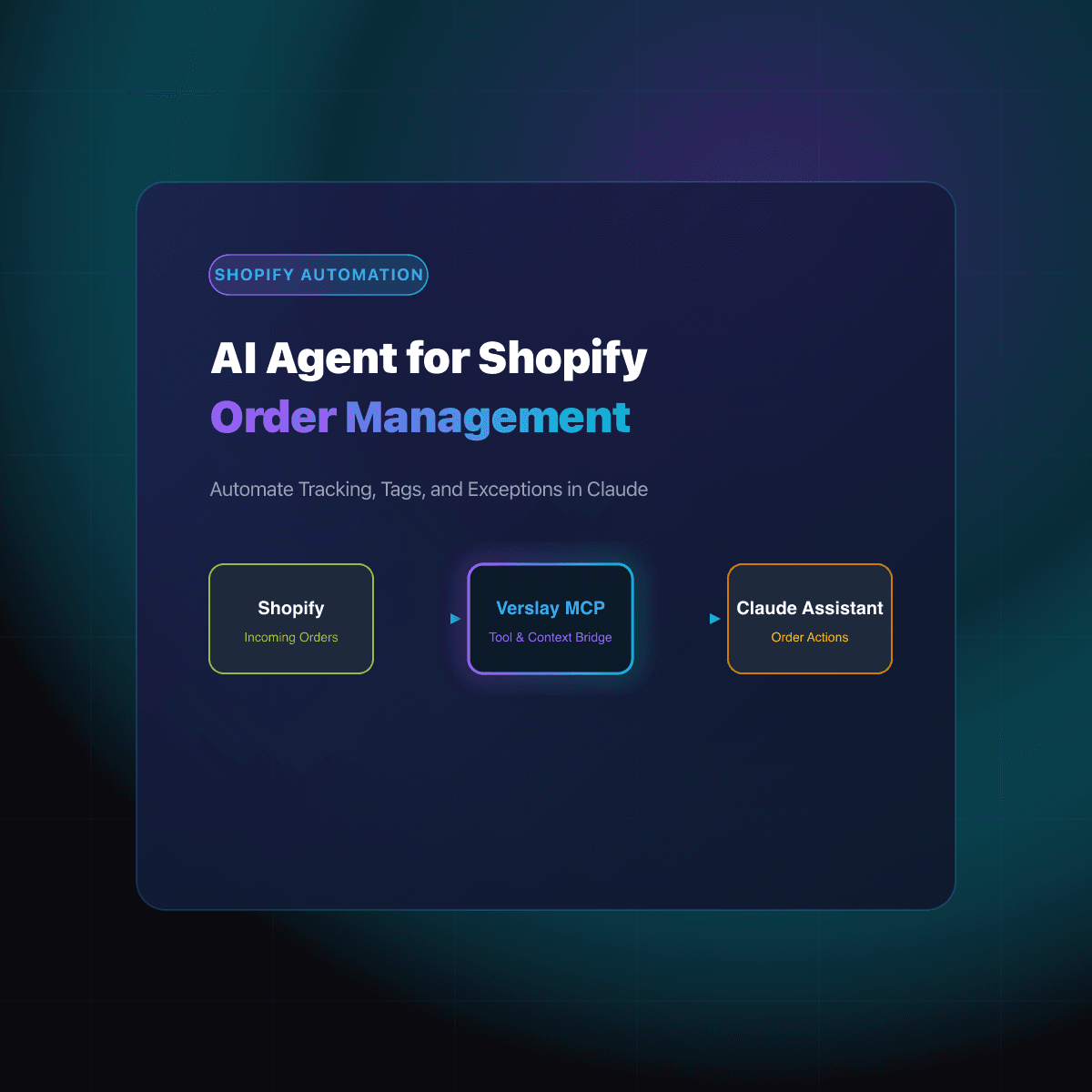
Verslay's approach is to run these agents through the customer's own Claude, using the Verslay MCP server, so the thinking happens in a tool the team already uses and no code is written. The E-Commerce Scanner agent reads store products and orders, and the store operations use cases listed there stage their output for review: an order-status buyer message when fulfillment stalls, a late-order list with the apology email, a daily store pulse that includes fulfillment lags. If you want the longer version of how that layer sits on top of Claude, it is on why Verslay.
One honest limit: an agent that is good at reading is also good at sounding confident when it is wrong. Read the drafts before they reach buyers.
How to set up ecommerce fulfillment automation in five steps
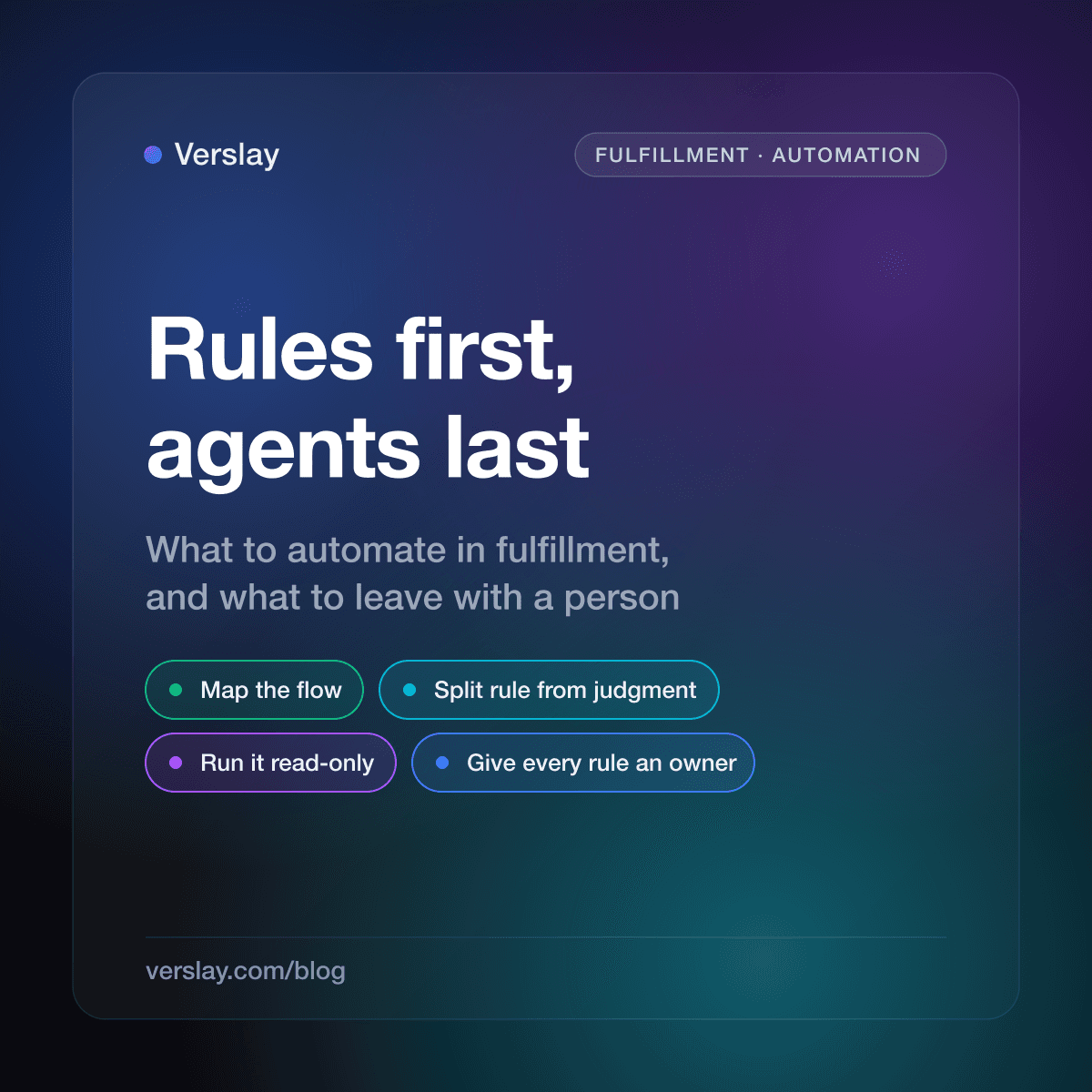
- Map the flow on one page. One line per step from payment to delivery, with who does it now and what it waits on. If two people disagree about a step, that is the step to automate first, because it is already costing you.
- Mark each line. Rule if it matches on values, person if it needs a decision, agent if it needs reading or writing. Most stores find the middle list is longer than they expected.
- Write the condition before the action. For every rule: what event starts it, what has to be true, what changes, and who gets told. A rule without a "who gets told" is a rule that fails quietly.
- Run it read-only first. Let the agent produce the list and the drafts, and let the rule log what it would have changed, for a week of real orders. Compare that to what your team actually did. This is the cheapest test you will ever run.
- Give every rule an owner and a review date. Shipping promises, carriers and product mix change. A rule that nobody owns is a rule that will be wrong in three months and nobody will notice.
What does a daily exception sweep look like?
This is the smallest useful version of the agent step, written as a plain-language instruction:
Every morning, list orders from the last few days that are paid but not fulfilled.
Group them by why they are stuck: stock, address, hold, carrier, or waiting on the buyer.
For each order that is past our ship promise, draft a short status email to the buyer
with the real reason and the date we now expect.
Show me the list and the drafts first. Do not send anything or change any order until I approve.
The rule part is the cutoff that creates the list. The agent part is the reading and the drafting. The approval line is the part most teams skip and then regret.
What usually goes wrong after go-live?
Four failures cover most of it.
Silent failure is the most common. The rule fires, the action runs, nobody is told. Build the notification into the rule itself, not into someone's memory.
Over-automation is the next one. The exciting demo is the agent deciding. The useful version has the agent preparing the decision for a person, and that is where to start.
Stale conditions are quieter. A rule written against last quarter's shipping promise keeps running against it until someone remembers to edit it.
No log comes last. When a buyer says they never got a message, you need to know which rule was supposed to send it, so keep the runs where you can find them.
None of this needs a big system. A store doing fulfillment by hand can get most of the gain from one mapped flow, three or four rules, and one agent run per morning that ends in a list a person approves. The order matters more than the tool: rules for the predictable work, people for the exceptions, agents for the reading.
If your fulfillment still runs on copy-paste and memory, start with the one-page map this week. When you want a second pair of eyes on where the handoffs should sit, book a short walkthrough at calendly.com/verslay/30mins.