Shopify Fraud Detection with AI: Practical Store Guide
Shopify fraud detection with AI protects online stores by inspecting transaction risk signals—including card verification codes, address alignment, customer location, and ordering velocity—directly within your Claude workspace. Connecting store data through Model Context Protocol (MCP) enables ecommerce operators to evaluate high-risk orders, automate fulfillment holds, and safeguard revenue without manual spreadsheet audits. Store teams identify stolen card patterns and coordinated attacks before items ship, preventing chargeback penalties while ensuring valid customer checkouts pass through uninterrupted.
At a glance:
- Automated risk triage: AI agents inspect order indicators from Shopify fraud analysis in real time.
- Fulfillment holds: Orders flagged with severe discrepancies receive instant hold tags before inventory leaves the warehouse.
- Chargeback prevention: Early detection halts stolen card testing spikes and costly dispute processing fees.
- Fewer false declines: Contextual evaluation distinguishes genuine travelers and gift buyers from fraudulent checkout attempts.
- Zero code needed: Connect Claude to Shopify via the Verslay MCP server to run triage workflows from conversational prompts.
What causes Shopify to mark an order as high risk?
Shopify analyzes every online checkout through built-in algorithms that assign an overall risk rating: low, medium, or high. When an order displays a red warning banner indicating high risk of fraud, the platform has identified one or more payment anomalies.
The primary signals that trigger these warnings include:
- Address Verification System (AVS) failures: The billing street address or postal code submitted at checkout fails to match records on file with the card-issuing bank.
- Card Verification Value (CVV) mismatches: The security code entered by the shopper was incorrect or omitted during checkout.
- High-risk IP address telemetry: The purchase originated from a commercial data center, proxy, hosting provider, or Tor exit node commonly tied to bot traffic.
- Severe geographic distance: The physical location of the IP address is hundreds or thousands of miles away from the billing location.
- Multiple payment attempts: The buyer tried multiple payment cards or altered card details in rapid succession before completing checkout.
While built-in indicators surface critical warnings, Shopify does not stop fulfillment on high-risk orders by default. Unless a store uses manual checks, warehouse teams frequently pack and ship compromised orders. Once shipped, the cardholder files a dispute, leaving the merchant responsible for lost merchandise, payment reversal, and non-refundable chargeback fees.
How does standard Shopify fraud analysis compare to AI agent detection?
Many store owners rely on Shopify's native fraud analysis or basic filter rules. However, manual inspection consumes hours during peak sales, while rigid rules create frustrating false positives that turn away real customers.
Deploying an AI agent connected via Verslay creates an active defense mechanism that evaluates risk in context.
| Capability | Native Shopify Fraud Analysis | Basic Fraud Filter Rules | AI Agent via Claude & MCP | | :--- | :--- | :--- | :--- | | Detection Speed | Passive tag applied upon checkout | Instant rule execution | Real-time automated inspection | | Contextual Judgment | None (shows raw indicators) | Binary if/then logic | Multi-factor contextual reasoning | | Fulfillment Action | Manual review required | Blanket cancel or accept | Dynamic hold with tailored tags | | False Positive Handling | High (flags legit travelers) | High (rigid thresholds fail) | Low (checks buyer history & nuances) | | Investigation Workflow | Manual admin page clicking | Static error log review | Natural language queries in Claude | | Setup & Maintenance | Pre-built in admin | Complex rule maintenance | No code required via app integrations |
Using an AI agent allows growing teams to move beyond passive observation. Instead of requiring a human operator to click into every order, the AI agent performs comprehensive triage across all checkout metrics.
How does an AI agent evaluate suspicious Shopify orders?
An AI agent reviews orders using a multi-layered verification approach rather than relying on a single isolated metric.
Layer 1: Identity and Address Alignment
The agent compares billing and shipping destinations. A shipping address differing from billing is common for gifts or office deliveries. However, combined with an international card, a newly created account, and overnight shipping on high-value goods, the risk score escalates immediately.
Layer 2: Network Telemetry and IP Consistency
The agent evaluates the checkout IP address. If the IP resolves to a residential ISP in the billing metropolitan area, trust increases. If the customer claims a billing address in Ohio while ordering through an overseas proxy server, the agent notes the geographic anomaly.
Layer 3: Order Composition and Velocity Spikes
Fraudulent actors test stolen credit cards by placing rapid small orders or purchasing multiples of easily resold items. The AI agent examines store-wide velocity:
- Did this profile attempt three failed checkouts in five minutes?
- Are multiple orders shipping to the same freight forwarder under different cardholder names?
- Does the cart value represent five times the store's typical average order value?
Layer 4: Historical Customer Reputation
If the customer has a six-month purchase history, two previous deliveries with zero chargebacks, and an active account, the agent recognizes an established buyer. This historical context prevents unnecessary holds on loyal shoppers who ordered while traveling.
Store teams exploring specialized autonomous workflows can view complementary capabilities in our AI agent catalog.
What steps automate order holds before fulfillment?
Setting up automated fraud triage through Claude and Verslay requires no code or complex installations.
Step 1: Capture Order Events
When a customer completes checkout, the store system triggers an evaluation event. Store operators run this as a scheduled pulse or invoke it when reviewing morning orders.
Step 2: Fetch Transaction Attributes via MCP
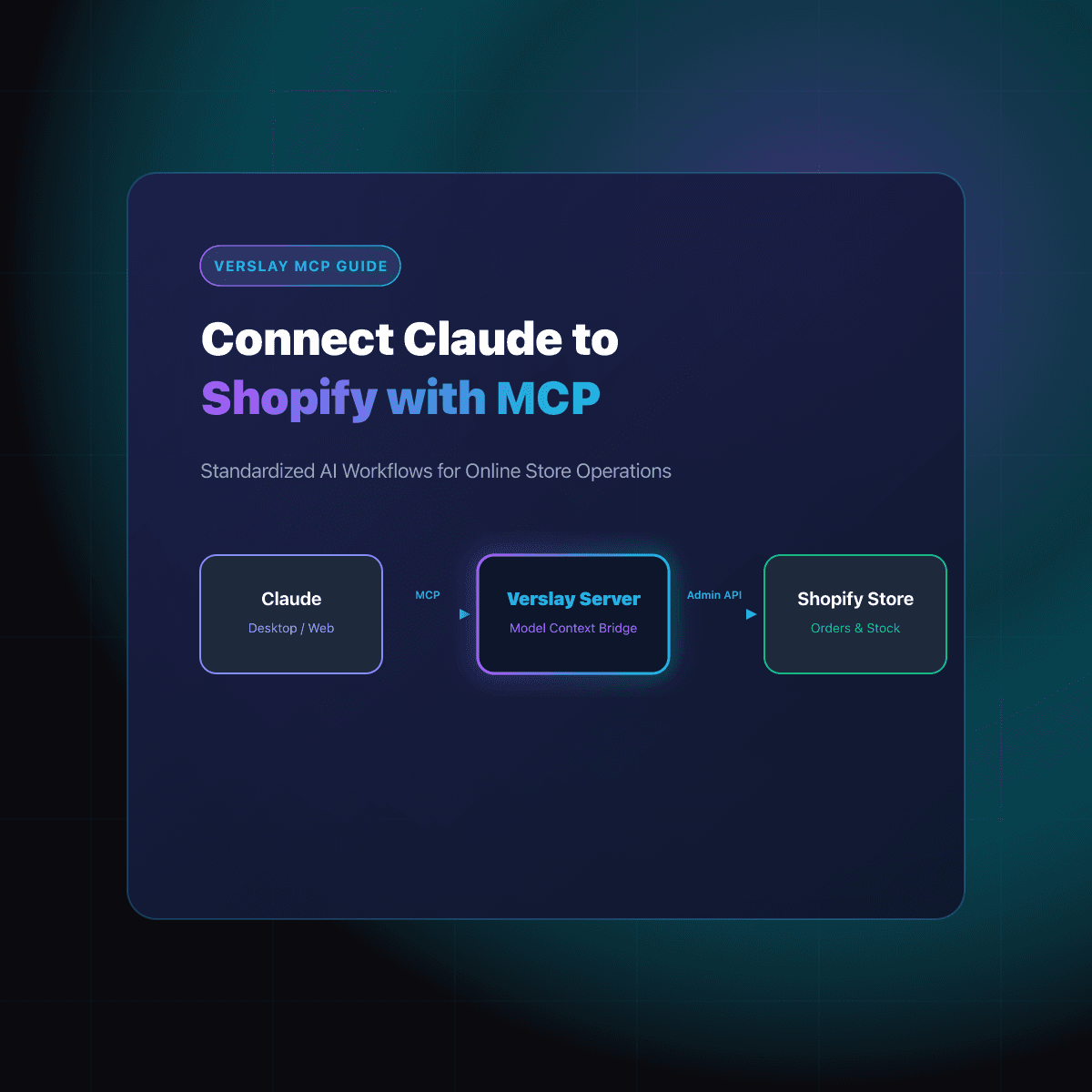
Using the Verslay MCP server, Claude queries the Shopify API to retrieve order payloads, payment gateway responses, risk assessments, customer history, and fulfillment statuses.
Step 3: Calculate the Actionable Risk Verdict
The agent evaluates gathered signals against your store's risk guidelines. It outputs a clear classification:
- Low Risk: All indicators verify cleanly; release for immediate fulfillment.
- Medium Risk: Minor address discrepancy with established buyer; apply informational tag.
- High Risk: Multiple payment failures, proxy usage, and mismatched credentials; apply immediate fulfillment hold.
Step 4: Apply Tags and Update Fulfillment Status
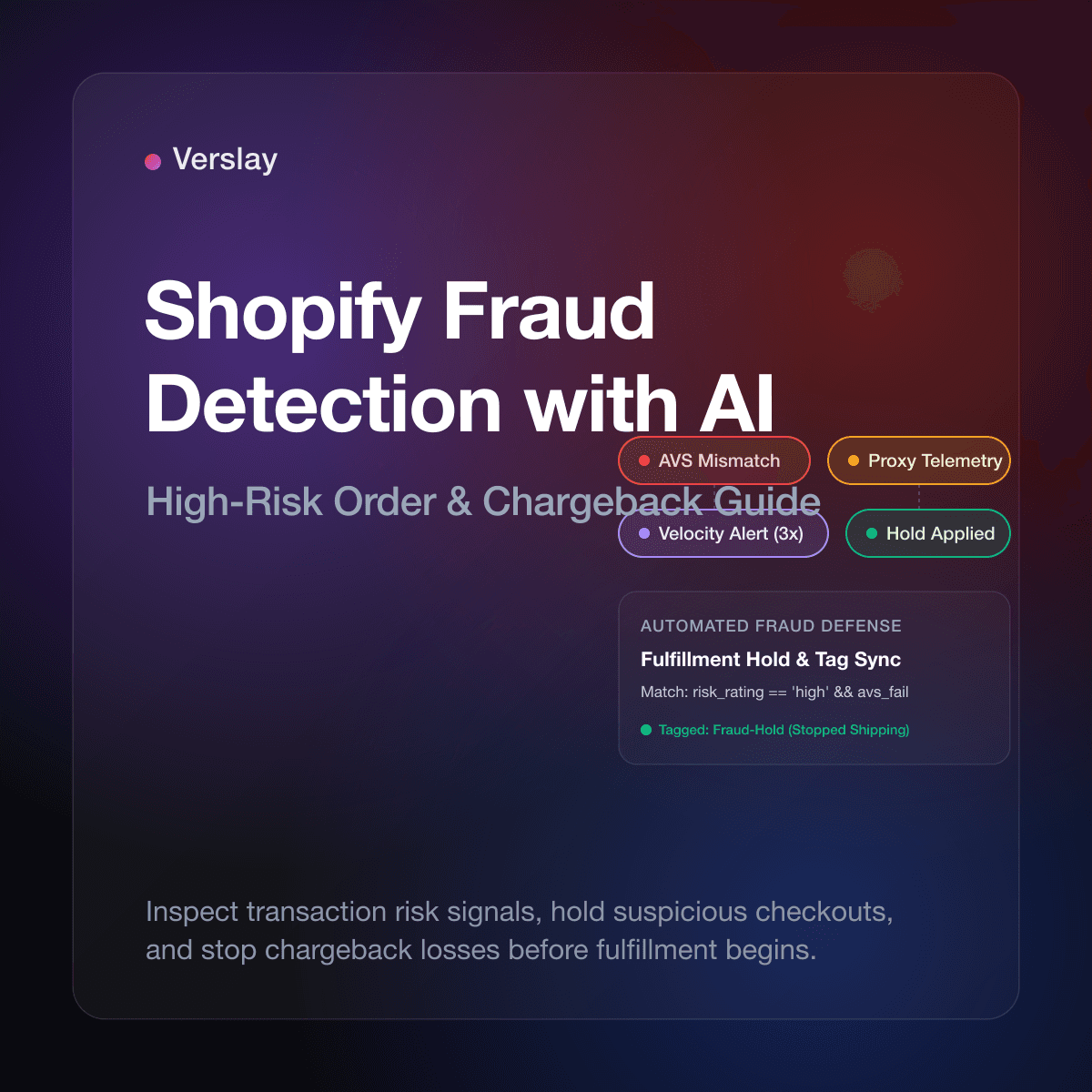
The AI agent interacts directly with your Shopify store. For high-risk checkouts, it sets fulfillment to on-hold and adds searchable admin tags such as Fraud-Hold and Needs-Verification. This stops 3PL warehouses or shipping teams from printing packing slips.
Step 5: Send Instant Team Notifications
The agent posts a concise summary to your operational Slack channel or sends an email alert with the order number, customer name, total dollar value, and reasons for the hold.
For teams managing order operations, pairing fraud triage with automated fulfillment workflows in our ecommerce workflows creates an end-to-end operational shield.
How do store teams review flagged orders with Claude?
Using Claude with Verslay allows operators to investigate flagged transactions using plain English queries instead of deciphering raw gateway codes.
Sample Operator Prompt
An ecommerce manager reviewing morning exceptions can prompt Claude:
"Review order #5192 in our Shopify store. Summarize the risk assessment, explain why it was flagged, check if the customer has ordered before, and recommend whether we should fulfill or cancel."
Sample Claude Response
Claude examines order metadata through MCP and replies:
Order #5192 Investigation Summary:
- Customer: Mark Davies (First-time customer)
- Order Value: $489.00 (Expedited Priority Shipping)
- Risk Status: High Risk
Identified Risk Factors:
- AVS Street Mismatch: Billing street address does not match issuing bank records.
- Proxy Telemetry: Order submitted via an anonymizing VPN in Germany, while billing address is in Miami, Florida.
- Card Velocity: Three previous checkout attempts were rejected for invalid expiration dates within 12 minutes.
Recommended Action: Keep fulfillment on hold. The combination of AVS mismatch, proxy connection, and rapid payment attempts indicates unauthorized card use. Recommended next step: Request identity verification or cancel and refund.
This conversational interaction provides clarity in seconds, empowering customer support and warehouse staff to make informed decisions without technical friction.
How does automated fraud triage prevent false declines?
False declines—legitimate orders incorrectly canceled due to overly aggressive filters—represent a hidden loss for online merchants. Shoppers who experience false declines often abandon the merchant entirely, taking their lifetime purchasing value to competitors.
Traditional fraud filter rules rely on rigid logic:
- "If IP country does not equal billing country, cancel order."
- "If order value exceeds $500 on first purchase, reject transaction."
These static rules fail to account for regular modern behaviors: traveling professionals purchasing gifts from airport Wi-Fi, shoppers sending items to a vacation home, or buyers using private relay services.
AI agents resolve this through contextual judgment. If an IP address indicates a traveler, but billing matches card records, the email domain has history, and shipping corresponds to a verified home, the agent does not cancel the order. It marks the transaction for standard fulfillment or applies a minor review tag without interrupting the buyer's experience.
By balancing rigorous defense against stolen cards with intelligent accommodation for legitimate shoppers, online businesses preserve their profit margins and build long-term customer trust.
Store teams looking to deploy AI workflows across operations can review our straightforward pricing options and consult our step-by-step connection guides to get started.
Frequently asked questions
How does AI detect fraudulent orders on Shopify?
AI evaluates order attributes—including AVS and CVV results, billing and shipping address alignment, IP geolocation, and purchasing velocity—against historical store behavior to flag anomalies before fulfillment.
Can AI automatically hold high-risk orders in Shopify?
Yes. Connected through Claude and the Verslay MCP server, AI agents can add tags like Fraud-Hold, place a fulfillment hold on flagged orders, and notify store operations for rapid review.
How does AI fraud detection reduce false declines for ecommerce stores?
Rather than rejecting orders based on rigid rules, AI reviews holistic customer signals, recognizing returning buyers using travel IPs or gift shipping addresses without erroneously canceling legitimate checkouts.
What is the difference between Shopify fraud analysis and AI agent triage?
Shopify fraud analysis displays static indicators on the order detail page, requiring human inspection. AI agent workflows continuously evaluate those indicators, cross-reference customer history, and execute hold actions automatically.
Ready to automate your store's fraud triage and protect your checkout revenue? Schedule a quick setup consultation on our demo booking page to connect your Shopify store with Claude today.